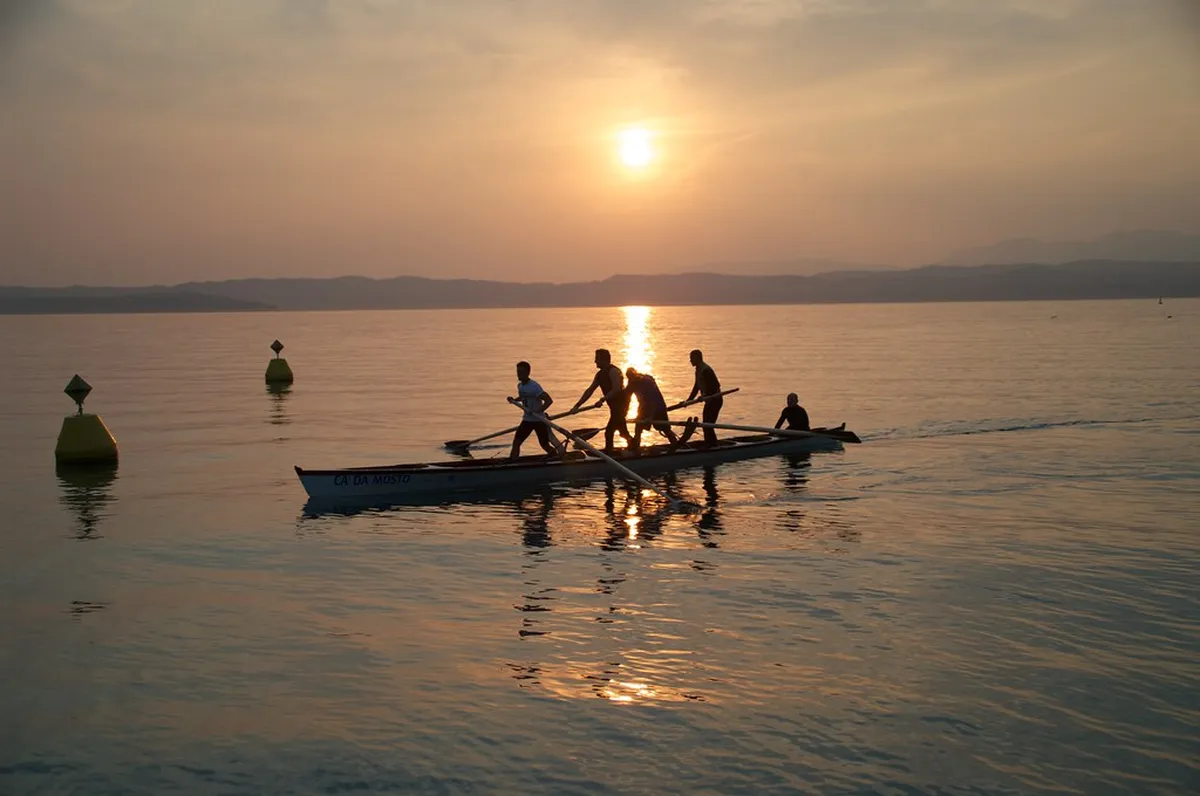
Sirmione sits at the end of a narrow 4-kilometre peninsula that juts into Lake Garda. The entire old town is walkable — no cars are allowed past the bridge — and the complete self-guided circuit from the gate to Grotte di Catullo and back covers roughly 5 km of mostly flat ground. This guide lays out the route stop by stop, with distances, realistic time budgets, and the photo spots every online list misses. Plan your full Sirmione itinerary around this walk and you will not waste a step.
Route Overview and Practical Notes
Turn this guide into a personal route with our free Sirmione itinerary planner.
The walk described here is a simple out-and-back along the spine of the peninsula, with a short loop around the lakefront on the return leg. Total distance is approximately 5 km. Allow 3.5 to 5 hours if you go inside the castle and the Roman ruins; 2 to 2.5 hours if you skip the interiors and treat it as a scenic stroll.
Start time matters. Gates into the old town have no formal opening hour, but the narrowest streets — Via Vittorio Emanuele in particular — become shoulder-to-shoulder by 10:30 in summer. Arriving at 08:30 or 09:00 on a weekday gives you the castle forecourt almost to yourself. Parking is in the large lots at Piazzale Porto (the main arrival point); pay at the machines before 09:00 to avoid a queue.
Footwear note: the cobblestones in the historic center are fine, but the path up to Grotte di Catullo runs over loose gravel and exposed Roman masonry. Trainers or light hiking shoes are better than sandals for that section. Bring water — there are drinking fountains on Via Catullo and inside the Grotte di Catullo site itself.
Stop 1 — Piazzale Porto: The Logical Start (0 km)
Every walking tour of Sirmione should begin at Piazzale Porto, the broad square just outside the medieval bridge. This is where buses drop passengers and where the pay-and-display car parks empty out. It takes about 2 minutes to walk from the farthest parking row to the bridge. The square itself is unremarkable, but the view back across the moat toward the castle towers is one of the best opening shots on the whole route — get it before the crowds arrive.
From Piazzale Porto, cross the narrow medieval bridge over the moat. The Scaligeri watchtower rises immediately on your right. Notice the iron portcullis groove cut into the arch above you — it is original 13th-century stonework. This 100-metre approach to the castle gate is the most photographed stretch in Sirmione; on summer mornings the light hits the yellow-ochre walls perfectly between 08:30 and 10:00.
Stop 2 — Scaliger Castle: Fortress at the Gate (0.1 km, allow 60–90 min)
Scaliger Castle (Rocca Scaligera) was built in the 13th century by the Scaligeri lords of Verona to control access to the peninsula. It is one of the most intact lakeside fortresses in northern Italy. The internal harbour, which sheltered Scaligeri war galleys, still holds water and is ringed by crenellated walls — a view almost no photo adequately captures until you are standing inside it. Ticket price in 2026 is around €6 per person; children under 18 enter free on the first Sunday of each month. Find current Sirmione Castle opening hours before you go, as times change between winter and summer schedules.
Climb the main tower for the panoramic view north toward Desenzano and south toward Peschiera del Garda. This is the highest publicly accessible point in the old town and the photo spot that rewards the most patience — wait for a boat to pass under the bridge below and you have a classic Lake Garda shot. The rampart walk connecting the towers is narrow (roughly 80 cm wide in places) and has no handrail on the interior side, so it is unsuitable for very young children unaccompanied. Budget 60 minutes for a thorough visit; 90 if you read every information panel.
Learn more on the official Sirmione tourism site for seasonal events held inside the castle walls. Summer concerts and historical re-enactments sometimes block standard visitor access — worth checking in advance.
Stop 3 — Piazza Carducci and the Centro Storico (0.3 km from castle gate, allow 30–45 min)
After the castle, pass under the arch and walk straight along Via Vittorio Emanuele into the centro storico. Piazza Carducci opens up within 2 minutes — it is the social heart of Sirmione, ringed by gelaterie, bars, and the small Church of Santa Maria Maggiore. This is a natural rest point and the place most visitors photograph without quite realising it has a name. The square is quietest before 10:00 and again after 18:00 when the day-trip buses have left.
From Piazza Carducci, the street forks. Left takes you toward the lakefront promenade on the western shore; straight ahead continues north toward the ruins. For this route, keep going straight — you will loop back along the lake on the return leg. The narrow lanes immediately north of the square, particularly Vicolo Strentelle, are worth a short detour: they open onto small terraces with bench seating directly over the water. Almost no day-tripper makes the 30-second turn down these alleys, which makes them the single most underused photo spot on the peninsula.
Continue north along Via Catullo — the main artery through the upper town. Several good lunch options line this street. A sit-down meal of grilled freshwater fish with a glass of Lugana white runs €15–€25 per head at most trattorias. Explore the best Sirmione restaurants for the most reliable picks on this strip.
Stop 4 — Grotte di Catullo: Roman Ruins at the Tip (2.2 km from Piazzale Porto, allow 60–90 min)
The walk from Piazza Carducci to Grotte di Catullo takes 20 to 25 minutes on foot — about 1.8 km along Via Catullo, which gently rises through olive groves and lemon terraces as the houses thin out. Grotte di Catullo is the largest Roman residential complex in northern Italy, built in the 1st century AD and covering roughly 2 hectares at the tip of the peninsula. The name means "grottoes of Catullus," linking the ruins to the Latin poet, though archaeologists believe the villa more likely belonged to a wealthy imperial family. The romantic attribution has stuck for 500 years.
The scale surprises most visitors. Barrel-vaulted storage rooms survive to near full height, and the terrace walls on the western side drop straight to the lake 15 metres below. The best view of the open water is from the far north-west corner of the site — three sides of the peninsula are visible simultaneously. Lake Garda's deep blue looks almost Adriatic from this angle on a clear day. Admission in 2026 is approximately €8 per person. Buy Grotte di Catullo Sirmione tickets online to skip the gate queue in July and August, when waits of 20 minutes are common. Allow 60 to 90 minutes to walk the full circuit of the site.
A small on-site museum displays mosaic fragments and a scale model of how the villa looked at its peak. It is easy to miss because the entrance is inside the excavations rather than at the ticket booth — follow the signs marked "Antiquarium" once you are inside the grounds.
Stop 5 — The Return: Western Lakefront and Jamaica Beach (2.2 km back to Piazzale Porto)
The return leg takes the western shore rather than retracing Via Catullo. From the Grotte di Catullo exit, bear left down to the lakefront path. This route is narrower and less obvious than the main street, but it connects to the Lungolago promenade that runs the full western flank of the peninsula back toward the castle. Walking time to Piazzale Porto along this route is 25 to 30 minutes without stops.
About halfway back, you will reach Jamaica Beach — a public pebble-and-rock beach where the lake bottom has a notable quirk: natural thermal water seeps up through the lakebed here, making the shallows measurably warmer than the rest of the lake. On cooler mornings it is actually visible as a faint shimmer on the surface. There are no facilities and no fee; locals use it year-round. It is one of the few places on the walk where you can sit directly at the water's edge without paying for a sunbed. Lake Garda tourism seasonal guides list it as a swimming spot, but even non-swimmers find the thermal seep interesting.
From Jamaica Beach, continue south along the promenade past the Aquaria Thermal Spa complex (the large modern building on your right). The promenade rejoins the main street just north of Piazza Carducci. From there it is a 5-minute walk back through the centro storico to the castle bridge and Piazzale Porto.
Thermal Baths: Optional Add-On After the Walk
Sirmione's thermal springs are genuinely unusual — they are among the few thermal sources in Europe that emerge directly into a lake. The Aquaria Thermal Spa harnesses this water for its pools and treatment facilities. A day pass in 2026 starts at around €45–€60 depending on the day and season. Booking at least a day ahead is necessary in summer; walk-ins are rarely possible from June through August. Read the full Sirmione thermal baths guide for what is included at each entry level.
If the thermal spa is not in your budget, Jamaica Beach (Stop 5) provides the free version of the same experience. The seeping thermal water is not as hot as the spa pools — typically 26–28°C versus the spa's 37°C — but it is free, and the setting directly on the open lake is arguably more atmospheric than a managed pool. Most guidebooks mention Jamaica Beach without explaining the thermal seep, so visitors walk past without knowing why the water there feels different.
Hidden Corners Most Visitors Miss
Three spots on this route deserve more attention than they typically get. The first is the moat view from the eastern side of the castle bridge — almost everyone photographs from the western side, but the eastern angle catches the full reflection of the towers in the still water of the moat at dawn. The second is Vicolo Strentelle (noted above), the alley just north of Piazza Carducci that drops to a terrace above the lake. The third is the Antiquarium inside Grotte di Catullo, which most visitors skip because it is signposted only once you are already inside the ruins.
One practical detail that catches first-timers out: the gate into the old town (the medieval arch under the castle) is the only pedestrian entry point. There is no shortcut from the car parks directly to Via Catullo or the northern ruins — everyone funnels through the same 3-metre arch. In high summer this creates a bottleneck between 11:00 and 14:00. Walking in or out during those hours adds 5 to 10 minutes to any transit. Arriving before 09:30 or after 16:30 avoids this entirely.
For practical tips on crowds, parking, and transport connections, see our Sirmione practical travel tips guide. If you are coming by water, check Sirmione boat tours for ferry options from Desenzano and Peschiera that drop you at the castle harbour entrance. And for the complete day plan built around this walk, the full Sirmione experience guide for first-timers covers arrival timing, lunch sequencing, and how to reach Sirmione from Milan or Verona.
Frequently Asked Questions
How long does a full Sirmione walking tour route take?
A comprehensive Sirmione walking tour typically takes 4-6 hours. This estimate includes exploring the castle and Roman ruins. It also allows time for meals and gelato breaks. You can adjust this based on your pace.
Add extra time if you plan to visit the thermal spa. Aquaria Thermal Spa can easily take half a day. It is a popular and relaxing destination. Consider an overnight stay for a full spa experience.
Is the Sirmione walking tour route suitable for all ages?
Yes, the main Sirmione walking tour route is largely flat. It is suitable for most fitness levels. Some areas, like the castle towers, have stairs. Grotte di Catullo involves walking on uneven ground.
Consider stroller or wheelchair accessibility for some sections. The historic center can be crowded. Visit during off-peak hours for easier navigation. Find more Sirmione practical travel tips for your trip. Prioritize comfortable footwear for walking.
Can I explore Sirmione on a budget?
Absolutely, Sirmione can be enjoyed on a budget. Walking the peninsula is free and offers stunning views. Pack a picnic lunch for an affordable meal. Many gelato shops offer budget-friendly treats.
Prioritize free attractions like Jamaica Beach and the promenade. Entrance fees for the castle and Grotte di Catullo are modest. Consider public transport over private transfers. Check out our Sirmione budget travel guide for more ideas. Enjoy Sirmione without breaking the bank.
Sirmione packs an exceptional range of experiences into a 5 km walk: a medieval fortress, a Roman imperial villa, natural thermal springs, and some of Lake Garda's most dramatic water views. The route described here — Piazzale Porto, Scaliger Castle, Piazza Carducci, Grotte di Catullo, western lakefront return — covers everything without backtracking unnecessarily. Start before 09:30, wear shoes with grip, and keep the afternoon free for either the thermal spa or a slow lunch by the lake.
Key Takeaways
- The full self-guided route covers approximately 5 km and takes 3.5 to 5 hours including both major paid sites.
- Start at Piazzale Porto before 09:30 to beat the bottleneck at the single pedestrian gate into the old town.
- Return via the western lakefront promenade to see Jamaica Beach's free thermal seep — a detail most visitors miss entirely.
- Book Aquaria Thermal Spa and Grotte di Catullo tickets online in summer to avoid gate queues.
- Wear trainers or light hiking shoes; the gravel path to the ruins is rough for sandals.