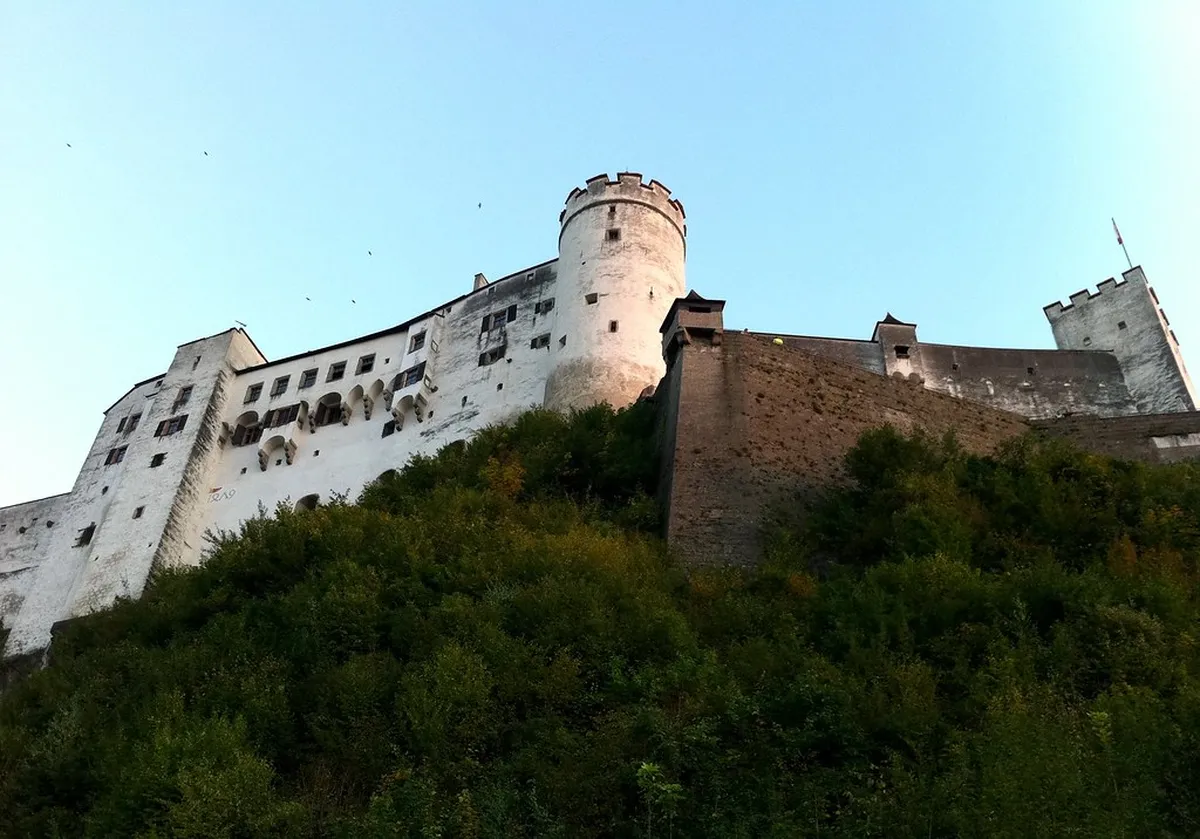
Standing high above the rooftops of the Baroque Old Town, Hohensalzburg Fortress remains one of Europe's largest and best-preserved medieval castles. Built in 1077 by Archbishop Gebhard von Helfenstein, this 11th-century icon has never been captured by a foreign force — a record that sets it apart from virtually every other fortress in Central Europe. Whether you are a history enthusiast or a photography lover, it is a mandatory stop on any our complete Salzburg guide.
The castle sits 120 metres above the city on Festungsberg hill, visible from almost every street in the Old Town below. Its massive bastions and ornate state rooms tell the story of nine centuries of prince-archbishop power. This guide covers everything you need in 2026: exact ticket prices, opening hours, how to get up, what to see inside, and how to fit the fortress into a full day.
History of Hohensalzburg Fortress
Turn this guide into a personal route with our free salzburg itinerary planner.
Archbishop Gebhard von Helfenstein ordered the first stone fortifications in 1077, during a period of intense conflict between the Holy Roman Emperor and the Pope known as the Investiture Controversy. The original structure was a modest defensive tower, but successive prince-archbishops expanded it aggressively over the following four centuries. By the early 1500s, Archbishop Leonhard von Keutschach had transformed it into the substantial fortress visitors see today — most of the state rooms, the distinctive round towers, and the decorative stonework all date from his reign (1495–1519).
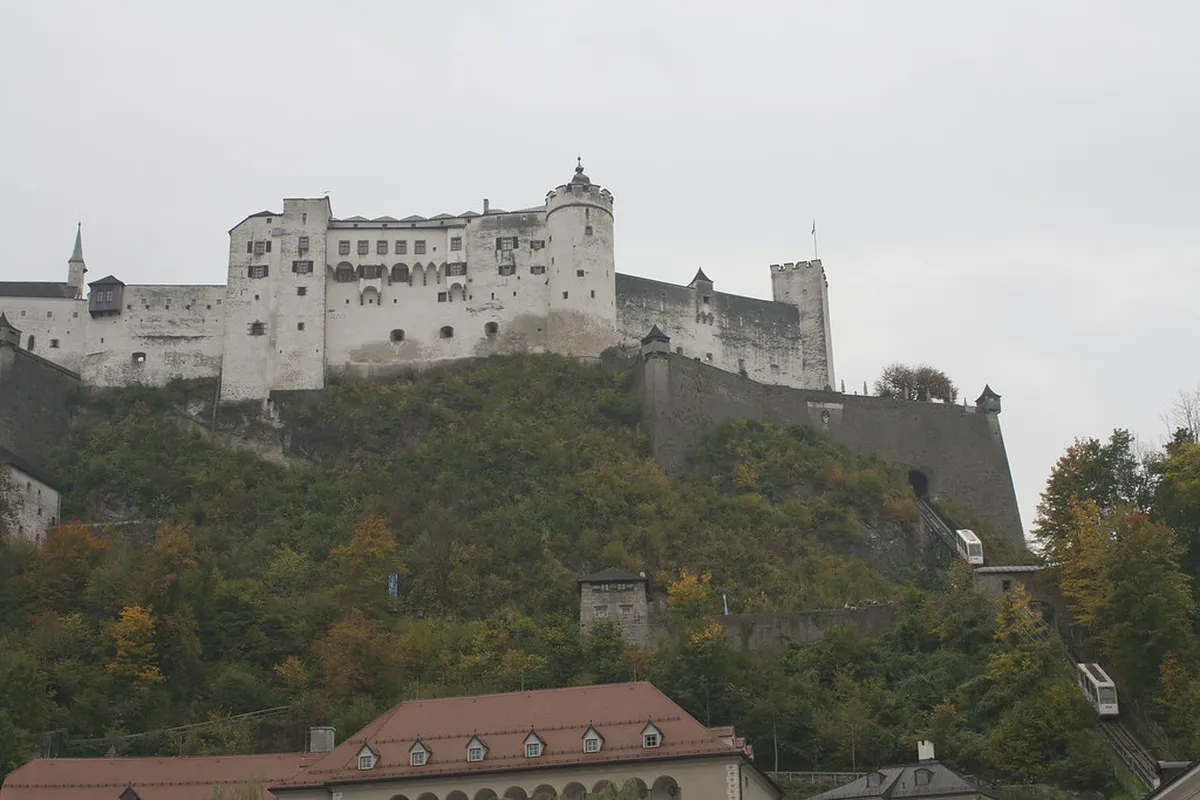
The fortress served as the primary seat of power for the ruling prince-archbishops of Salzburg, who controlled both the city's spiritual and secular life. It doubled as a prison for political opponents; Archbishop Wolf Dietrich von Raitenau was famously imprisoned here in 1612 after losing a war with Bavaria and spent the last six years of his life inside its walls. During the Napoleonic era the city was occupied, but the fortress itself was never taken by force — its formidable walls made a direct assault impractical.
Salzburg was incorporated into the Austrian Empire in 1816, and the fortress gradually shifted from a military installation to a heritage site. Today it is managed by Salzburg Museum and listed as part of the UNESCO World Heritage Site "Historic Centre of Salzburg." Its unbroken 950-year presence on the skyline makes it the defining symbol of the city.
How to Get Up: FestungsBahn Funicular vs. Walking
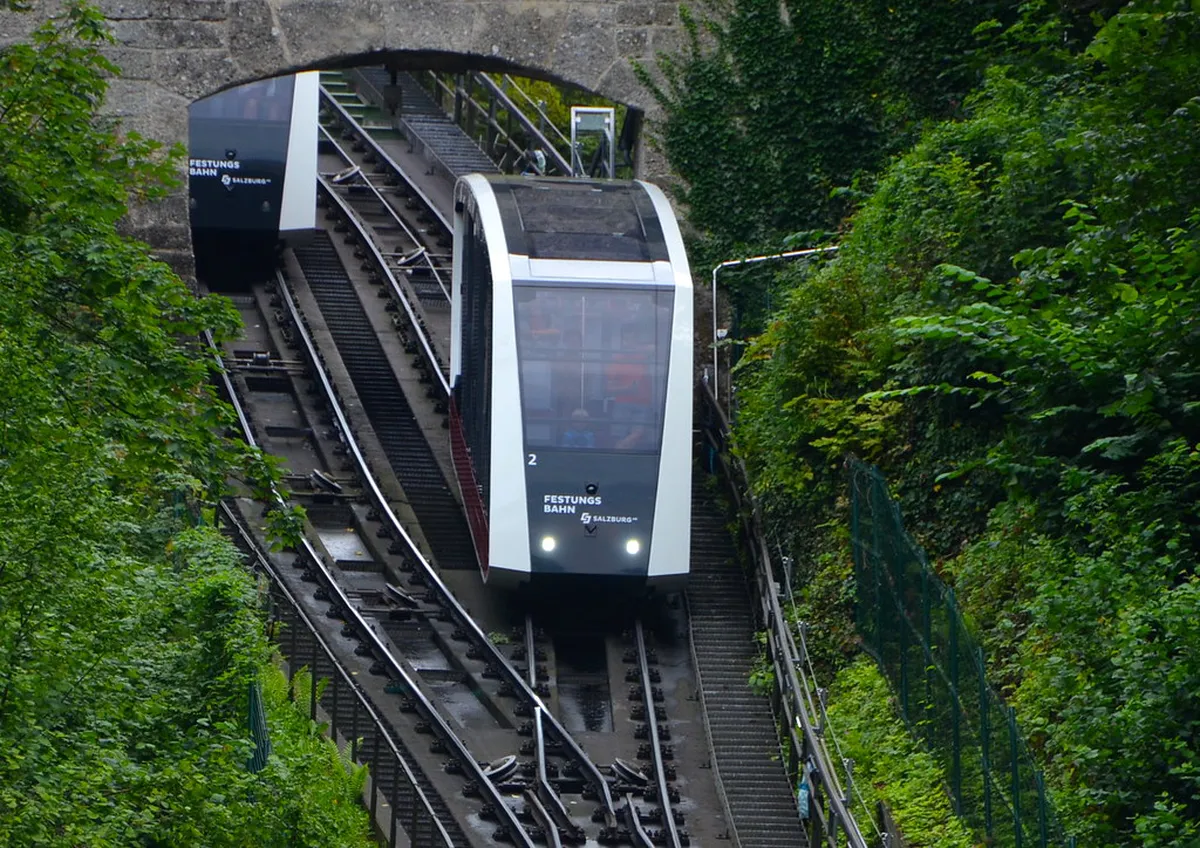
The FestungsBahn (Festungsgasse 4) is the fastest route to the top. The funicular departs every few minutes from a station just behind the cathedral, and the ride takes under a minute. In 2026 the round-trip funicular fare bundled with full fortress admission (Audio & Panorama ticket) costs approximately €16.30 for adults. The funicular is fully wheelchair-accessible and stroller-friendly, and it is the practical choice for families or anyone travelling with luggage.
Walking up is free and takes around 15 minutes from Kapitelplatz. The path follows Festungsgasse uphill through a series of historic gates and shaded sections of the hill. It is genuinely steep in places, but the path is paved and well-maintained. If you walk up, you still pay fortress entry at the top — you simply skip the funicular surcharge. For fit travellers on a budget, this saves roughly €4–5 per person on the round-trip cable component and gives you several excellent photo angles of the cathedral from above that funicular riders miss entirely.
Public transport drops you within easy walking distance of the funicular base station. Check our getting around the city for the specific bus lines that serve the pedestrian zones. Most central bus stops are only a five-to-ten minute stroll from Festungsgasse.
Ticket Types and 2026 Prices
The official site (festung-hohensalzburg.at) sells three main ticket tiers for 2026. The Basic ticket (entry on foot, no funicular) covers the fortress courtyards and the Fortress Museum only, and costs around €10.50 for adults. The Audio & Panorama ticket adds the funicular round-trip, the audio guide tour, and access to the Panorama Tower viewpoint — this is the most popular option at approximately €16.30. The All-Inclusive ticket layers on top of that: the Regency Rooms, the Golden Hall, the Magic Theater, and the Marionette Museum, running around €19.50 for adults. Children under 6 enter free; students and seniors get a roughly 15–20% reduction across all tiers.
| Ticket | Price (2026, adult) | Includes | Funicular |
|---|---|---|---|
| Basic (walk up) | ~€10.50 | Fortress courtyards + Fortress Museum | No — walk up Festungsgasse |
| Audio & Panorama | ~€16.30 | Basic + audio guide + Panorama Tower viewpoint | Yes — round-trip included |
| All-Inclusive | ~€19.50 | Audio & Panorama + Regency Rooms, Golden Hall, Magic Theater, Marionette Museum | Yes — round-trip included |
| Salzburg Card holders | Covered by card | Equivalent to Audio & Panorama level | Yes — round-trip included |
Booking online in advance is recommended in the summer months (June–August), when the ticket window queue can add 20–30 minutes to your wait. Online vouchers let you walk directly to the funicular boarding area. Prices above are indicative for 2026 — always verify on the official site before you go, as seasonal adjustments do occur.
Holders of the Salzburg Card receive free round-trip funicular access and full fortress entry (equivalent to the Audio & Panorama ticket level) with no separate purchase needed. If you plan to visit two or more paid attractions in a day, the Salzburg Card almost always pays for itself — it also covers public transport and a range of museums.
Opening Hours
In 2026 the fortress operates on a seasonal schedule. From January through April and in November and December, it opens at 09:30 and closes at 17:00 (last funicular ascent around 16:30). From May through September — the peak tourist window — doors open at 09:00 and the site stays open until 20:00, with the last funicular running at 19:30. October sits in the middle: 09:00 to 18:00. The fortress is open every day of the year, including public holidays, though hours may shift around major Austrian holidays.
The individual museums inside (Fortress Museum, Marionette Museum, Regency Rooms) follow the same operating window as the fortress itself but occasionally close 30 minutes before the main site does during quieter months. Always confirm current hours at salzburg.info before your visit, as these times are adjusted more frequently than the main gate schedule.
What to See Inside
The Golden Hall (Goldener Saal) is the centrepiece of the Regency Rooms. Archbishop Leonhard von Keutschach had it decorated in the early 1500s with a ceiling of gilded bosses arranged to mimic a night sky full of stars. The adjacent bedchamber and audience room are equally ornate, featuring carved red marble portals and intricate late-Gothic stonework. These rooms demonstrate that the fortress was never purely a military installation — it was also a statement of wealth and spiritual authority.
The Fortress Museum spans two floors and traces the castle's development from wooden outpost to stone stronghold. Exhibits include medieval weapons, suits of armour, and large-scale models that show how each archbishop added to the structure. The display is well laid out and contextualises the political power struggles that drove each phase of construction.
The Marionette Museum is a genuinely surprising section that many visitors overlook. It houses historical puppets from the Salzburg Marionette Theatre, one of the oldest puppet theatres in the world, and traces the craft back several centuries. Children tend to linger here longer than anywhere else in the fortress.
The Reckturm (Panorama Tower) is the highest accessible point and offers an unobstructed 360-degree view. To the north you see the Old Town's spires, the Salzach River, and the Salzburg Museum district; to the south the Tennengebirge and Untersberg massifs fill the horizon. The Salzburg Bull — a mechanical pipe organ built in 1502 and housed in the Krautturm — can be heard playing at certain times of day, its deep tones still carrying across the valley as they did five centuries ago.
Panoramic Views and Photography Tips
The north-facing bastion walls give the most famous shot: the spires of the Old Town, the green dome of the Cathedral, and the Salzach curving past the Mirabell Gardens, with the Alps rising behind. This is the image on every postcard and it earns its reputation — but it also attracts the heaviest crowds, particularly around midday.
The south-facing bastions are the differentiator. Most visitors never cross to that side, but from there you look directly at the Untersberg (1,973 m) and the Tennengebirge range. In the late afternoon, from roughly 16:00 onward, the light hits those peaks at a low angle that creates genuinely dramatic alpine photography. The terrace is far quieter than the north side and gives you space to set up a tripod without elbowing anyone out of the frame.
For city views at their most atmospheric, visit in the first hour after opening (09:00–10:00) when haze is low and tour groups have not yet arrived, or stay into the evening in summer when the Old Town lights begin to emerge. The fortress floodlights switch on at dusk, producing a completely different atmosphere from the daytime views.
Best Time to Visit
The fortress is busiest from late June through mid-August, when cruise-and-coach tour groups fill the funicular queue by 10:30. If you are visiting in peak summer, arrive before 09:30 or plan an afternoon visit after 15:00 when the group tours have largely cleared out. Shoulder season — April through May and September through October — offers a significantly calmer experience with shorter queues and mild temperatures that make the courtyard walks comfortable.
Winter visits (November–March) are underrated. The crowds thin dramatically, the fortress sees occasional snow on the battlements, and the views south toward the Alps can be spectacular on clear days. Hours are shorter in winter, so plan to arrive by 10:00 to get the most out of the visit. The Christmas market season (late November through Christmas Eve) is a separate reason to time a trip to Salzburg — check our Salzburg Christmas market guide for how the fortress fits into a festive itinerary.
Regardless of season, allow 2–3 hours for a thorough visit. Add an hour if you plan to eat at the fortress restaurant or attend an evening concert in the Golden Hall. The concert programme — which typically runs chamber music and Mozart pieces in the same rooms where high society gathered centuries ago — is bookable separately and worth checking when you plan your trip.
Combining the Fortress with the Old Town
The fortress and the Old Town are designed to be walked together. The funicular base at Festungsgasse is 3 minutes on foot from the Cathedral's south entrance, and Kapitelplatz — the square with the giant golden sphere — sits directly between them. A natural loop runs: Kapitelplatz → funicular up → fortress (2–3 hours) → walk down → Cathedral → St. Peter's Abbey and cemetery → Getreidegasse. The whole circuit takes roughly half a day without rushing.
St. Peter's Abbey is particularly worth the 10-minute detour. It is the oldest monastery in the German-speaking world (founded 696 AD), and its rock-cut catacombs carved into the cliff face directly below the fortress walls are a striking visual link between the two sites. The cemetery there has some of the most ornate ironwork grave markers you will see anywhere in Austria.
For travellers building their first trip to Salzburg, the first-timers Salzburg itinerary sequences these sites in the most efficient order. Starting at the fortress right at opening gives you the courtyards mostly to yourself; by the time you descend, the Cathedral and abbey are fully open and the Old Town is coming alive. This route keeps walking distances short and front-loads the most dramatic views.
Frequently Asked Questions
What is the history of Hohensalzburg Fortress?
Built in 1077 by Archbishop Gebhard, the fortress was expanded over centuries to protect the prince-archbishops. It served as a military stronghold, a residence, and even a prison. You can find more details on en.Wikipedia.org regarding its various architectural phases and historical sieges.
How much do Hohensalzburg Fortress tickets cost?
Ticket prices generally range from €13 to €17 depending on the inclusions like the Regency Rooms or funicular. Prices for 2026 may vary, so check the official site for current rates. Using a Salzburg Card provides free entry and is often the most cost-effective method for tourists.
How long should I spend at Hohensalzburg Fortress?
Most visitors find that 2 to 3 hours is sufficient to explore the museums, chambers, and viewing platforms. If you enjoy photography or plan to dine at the on-site restaurant, you might want to allow for 4 hours. This ensures you aren't rushing through the extensive museum exhibits.
Is the Hohensalzburg funicular worth it?
Yes, the funicular is worth it for the speed and the unique perspective of the city as you ascend. It is especially helpful for those with limited mobility or those wanting to save energy for walking the castle grounds. The ride is included in most standard ticket types and the Salzburg Card.
What are the opening hours for Hohensalzburg Fortress?
The fortress is open daily, typically from 9:00 AM to 6:00 PM, with extended hours during the peak summer season. Some museums within the complex may close slightly earlier than the main gates. Always verify the specific hours on the official website before finalizing your daily travel plans.
Hohensalzburg Fortress is more than just a monument; it is a vital part of Salzburg's identity and a window into its powerful past. From the opulent Golden Hall to the rugged defensive bastions, every corner of the castle tells a unique story. A visit here provides the perfect balance of historical education and stunning natural beauty.
Planning your trip with the right tickets and timing will ensure a smooth and memorable experience. Whether you ride the funicular or hike the hill, the views from the top remain some of the best in all of Austria. Don't forget to check our when to plan your visit guide to pick the perfect season for your mountain adventure.