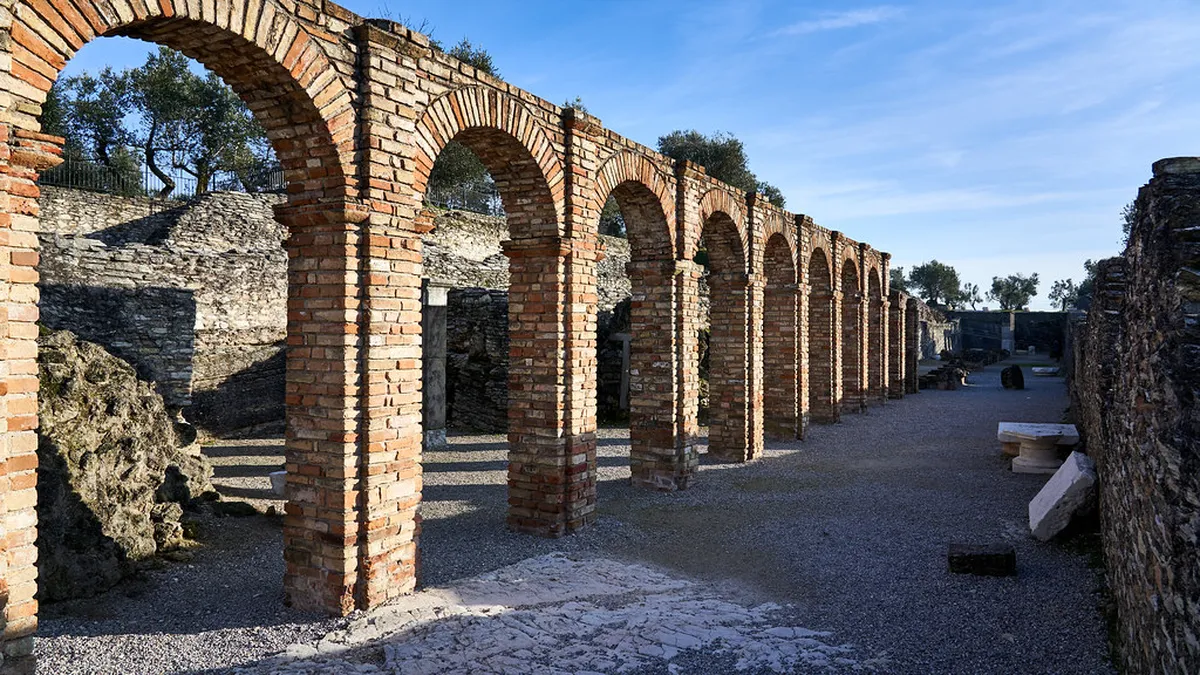
The Grotte di Catullo sits at the northernmost tip of the Sirmione peninsula on Lake Garda. It is one of the largest and best-preserved Roman villas in northern Italy, covering roughly two hectares of terraced ruins above the water. Getting your Grotte Catullo Sirmione tickets sorted before you arrive saves time and avoids the busiest queues in July and August.
This guide covers the 2026 ticket prices, seasonal opening hours, how to reach the site without a car, what the Antiquarium museum contains, and the practical details that help you get the most out of the visit. Pair it with our best Sirmione itinerary to plan a full day on the peninsula.
Grotte di Catullo Ticket Prices in 2026
Turn this guide into a personal route with our free Sirmione itinerary planner.
The standard adult entrance fee is €8.00. This single ticket covers both the outdoor archaeological park and the Antiquarium museum inside the site — there is no separate museum charge. EU citizens aged 18 to 25 pay a reduced rate of €2.00 on production of a valid ID. Visitors under 18 enter free, as do teachers on school trips with documentary proof and registered disabled visitors with one accompanying carer.
No timed-entry reservation is required for walk-in visits, but the site operates a daily capacity limit during peak season. If you are visiting in July or August on a weekend, buying online through the official Vivaticket portal (linked from musei.lombardia.beniculturali.it) removes the risk of finding the site at capacity when you arrive. Third-party booking platforms such as GetYourGuide also sell skip-the-line options that include a printed or mobile ticket.
Cash and major credit cards are accepted at the on-site ticket window. There is no combined ticket with Scaliger Castle — you buy the two tickets separately. Factor both into your Sirmione budget travel guide calculations: Scaliger Castle runs around €4.00 for adults.
Opening Hours: Winter vs Summer Schedule (2026)
The Grotte di Catullo operates on two distinct seasonal timetables, and confusing them is one of the most common planning mistakes. The site is closed every Monday year-round.
Summer schedule (typically April to October):
- Tuesday to Saturday: 08:30 – 19:30
- Sunday: 09:30 – 18:30
Winter schedule (typically November to March):
- Tuesday to Saturday: 08:30 – 17:00
- Sunday: 08:30 – 14:00
Last entry is 30 minutes before closing — not one hour as some sources suggest. If you arrive at 19:00 on a Tuesday in July, you will be turned away. Always confirm the exact date range for each schedule on the official Lombardy cultural heritage website before your trip, as the switchover dates shift slightly each year.
Public holidays can bring shorter hours or full closure. The site typically closes on 1 January, 1 May, and 25 December. Easter Sunday and Easter Monday are usually open but with adjusted hours.
How to Get There: The No-Car Reality Every Visitor Should Know
Sirmione's historic centre is a ZTL (Zona a Traffico Limitato) — private vehicles are banned beyond the drawbridge unless you have a hotel reservation inside the zone. This means almost all visitors must park outside the old town and walk in. The main car parks are Parking P1 and P2 near the causeway entrance, roughly 1 km south of the ruins.
From the car park, you pass through the medieval gate, walk through the town centre past Scaliger Castle, continue along Via Vittorio Emanuele, and follow Via Catullo all the way to the northern tip. Allow 15 to 20 minutes on foot. The path is paved and flat through the town, but turns to stone and compacted gravel once you enter the archaeological park. There is no shuttle service operating on this route in 2026.
Arriving by public transport simplifies this considerably. Buses from Desenzano del Garda and Peschiera del Garda stop at Sirmione village, dropping you within a few minutes' walk of the old-town entrance. Read our guide on how to reach Sirmione for bus timetables and ferry options. Cyclists may bring bikes through the gate and lock them near the park entrance on Piazzale Orti Manara 4 — the official site address.
Inside the Site: The Ruins and the Antiquarium Museum
Your ticket gives access to two distinct experiences. The outdoor archaeological park stretches across the rocky headland and contains the main building structures — the cryptoporticus (a long underground corridor used for storage and thermal regulation), the large cisterns that held the villa's water supply, the remains of the thermal bath suite, and the open peristyle terrace overlooking the lake. Walking between these structures on the gravel paths takes 45 to 75 minutes at a relaxed pace.
The Antiquarium di Sirmione sits at the entrance to the park and houses the finds excavated from the site since the 19th century. The collection includes Roman bronze statuettes, marble architectural fragments, frescoed plaster panels, black-and-white mosaic floor sections, and pottery from the 1st century BC through to late antiquity. The museum is air-conditioned, which makes it the sensible place to take your midday break in summer before continuing through the open-air ruins. Labels are in Italian and English.
One detail that often surprises visitors: the name "Grotte" (caves) does not refer to actual caves. It describes the large vaulted substructures that remain standing while the upper floors have collapsed, creating dark arch-framed spaces that early medieval visitors assumed were natural grottoes. The poet Catullus is associated with Sirmione in his own verse, but no inscription or artefact has conclusively identified this specific villa as his. The connection is poetic rather than proven.
Combine your historical visit with a stop at the Sirmione thermal baths in the afternoon. The two experiences — Roman ruins and living thermal tradition — fit naturally into a single day.
Best Time to Visit and How Long to Allow
April, May, September, and October give the best combination of mild weather, manageable crowd levels, and full summer opening hours. Summer (June to August) brings the highest visitor numbers, with Saturday afternoons being the worst time for queues at the ticket window. Early morning arrival — 08:30 on a weekday — means you will have the terraced ruins nearly to yourself for the first hour.
Budget a minimum of 1.5 hours for a walk-through of the park and a look at the museum. History enthusiasts and photographers typically spend 2 to 2.5 hours. The lake views from the northern terrace are best in the late afternoon when the light catches the water from the west. Winter visits have a particular quality: fewer tourists, lower raking light on the stonework, and no heat. The shorter winter hours (closing at 17:00 on weekdays) mean you need to arrive by 14:00 at the latest to do the site justice.
Check Sirmione castle opening hours if you plan to combine the Grotte with Scaliger Castle on the same day. The castle is near the town gate and best visited first, before you walk north to the ruins.
Practical Visitor Tips
Wear closed, flat-soled shoes. The path through the park includes loose gravel, uneven stone, and steps between terraces. Sandals or heeled shoes cause real difficulty. The site is mostly exposed with limited shade between structures, so bring a hat, sunscreen, and a full water bottle. There is a small vending machine near the entrance but no cafe inside the park itself.
Photography is permitted for personal use throughout the site and museum. Drone flights are prohibited within the archaeological zone. The best photo positions are from the northern terrace looking back south over the ruins with Lake Garda on both sides, and from the lower cryptoporticus looking up through the Roman arches.
Wheelchair and stroller access is limited. The Antiquarium museum entrance is accessible, but the main ruins involve unpaved surfaces, gravel paths, and steps that are not navigable in a standard wheelchair. The site does not currently offer an alternative accessible route through the excavation area. Visitors with severe mobility limitations should check directly with the site administration (telephone +39 030 916157) before making the trip.
For a full afternoon on the peninsula after your visit, our Sirmione walking tour route picks up where the ruins end and takes you back through the old town with stops at key viewpoints, the spa waterfront, and the best gelato in Sirmione. See our guide to best Sirmione restaurants for dinner options at the end of the day.
Grotte di Catullo: History and Significance
The villa dates to the late 1st century BC and early 1st century AD, placing its construction during the late Roman Republic or early Imperial period. At its height it covered approximately 2 hectares and extended across multiple levels of the rocky promontory, with terraced gardens, private baths, and a network of service corridors beneath the main residential floors.
The scale of the construction indicates an owner of exceptional wealth. The Roman poet Gaius Valerius Catullus repeatedly mentioned Sirmione with great affection in his verse — his poem Salve, o venusta Sirmio is still quoted on plaques in the town — but no physical evidence confirms this particular villa was his. The association is conventional and centuries old, but the archaeological record leaves the true owner unnamed.
Excavations began in earnest in the 19th century and continued intermittently through the 20th. The surviving structures include one of the most complete examples of Roman cryptoporticus design in northern Italy. This underground colonnaded corridor, originally used to regulate temperature in the rooms above, runs for over 150 metres along the western edge of the site. It is one of the archaeological highlights that separates Grotte di Catullo from smaller Roman sites in the Lake Garda region.
For visitors interested in Roman history along the Garda shore, the site pairs well with the museum at Desenzano del Garda (which holds Roman mosaics from a separate Late Roman villa) and with Verona's Roman Arena, reachable in 35 minutes by train. Consider broader Sirmione day trip ideas that build Roman heritage into a multi-stop route.
Frequently Asked Questions
Are Grotte di Catullo Sirmione tickets worth the cost?
At €8.00 for adults in 2026, the Grotte di Catullo offers strong value. The ticket covers both the outdoor archaeological park and the Antiquarium museum. The panoramic views of Lake Garda from the northern terrace alone justify the entry fee, and the site requires no timed booking outside peak weekends. Most visitors rate it as the most historically substantial attraction in Sirmione, ahead of Scaliger Castle.
Combine it with a Sirmione walking tour route for a full day of exploration. The ruins and museum together fill a comfortable 1.5 to 2.5 hours, making it an efficient use of time on a peninsula day trip.
Can I buy Grotte Catullo Sirmione tickets at the entrance?
Yes, tickets are sold at the on-site ticket window during opening hours. Cash and credit cards are accepted. In July and August, particularly on Saturday and Sunday afternoons, the ticket queue can run 20 to 30 minutes. Buying online through the official Vivaticket portal or a third-party provider eliminates that wait. During the shoulder seasons (April, May, September, October), walk-in purchase at the gate is rarely a problem.
Read our Sirmione practical travel tips for more on managing peak-season crowds efficiently across the peninsula's main attractions.
How long does it take to visit Grotte di Catullo thoroughly?
Allow 1.5 to 2 hours for a thorough visit that includes the Antiquarium museum and the main ruin terraces. History enthusiasts or photographers may spend up to 2.5 hours. The site closes to new entries 30 minutes before the published closing time, so plan accordingly. Consider a full Sirmione itinerary if you want to pair the ruins with Scaliger Castle and the thermal waterfront in a single day.
Is Grotte di Catullo accessible for all visitors?
Accessibility is limited. The Antiquarium museum building is accessible. The outdoor archaeological park involves gravel paths, uneven stone surfaces, and steps between terrace levels that are not navigable in a standard wheelchair. Pushchairs also face difficulty on the rougher sections. The site does not currently offer an alternative accessible route through the main excavation area. Visitors with mobility concerns should call the site directly on +39 030 916157 to discuss current conditions before making the trip. See also our guide on how to reach Sirmione for transport options that minimise walking distance to the entrance.
What other attractions are near Grotte di Catullo?
Scaliger Castle (Rocca Scaligera) is the other major sight, located at the entrance to the old town roughly 1 km south of the ruins — it costs around €4.00 and takes 45 to 60 minutes. The Terme di Sirmione thermal spa complex offers public bathing and pool access. The historic town centre has numerous restaurants, gelato shops, and lake-view terraces. Check our guide to Sirmione gelato spots and Sirmione boat tours for ways to extend your day on the peninsula.
Grotte di Catullo is the centrepiece of any serious Sirmione visit. At €8.00 per adult in 2026, with the Antiquarium museum included and views of Lake Garda from the northern terrace, it offers more depth than any other site on the peninsula. Confirm your date against the seasonal schedule (the site closes Mondays), arrive before 09:30 to beat the summer crowds, and allow enough time for both the outdoor ruins and the museum. Start planning your Sirmione itinerary today. Explore more travel guides on itimaker.com.
Key Takeaways
- Standard adult ticket: €8.00 in 2026, covering both the ruins and the Antiquarium museum. EU citizens 18–25 pay €2.00; under-18s free.
- Closed every Monday. Summer hours: Tue–Sat 08:30–19:30, Sun 09:30–18:30. Winter hours: Tue–Sat 08:30–17:00, Sun 08:30–14:00.
- Last entry is 30 minutes before closing — not one hour.
- No private car access to the peninsula. Park at P1/P2 near the causeway and walk 1 km through the old town to the site.
- Allow 1.5 to 2 hours. Visit early morning on a weekday for the smallest crowds.
- The Antiquarium museum is air-conditioned — a practical midday refuge in summer.