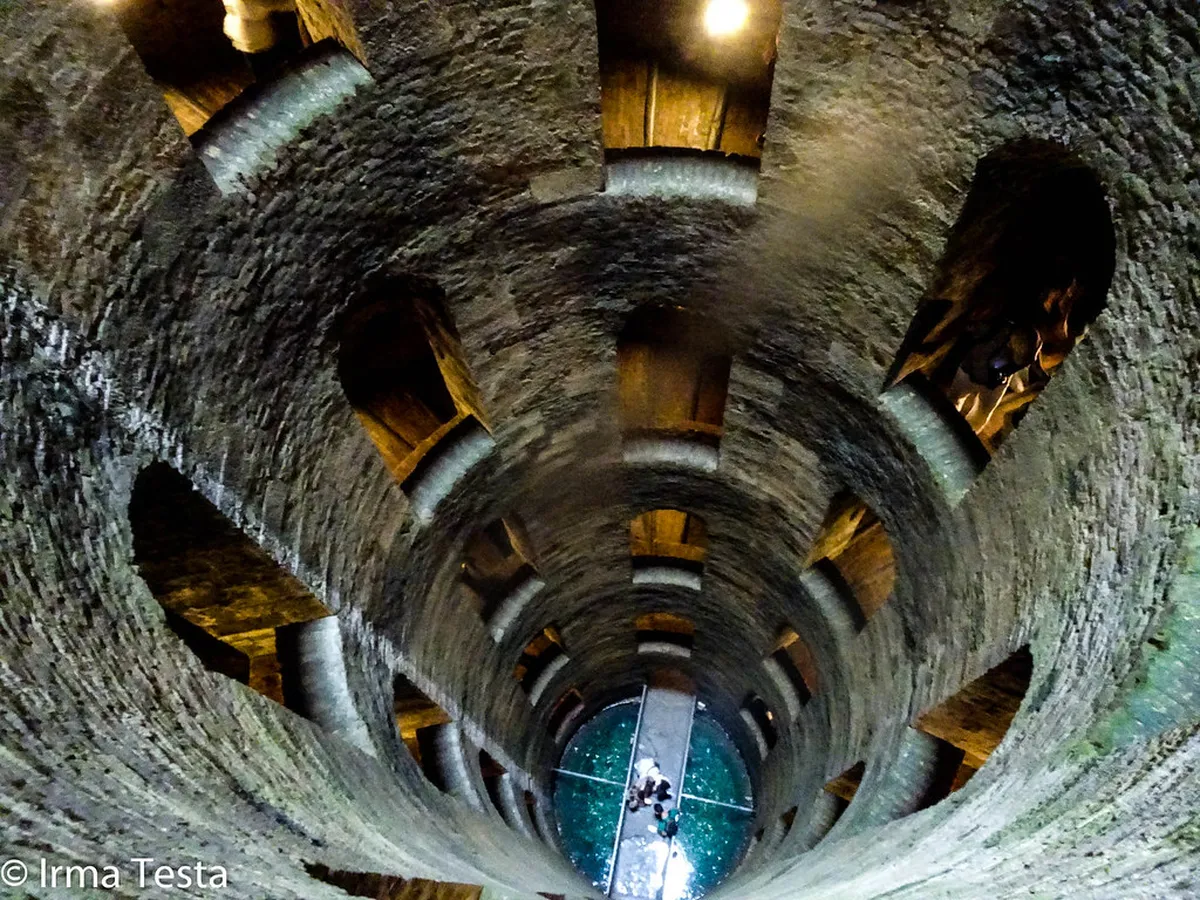
Orvieto holds many secrets beneath its ancient streets and volcanic cliffs. One of the most impressive is the Pozzo di San Patrizio, a deep well that represents a pinnacle of Renaissance engineering. Visitors descend 248 steps into the volcanic tuff to witness an architectural solution so clever it has never needed improving. The entrance plaque says it all: "Quod natura munimento inviderat, industria adiecit" — what nature did not do, artifice added.
The project began after the dramatic Sack of Rome in 1527. Pope Clement VII sought refuge in this hilltop city to escape imperial troops and the Landsknechts. He realized the town needed a reliable water source to survive a long siege. This necessity drove the creation of an extraordinary underground structure that took a decade to complete.
The History and Legend of St. Patrick's Well
Turn this guide into a personal route with our free orvieto itinerary planner.
Pope Clement VII fled to Orvieto in 1527 after the Sack of Rome. He needed a secure water supply capable of sustaining the city through a military siege of unknown duration. Antonio da Sangallo the Younger was given the commission, and work finished in 1537 under Pope Paul III Farnese.
The structure was originally called the Pozzo della Rocca — the Well of the Fortress — because of its proximity to the Albornoz citadel. It acquired the name St. Patrick's Well only in the 19th century when friars from the nearby Servite convent recognized a parallel with the Irish legend of Saint Patrick's Cave. According to that legend, Patrick guarded a bottomless pit from which visitors could witness the pains of Purgatory and glimpse Paradise. The resemblance between the two "bottomless" structures stuck, and the modern name was born.
To commemorate the project, Pope Clement VI commissioned Benvenuto Cellini to mint a medal inscribed "Ut bibat populus" — so that the people may drink. The medal depicted Moses striking a rock to produce water, a direct parallel to the Pope's engineering achievement. Surviving examples are held in the Vatican Museums in Rome and in the British Museum in London.
Architectural Brilliance: The Double Helix Design
Sangallo's genius lay in a single spatial insight: if the descent and the ascent are completely separate spirals, the animals hauling water will never block each other. He wrapped two independent staircases around the same central shaft in a double helix — one ramp going down, one going up, each completing a full rotation before the other intersects the same vertical point. The result is 248 steps on the way down and 248 different steps on the way back up, with no crossings at any point.
The well plunges approximately 53 to 54 metres into the volcanic tuff of the Orvieto plateau. The shaft is 13 metres in diameter, large enough to allow loaded pack animals to navigate without difficulty. Natural light enters through 72 large round-arched windows cut directly into the stone at regular intervals. These windows not only illuminate the path but create the mesmerizing visual repetition that photographers have sought ever since the site opened to tourists.
Sangallo drew inspiration from the spiral staircase of the Villa del Belvedere in the Vatican. The same architectural logic appears in the Regia Staircase of Palazzo Farnese at Caprarola. At Orvieto, however, the scale is industrial rather than ceremonial — this was infrastructure built to keep a city alive, not to impress papal guests.
The Escape Tunnel Most Visitors Walk Past
At the very bottom of the shaft, near the water level, there is a small door set into the tufa wall. Most visitors walk to the bridge, look up, take their photograph, and turn back without noticing it. That door connects to a narrow tunnel dug through the rock that leads outside the cliff to the Fontana di San Zero, a natural spring below the plateau.
The tunnel serves two purposes. First, it channels the outflow from the natural spring to maintain a constant water level at the bottom of the well. Second, historians believe it was also designed as a rapid escape route for Pope Clement VII in the event the city fell to enemy forces. Orvieto's position on a volcanic mesa made subterranean exits a practical military asset, not an architectural flourish.
This detail does not appear on most tourist information boards inside the site. If you descend to the bottom and look toward the far wall rather than straight up, you will find the door. It takes less than thirty seconds to examine and changes how you read the entire structure — from public utility to papal bunker.
Essential Visitor Information: Hours, Tickets, and Booking
Opening hours follow a four-season schedule. Check the Official Orvieto Tourism Portal (Live Orvieto) before you travel, as last-entry cut-offs apply 30 minutes before closing time.
- November, December, January, February: 10:00 to 17:00 (last entry 16:30)
- March, April, September, October: 09:30 to 19:00 (last entry 18:30)
- May, June, July, August: 09:00 to 20:00 (last entry 19:30)
Current ticket prices as of 2026 are €6.00 for a full adult ticket and €4.50 reduced. The reduced rate applies to groups of at least six people, students, seniors, minors, disabled visitors, Touring Club Italiano members, and anyone already holding a Pozzo della Cava ticket. Children aged 0–6 enter free. Animals are not admitted. Tickets are bookable online or purchased at the entrance near Piazza Cahen. Check the Comune di Orvieto Cultural Heritage page for group booking procedures.
The site is also included in the Carta Unica, Orvieto's combined ticket covering multiple city monuments. If you plan to visit more than two or three paid attractions in a single day, the Carta Unica saves money and eliminates separate queues. Ask at the well's ticket office or at the tourist information point near Piazza del Duomo.
How to Reach the Well: Transport and Parking
The well sits on Viale Sangallo, at the eastern edge of the cliff plateau near Piazza Cahen. It is less than two minutes on foot from the upper funicular station. Review the Orvieto Funicular Schedule 2026: Essential Travel Guide to plan your arrival time, as the funicular connects Orvieto Scalo train station to the hilltop every ten minutes.
Drivers will find a large parking area immediately adjacent to the site at Piazza Cahen. This is one of the most convenient parking spots in the city for those arriving by car. Many visitors treat this as the logical starting point of their Orvieto Itinerary: A Memorable Trip in 2026 before walking east toward the Duomo.
Travelers arriving by train from Rome (approximately 1 hour 15 minutes on the fast Intercity service) can follow the signs from Orvieto Scalo station directly to the funicular. The walk from the funicular exit at Piazza Cahen to the well entrance takes under two minutes. More transit options are covered in our guide on How to Reach Orvieto: Your Essential 2026 Travel Guide by train or car.
The Experience: Descending the 248 Steps
The temperature inside the shaft drops noticeably within the first fifty steps. By the midpoint of the descent, you will have left the warmth of the surface entirely. At the water level, the air sits at a near-constant cool and holds significant humidity, which can feel refreshing in summer but heavy on damp autumn days. Bring a light layer if you are sensitive to cold.
A small bridge crosses the water at the very bottom of the shaft. Standing on it and looking straight up reveals the optical effect visitors describe most often: the 72 arched windows repeat in diminishing circles until they converge on the sky, creating the impression of an infinite cylindrical tunnel. The best light for this view arrives between 11:00 and 13:00 when the sun is directly overhead and reaches the lower windows.
Photographers should avoid flash entirely — the natural gradients in the stone and the soft window light are the composition. The ascent uses the second spiral, which means you see a completely different set of windows and walls on the way back up. Budget 40 to 50 minutes total for a relaxed visit, including time at the bottom.
Nearby Landmarks: Albornoz Fortress and Etruscan Temple
The Albornoz Fortress stands directly adjacent to the well entrance, connected by a recently restored passageway. Cardinal Egidio Albornoz ordered the original construction in 1364. It was destroyed in 1390 during a period of internal conflict and rebuilt in 1450 under Papal State control. Today the fortress houses public gardens and an amphitheatre used for summer events, and it is also the birthplace of Luigi Barzini, considered the first special correspondent in the history of Italian journalism.
From the fortress ramparts you get an unobstructed view across the Paglia River Valley. This is one of the better viewpoints in Orvieto, and the walk around the walls takes under fifteen minutes. The Etruscan Temple of Belvedere ruins lie a short distance further along the plateau edge, offering a glimpse of the pre-Roman history of the site.
Both landmarks are included in the route that many visitors take on an Orvieto Day Trip From Rome: 8 Essential Tips for Your Visit. The cluster of the well, fortress, and temple ruins occupies one compact corner of the city and can be covered in under an hour before moving toward the Duomo.
Comparing Orvieto's Wells: San Patrizio vs. Pozzo della Cava
Orvieto has two famous wells, and choosing between them — or combining them — is a common planning question. San Patrizio was built in 1527 to 1537 as civic infrastructure on a grand scale: 53 metres deep, 13 metres wide, 248 steps, with space for loaded donkeys. Pozzo della Cava, located in the medieval quarter near Via della Cava, was dug in the Etruscan period and expanded through the Middle Ages. It is intimate, labyrinthine, and surrounded by archaeological finds including kilns and storage cavities.
On practical terms: San Patrizio costs €6.00 full / €4.50 reduced and takes around 45 minutes. Pozzo della Cava costs €4.00 full and includes access to several connected underground chambers; it takes 30 to 45 minutes. Holders of a Pozzo della Cava ticket qualify for the reduced rate at San Patrizio, making the combination a sensible pairing. Our Orvieto Underground Tour Tips: Your Essential 2026 Guide cover both sites and the guided Orvieto Underground experience in more detail.
The two wells address different interests. San Patrizio is the choice for Renaissance engineering and the grandeur of scale. Pozzo della Cava is for visitors who want Etruscan history and closer archaeological context. Visiting both in a single morning is easy — they are under ten minutes apart on foot — and gives a complete picture of Orvieto's subterranean layers.
Practical Tips for Your Visit: Accessibility and Timing
The well is not accessible to visitors with mobility impairments. There are no elevators, no wheelchair ramps, and no rest points inside the spiral. The official accessibility rating is "ridotta" (limited). If mobility is a concern, the fortress gardens next door provide the elevated plateau views without any steps. Wear shoes with good grip — the stone steps are worn smooth in places and become damp near the lower levels.
Visitors with claustrophobia should know that the shaft is wide (13 metres in diameter) and the 72 windows provide consistent natural light throughout the descent. The feeling is more cathedral than cave. However, the bottom section narrows slightly and the air is noticeably heavier. Most visitors who are mildly claustrophobic manage the descent without difficulty; the return spiral feels more open.
To avoid crowds, arrive before 10:00 or after 17:00. Peak congestion occurs between 11:00 and 14:00 in July and August. For broader seasonal planning, our guide on the Best Time to Visit Orvieto: Your 2026 Travel Guide covers weather, crowds, and local events across the year. A visit to the well pairs naturally with the Duomo, roughly 700 metres east along the main road. See also our Duomo visitor guide.
Frequently Asked Questions
Is Pozzo di San Patrizio worth the climb?
Yes, it is absolutely worth the effort for anyone interested in history or architecture. The double helix design is a rare engineering masterpiece that you won't find in many other places. It offers incredible photography opportunities and a unique perspective on Orvieto's survival strategies during the Renaissance.
How many steps are in the St. Patrick's Well in Orvieto?
There are exactly 248 steps leading down to the bottom of the well. Because of the double helix design, you will climb another 248 steps to return to the surface. The steps are wide and shallow, making the climb manageable for most visitors with average fitness levels.
Why was the Pozzo di San Patrizio built?
Pope Clement VII ordered the construction to ensure a reliable water supply for Orvieto. After the Sack of Rome in 1527, he feared the city might face a long siege by imperial troops. The well was designed to reach the natural spring at the base of the volcanic cliff.
Can you visit St. Patrick's Well and the Orvieto Underground on the same day?
You can easily visit both attractions in a single day as they are located within the same small city. Many travelers start at the well in the morning and then join an underground tour later in the afternoon. This allows you to see two very different sides of the city's history.
Are dogs allowed inside Pozzo di San Patrizio?
Small dogs are generally allowed inside if they are kept in a carrier or on a short leash. However, the 496 total steps can be difficult for some pets to navigate safely. It is always best to check the latest rules at the ticket office before you enter the site.
Pozzo di San Patrizio remains one of the most fascinating landmarks in all of Italy. Its combination of Renaissance beauty and practical engineering continues to inspire modern visitors. Standing at the bottom of the shaft provides a rare sense of history and scale. The climb is a memorable part of any trip to the beautiful city of Orvieto.
Make sure to plan your visit around the best lighting conditions for the best experience. Exploring the nearby fortress and temple ruins will round out your morning perfectly. This site proves that even the most functional structures can be works of art. Enjoy your journey into the depths of this incredible 16th-century well in 2026.