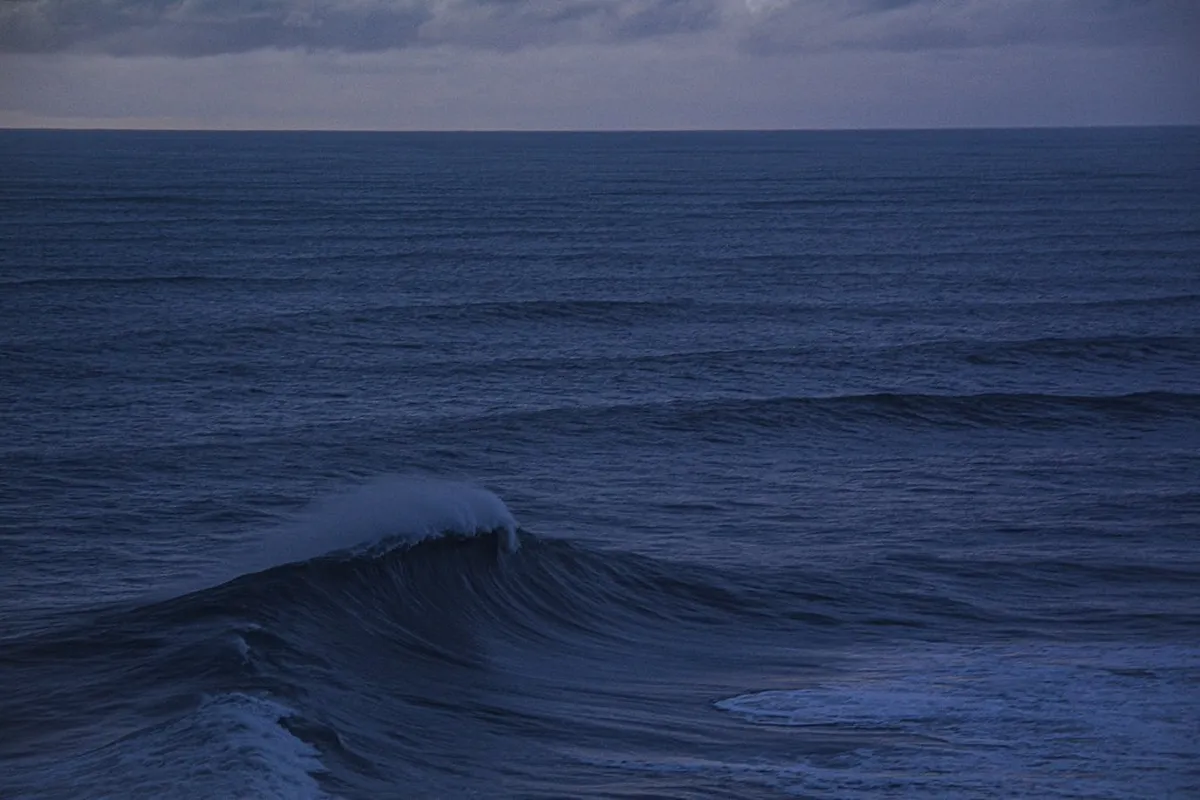
Every winter, walls of water up to 30 meters tall crash against the cliffs of Praia do Norte in Nazaré, Portugal. These are not just large waves — they are the largest waves reliably surfed anywhere on Earth, and their existence is no accident of weather.
Four distinct geological and oceanographic processes combine here in a way that occurs almost nowhere else on the planet. Each one amplifies the wave height independently, and when they all align during a major North Atlantic storm, the results are extraordinary. Understanding each process separately makes the whole picture clear.
The Nazaré Canyon: Europe's Largest Submarine Valley
Turn this guide into a personal route with our free nazaré itinerary planner.
The Nazaré Canyon is the largest submarine canyon in Europe and one of the largest in the world. It stretches roughly 230 kilometres from the Portuguese coast out to the Iberian Abyssal Plain, where the ocean floor sits at around 5,000 metres depth. To put that in scale: the Grand Canyon in Arizona averages about 1,800 metres deep. The Nazaré Canyon is nearly three times deeper, and it runs all the way to the doorstep of the beach. Learn more about the underwater geology that creates this unique formation.
That last point matters more than the raw numbers. The canyon head sits just a few hundred metres offshore, and at its closest point it reaches only 20 metres below the surface. The continental shelf beside it, by contrast, is relatively shallow. This extreme contrast in depth — deep canyon immediately next to shallow shelf — compressed into a very short horizontal distance is the physical root cause of everything that follows.
The canyon's orientation runs roughly east-west in its middle and lower sections, which aligns it almost perfectly with the dominant west and northwest swell directions of the North Atlantic. Swells generated by storms thousands of kilometres away travel the length of the canyon like energy moving through a pipe, arriving at the shore with almost none of their power dissipated.
- Nazaré Canyon depth: approximately 5,000 metres
- Grand Canyon depth: approximately 1,800 metres
- Canyon length: roughly 230 kilometres
- Canyon head distance from shore: a few hundred metres
- Canyon head depth at its shallowest: around 20 metres
Praia do Norte: Where Geography Shapes the Break
The canyon does not empty onto a generic stretch of beach. It terminates directly in front of the Promontório do Sítio, a rocky headland that rises 110 metres above sea level. This headland physically divides the coastline into two separate beaches: Praia do Norte to the north, facing the full force of the Atlantic, and Praia da Nazaré to the south, sheltered inside a calmer bay.
The headland also sits at the mouth of the canyon, which is why the Fort of São Miguel Arcanjo — built on the headland tip in the 16th century originally to defend against pirate raids — gives the best possible view of the wave mechanics in action. From the lighthouse platform, you can watch the two distinct wave systems approaching from different angles and see the exact moment they converge below. No other vantage point makes the physics as visible.
The prevailing winds blow from the northwest and southwest. The headland intercepts these winds and alters the local sea conditions significantly. On days with easterly offshore winds, the wave face stands up cleanly and holds its shape long enough for a surfer to ride it. When southwest winds dominate, the sea surface becomes confused and the waves lose their clean form despite remaining enormous.
Wave Refraction: How the Canyon Bends the Swell
Wave refraction is the first and most fundamental amplifying process. When a swell moves from deep water into shallower water, it slows down. Waves in the deep canyon maintain their speed because the seafloor is far below and exerts no friction on the passing energy. Waves on the adjacent shallow continental shelf slow dramatically as they drag against the bottom.
This speed difference causes the wave fronts to bend. Think of a line of people walking at different speeds — the faster walkers pull ahead and the line curves. Ocean wave fronts work the same way. The canyon-side of the wave stays fast while the shelf-side slows, and the entire wave front rotates to aim toward the headland. The canyon acts as a lens that focuses dispersed Atlantic energy into a single concentrated point.
This focusing effect is why the waves at Praia do Norte are so dramatically larger than those on any other part of the surrounding coast. The same swell that produces a 2-metre wave on a beach 20 kilometres away can produce a 20-metre wave at the canyon mouth. The geography is doing the amplification, not the storm size alone.
The "Wedge" Effect: Constructive Interference Explained
The wave that travels through the canyon and the wave that moves across the northern continental shelf are two separate wave systems. They approach the headland from slightly different angles and at different speeds. When they arrive at the same point at the same time, they do not cancel each other out — they add together. In physics this is called constructive interference, and it can roughly double the height of the resulting wave.
The merged peak takes on the distinctive A-frame shape that makes Nazaré so recognizable in surf photography. The collision creates a steep, almost vertical face with thick lips that hold their shape briefly before collapsing. From the lighthouse, observers can watch both fronts approaching separately and track the exact moment they join into a single giant peak below.
The timing of this collision is not guaranteed. On many days the two systems are slightly out of phase and the resulting waves, while still very large, do not reach their maximum potential. On the rare days when the refracted canyon wave and the shelf wave meet in perfect synchrony, the wave heights jump to record territory. This is why the biggest days at Nazaré are unpredictable even for experienced forecasters.
Overtopping the Topographic Barrier
The third process is called overtopping a topographic barrier, or the shoaling effect. As the canyon swell approaches the beach, it crosses the canyon head — the abrupt point where the deep underwater valley rises steeply toward the surface. This rapid reduction in depth compresses the wavelength and forces the wave height to increase sharply. The water column has nowhere horizontal to go, so it goes vertical.
Scientists at the Portuguese Hydrographic Institute describe this as a steep vertical variation in local bathymetry. In practical terms, the canyon functions like a ramp. The swell hits the rising canyon floor and the crest is launched upward. This shoaling boost adds significant height on top of what refraction and constructive interference have already produced.
The effect builds gradually as the wave moves through shallower water, not all at once. By the time the wave reaches the surf zone at Praia do Norte, it has been amplified by refraction, doubled by constructive interference, and then given a final vertical push by the canyon head. Each process compounds the last.
Littoral Drift: The Fourth Amplifier
Most explanations of Nazaré's waves stop at three processes. There is a fourth. Wave propagation at Praia do Norte drives a water current along the beach in a northerly direction. This current deflects offshore when it reaches the cape — the headland acts as a topographic barrier that redirects the flow back out to sea. The water piled up inside the cove reinforces this outflowing current.
This seashore channel runs in the opposite direction to the incoming waves. When a current opposes a wave's direction of travel, it steepens the wave face and adds to the shoaling effect. The Portuguese Hydrographic Institute identifies this litoral drift as a genuine fourth amplifier — distinct from refraction, constructive interference, and overtopping — that pushes wave height even higher than the other three processes alone would achieve.
In practice, this means the current conditions on any given day affect the final wave height as much as the swell size does. A moderately large swell arriving against a strong northerly current can produce a bigger breaking wave than a larger swell arriving without one. It is one reason why Nazaré's biggest waves are difficult to predict from swell forecasts alone.
Optimal Swell and Wind Conditions for Big Waves
The canyon provides the geological infrastructure, but it still needs the right raw material to work with. The ideal swell travels from the west or northwest, aligning with the canyon's orientation. A swell period of 14 seconds or more indicates deep-water energy that has been generated by a large, distant storm — this type of swell carries far more power per wave than a short-period chop produced by local wind.
Wind direction at Nazaré is critical for wave quality. Easterly offshore winds hold the wave face up and prevent premature breaking. Southwest winds, which arrive with Atlantic depressions, create rough, disorganised conditions even on large swells. The headland mitigates some of the wind effect by acting as a natural windbreak, but it cannot compensate for a strong onshore blow.
- Ideal swell direction: west or northwest
- Ideal wind direction: easterly (offshore)
- Minimum swell period for giant waves: 14+ seconds
- Storm origin: large North Atlantic low-pressure systems
The Big Wave Season: When to Witness the Giants
The big wave season runs from October through late March, with November, December, and January consistently producing the largest swells. North Atlantic storm activity peaks in midwinter, and the storms that generate the longest-period swells tend to track across the ocean in ways that send energy directly toward the Portuguese coast.
Planning a visit around a specific big swell requires monitoring surf forecasts rather than booking around fixed dates. Giants do not break every day, even in peak winter. Check Portugal's travel guide for logistics before heading to Praia do Norte. The World Surf League holds its annual Nazaré Tow Surfing Challenge during this window when conditions warrant — the contest can be called with as little as 24 hours' notice once a qualifying swell is confirmed.
Safety is non-negotiable at Praia do Norte during swell season. The beach is closed to swimmers and the water can surge violently up the sand with minimal warning. Stay well behind the safety barriers, follow the directions of maritime police on duty, and never turn your back on the ocean. The Nazaré itinerary guide covers logistics for timing your visit around a winter swell, including the best viewpoints from the lighthouse and the cliff path above the beach.
Human Feats: Record-Breaking Surfers at Praia do Norte
Nazaré was barely known outside Portugal until November 2011, when Garrett McNamara surfed a wave measured at approximately 78 feet and made international news. His decade-long collaboration with the town — documented in the HBO series 100 Foot Wave — transformed Praia do Norte from a quiet fishing beach into the global capital of big-wave surfing.
Today, Nazaré holds three simultaneous Guinness World Records: the largest wave surfed by a man (Sebastian Steudtner, 26.21 metres / 86 feet, October 2020), the largest wave surfed by a woman (Maya Gabeira, 22.4 metres / 73.5 feet), and the largest wave surfed by a kitesurfer (Nuno "Stru" Figueiredo). No other surf break on the planet holds records across all three categories at once. The concentration of world records here is itself a product of the canyon — the geological conditions that make Nazaré dangerous also make it uniquely capable of generating the specific wave shape that allows humans to ride at extreme heights.
All these surfers use jet skis for tow-in entry because the canyon waves move too fast to catch by paddling. The velocity of the wave face at full height exceeds what any paddler can match. The jet ski team also serves as rescue — wipe-outs at this scale are violent enough to hold surfers underwater through multiple wave cycles, and a rescue craft must be within seconds of the impact zone at all times. The bravery required is as much logistical as it is physical. Visitors wanting context on the broader surf culture of Portugal can find it in the Nazaré travel guide, which also covers the town's fishing heritage and its transition into a surf tourism hub.
Planning the rest of your Nazaré trip? See our Nazaré beaches and Praia do Norte and Nazaré weather month by month.
Frequently Asked Questions
How deep is the Nazaré Canyon compared to the Grand Canyon?
The Nazaré Canyon is significantly deeper than the Grand Canyon. It reaches depths of approximately 5,000 meters, while the Grand Canyon averages about 1,800 meters. This immense depth allows massive ocean swells to travel toward the Nazaré shoreline without losing any of their power or speed.
What is the best month to see the big waves in Nazaré?
The best months to witness the giant waves are November, December, and January. This period offers the most consistent North Atlantic storm activity. However, big swells can occur anytime between October and March depending on the yearly weather patterns and storm tracks across the ocean.
Why does the wave at Nazaré look like a wedge?
The wave looks like a wedge because two separate wave fronts collide at a specific point. One wave travels fast through the deep canyon, while the other slows down on the continental shelf. When they meet, they merge into a single, massive peak through a process called constructive interference.
Can you swim at Praia do Norte during big wave season?
Swimming at Praia do Norte is extremely dangerous and strictly discouraged during the big wave season. The currents are incredibly strong, and the shore break can be fatal even on smaller days. Most visitors prefer to watch the action safely from the cliffs near the lighthouse.
Who holds the world record for the largest wave surfed at Nazaré?
Sebastian Steudtner holds the current Guinness World Record for the largest wave ever surfed. He conquered an 86-foot giant at Praia do Norte in October 2020. This feat cemented Nazaré's reputation as the premier destination for world-record-breaking big wave surfing attempts.
The massive waves of Nazaré are the product of four compounding geological and oceanographic processes: refraction by the canyon, constructive interference at the headland, overtopping of the canyon's steep head, and the shore-parallel current that adds a final boost. Remove any one of them and the waves become merely large. With all four aligned, they become historic.
Visitors who come to witness these giants should always prioritize safety and respect the power of the Atlantic. Check the Nazaré itinerary to plan the logistics of a winter trip, including the best viewing spots and how to monitor swell forecasts before you travel.