Bergamo's Citta Alta — the Upper City — is one of Italy's most perfectly preserved medieval hilltop towns. Ringed by six kilometres of UNESCO World Heritage Venetian walls, it rises above the modern Citta Bassa on a rocky spur that the Republic of Venice spent a century fortifying. Inside those walls you find Piazza Vecchia, the Basilica di Santa Maria Maggiore, the Cappella Colleoni, gelato in sunlit lanes, and views stretching from the Bergamasque Alps to the Po Plain. This guide covers everything: how to get up there, which walking route to follow, every major sight explained in depth, where to eat, and the practical details that make the difference between a rushed half-day and a genuinely memorable visit.
For a full day-by-day plan across the whole city, see our Bergamo itinerary. If you are deciding where to base yourself, our where to stay in Bergamo guide covers options in both the upper and lower towns.
What Is Bergamo Citta Alta?
Turn this guide into a personal route with our free Bergamo itinerary planner.
Bergamo Citta Alta — literally "Upper Bergamo" — is the historic walled hilltop district that sits roughly 120 metres above the modern commercial Citta Bassa. It is not simply a neighbourhood: it is a functioning medieval city in its own right, with its own cathedral square, civic tower, markets, restaurants, and residents who live inside centuries-old stone buildings.
The settlement has pre-Roman origins, but its current skyline was shaped by two centuries of Venetian rule from 1428 to 1797. The Republic of Venice spent lavishly to transform Bergamo into its most heavily fortified western outpost. The result — the Venetian Walls — gained UNESCO World Heritage status in 2017 as part of the transnational serial inscription "Venetian Defense Works between the 16th and 17th Centuries: State by Land — State by Western Sea," a grouping that also includes fortifications in Peschiera del Garda and Palmanova in Italy, plus sites in Croatia and Montenegro.
Today, Citta Alta attracts visitors from Milan (45 minutes by train) and from across Europe who come specifically for its intact character. Unlike many Italian hilltowns that have become theme parks, Citta Alta remains a lived-in community: you hear church bells at dusk, see schoolchildren crossing Piazza Vecchia, and find locals queuing at the salumeria for lunch. That authenticity is its greatest asset.
How to Get Up to Citta Alta: Funicular, Bus, and Walking
The most enjoyable way to arrive in Citta Alta is by the City Funicular (Funicolare Citta), one of Bergamo's most beloved institutions. The line has been running for more than 120 years, connecting Viale Vittorio Emanuele II in the Citta Bassa with Piazza Mercato delle Scarpe at the entrance to the upper town. The ride takes just a few minutes, covers 240 metres of track, and climbs a height difference of 85 metres — at its steepest point the gradient reaches 52 percent. The views over the lower city on the ascent alone are worth the ticket.
Tickets cost around €1.30–1.50 in 2026 and can be purchased at the lower station or at tobacco shops (tabacchi). An integrated ATB day pass covers both the funicular and city buses and makes sense if you plan to move around the lower city as well. Check our dedicated page on Citta Alta funicular hours for the current timetable, as the service runs from early morning until late evening with short gaps for maintenance.
A second funicular — the San Vigilio Funicular — connects Citta Alta's Colle Aperto area with the hilltop castle of San Vigilio, the highest point above Bergamo. If you want the widest panorama over the city and the plain stretching south to Milan, add this short ride to your afternoon.
Prefer to arrive on foot? The steep pedestrian paths from the Citta Bassa provide a genuine workout but reward you with medieval street glimpses at every hairpin. Most visitors take the funicular up and walk down — an excellent strategy. City buses also serve Citta Alta from Bergamo railway station, and if you are arriving from Orio al Serio Airport (BGY), frequent airport buses connect to the city centre, from where you can transfer to the funicular. For full public transport details, see our Bergamo public transport tips.
The Recommended Walking Route Through Citta Alta
Once the funicular deposits you at Piazza Mercato delle Scarpe — the old shoe market — you are at the western gate of Citta Alta. The logical route through the upper town follows the main spine road, the Corsarola (Via Colleoni and its continuation), from west to east. Allow two to three hours for a thorough exploration; half a day if you want to linger at the basilica, climb the Campanone tower, and walk a section of the walls.
From Piazza Mercato delle Scarpe, head east along Via Gombito past the medieval Torre di Gombito, a 12th-century tower that dominates the first stretch of the Corsarola. Continue until the lane opens without warning into Piazza Vecchia, the emotional heart of the upper town. Spend time here — it rewards patience.
From Piazza Vecchia, step through the archway into the adjacent Piazza Duomo, home to the Basilica di Santa Maria Maggiore, the Cappella Colleoni, and the Cathedral. After the religious quarter, continue east along Via Colleoni toward the Cittadella Viscontea — a 14th-century fortified compound now housing science and archaeology museums. Beyond the Cittadella, the road leads to Colle Aperto, the open square near the Porta Sant'Alessandro gate, where the second funicular to San Vigilio departs.
From Colle Aperto, pick up the walls walk: head clockwise (north) to follow the best-preserved bastions and get the most dramatic views across the plain. The full perimeter circuit takes 60–90 minutes at a relaxed pace. Many visitors do a partial loop from Porta Sant'Alessandro back to Porta San Giacomo near the lower funicular station, which is entirely sufficient and beautifully scenic. For a full narrated route, our Bergamo self-guided walking tour covers every stop with commentary.
Piazza Vecchia: The Living Room of Citta Alta
Piazza Vecchia is universally cited as one of the most beautiful town squares in Italy, and the accolade is deserved. The architectural ensemble was praised by Le Corbusier himself during a 1934 visit, and it retains the same proportional perfection today. The square is framed by a sequence of historic buildings that span eight centuries of civic ambition without ever feeling incoherent.
At the centre stands the Contarini Fountain, built in 1780 by the Venetian governor Alvise Contarini. Its sphinxes — one facing the Palazzo della Ragione, one facing the Mai Library — symbolise reason and knowledge, an Enlightenment touch grafted onto a medieval square. The Palazzo della Ragione (Palace of Reason), occupying the south side, dates to the 12th century and is the oldest town hall in Lombardy still standing. Its open loggia and the lion of St Mark — Venice's symbol — carved above the main arch remind you that this square was the administrative heart of a Venetian frontier province.
Rising above the Palazzo della Ragione is the Campanone, the Civic Tower, standing 52 metres high. It dates from the 12th century but was raised to its current height during Venetian rule. Climbing the tower — 230 steps — earns you the best panoramic vantage point in Bergamo, with views across the terracotta rooftops of Citta Alta, the mountains to the north, and the plains to the south. The tower is open daily except Monday from 10 AM to 6 PM; entry costs €5 per person and includes access to a small archaeological museum on the first floor. Every evening at 10 PM the Campanone rings 100 times — a tradition dating from when the bell signalled the closing of the city gates to the surrounding countryside.
The north side of the square is anchored by the Palazzo Nuovo, home to the Angelo Mai Library, one of Italy's finest civic libraries with a collection of 16th-century manuscripts and rare books. The building's classical colonnade makes it the visual counter-weight to the medieval Palazzo della Ragione across the square. Between these two buildings, and spilling into the lane that leads to Piazza Duomo, Piazza Vecchia functions as the genuine social hub of Citta Alta: locals take morning espresso at the terrace cafes, schoolchildren play around the fountain, and visitors slow to a stop the moment they emerge from the narrow lane.
Basilica di Santa Maria Maggiore: Bergamo's Spiritual Jewel
Steps from Piazza Vecchia, through the archway into Piazza Duomo, you encounter the Basilica di Santa Maria Maggiore — a church that has been absorbing centuries of artistic patronage since its founding in 1137. The basilica was built on the site of an earlier 8th-century church dedicated to the Virgin, which was itself erected over a Roman temple. The high altar was consecrated in 1185; the transept and presbytery completed in 1187.
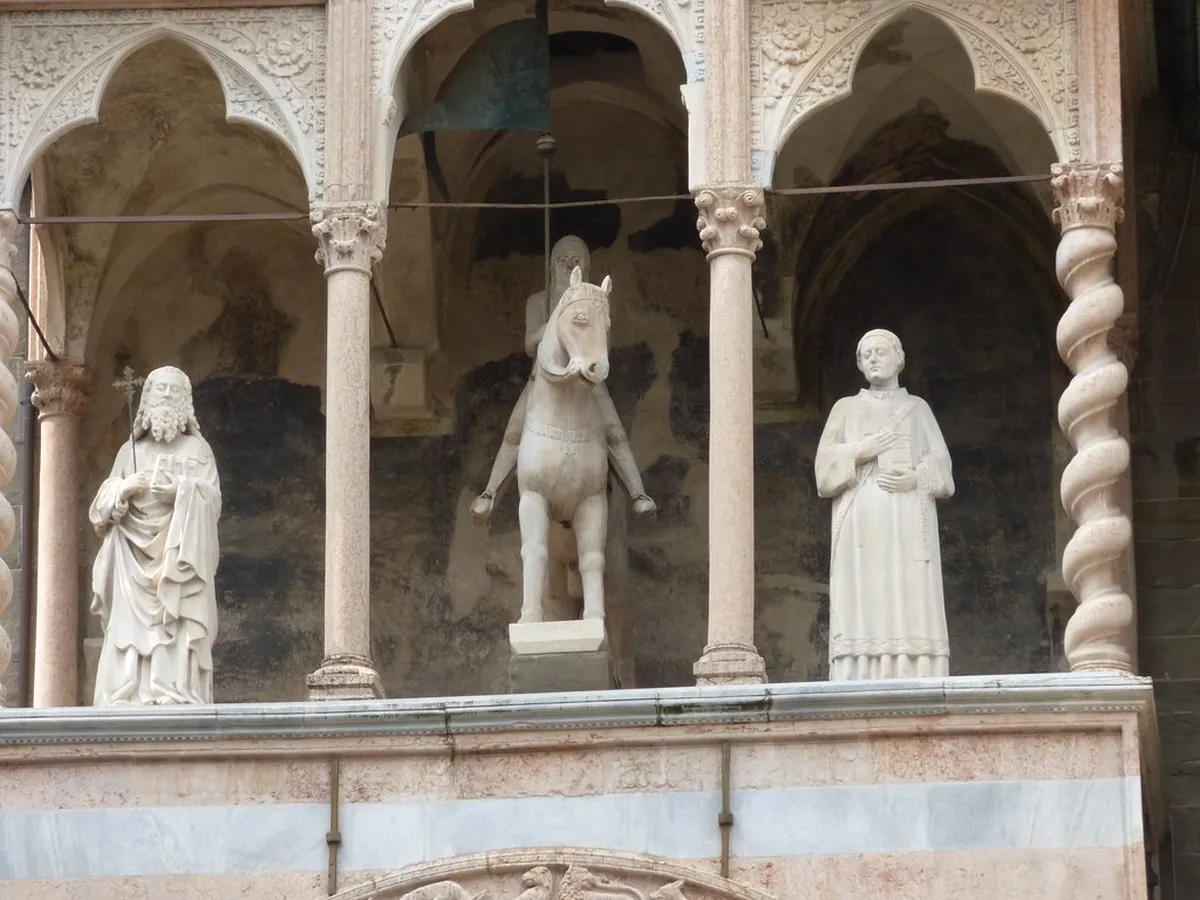
One of the basilica's most distinctive architectural quirks is immediately apparent: it has no central facade. The building forms a continuous wall with the adjoining Palazzo del Podesta, and its four entrances are all lateral. The two most photogenic are the Porta dei Leoni Rossi (Red Lions' Gate) on the north side, opening onto Piazza Duomo, and the Porta dei Leoni Bianchi (White Lions' Gate) on the south side, facing Piazza Rosate. Each is covered by a 14th-century Gothic porch — called a protiro — designed by Giovanni da Campione, supported by columns resting on the backs of carved lions in red and white marble. These lions have guarded the church for seven hundred years and are among Bergamo's most photographed architectural details.
Inside, the basilica is a lavish accumulation of artistic treasure. The walls and vaulted ceilings are covered in gilded Baroque stucco work and Flemish tapestries — sixteen of them — commissioned by the city in the 16th and 17th centuries to depict scenes from the Old Testament. The wooden choir stalls in the presbytery were designed by Bernardo Zenale and carved between 1524 and 1555 using designs by Lorenzo Lotto, the Venetian Renaissance master who spent decades in Bergamo. Lotto's inlaid biblical panels achieve a polychrome richness through the use of different wood species — a technique that reproduces the tonal range of painting in a medium of pure carpentry. In the corner of the basilica, a simple tomb marks the burial place of Gaetano Donizetti, Bergamo's most celebrated son and one of the giants of Italian opera.
Admission to the basilica is free. Opening hours vary by season, but the church is generally open from 9 AM to 12:30 PM and 2:30 PM to 6 PM. Dress modestly — shoulders and knees must be covered — and avoid visiting during services if you want unhurried access to the artworks. Our dedicated Bergamo Basilica Santa Maria Maggiore guide covers the interior in full detail, including the Lotto reliefs and the Donizetti connection.
Cappella Colleoni: Renaissance Opulence in Stone
Immediately adjacent to the basilica, the Cappella Colleoni occupies what was originally the sacristy of Santa Maria Maggiore — reportedly demolished against the church's protests when the condottiero Bartolomeo Colleoni ordered his personal mausoleum built in its place in 1472. Construction was completed in 1476 under architect Giovanni Antonio Amadeo, who was also working on the Certosa di Pavia at the time. The chapel is dedicated to St John the Baptist and served simultaneously as Colleoni's funeral monument and a statement of personal grandeur.
The exterior facade is among the most extraordinary pieces of Renaissance decoration in Italy. Amadeo covered the entire surface in a polychrome mosaic of white Carrara marble, black Varenna marble, and red Verona marble, arranged in geometric patterns, medallions, and carved relief panels that seem to compete with each other for attention. The result is visually dense in a way that anticipates the excess of the Baroque, yet every element is precisely controlled. The effect is best appreciated in morning light, when the marbles cast shadows that accentuate the three-dimensional carving.
Inside, the chapel is more intimate but no less rich. Bartolomeo Colleoni's funeral monument dominates the space: two superimposed marble sarcophagi, exquisitely carved, are surmounted by a gilded wooden equestrian statue attributed to sculptors Sisto and Leonardo from Nuremberg, depicting Colleoni in full armour on horseback. The ceiling frescoes — vivid, dynamic scenes of biblical and allegorical subjects — were painted by Giambattista Tiepolo in the 18th century. Tiepolo's "Glory of Saint Alexander," Bergamo's patron saint, is particularly celebrated for its spatial daring: figures appear to tumble through the painted sky with theatrical confidence.
Admission is free. The chapel keeps the same hours as the basilica. Note that photography of Tiepolo's frescoes is permitted without flash; the gilded equestrian statue is best photographed from the far end of the chapel where you can take in the full vertical composition.
The Venetian Walls: Walking a UNESCO World Heritage Site
The Venetian Walls (Le Mura Veneziane) are the defining feature of Bergamo's skyline and among the most significant examples of Renaissance military engineering surviving in Europe. Construction began in 1561 under the Republic of Venice, which governed Bergamo from 1428 onwards and viewed it as the critical land-facing bulwark of its western territories. The walls were designed by the Venetian military architect Bartolomeo Colleoni (not the condottiero — a different man) and represent a decisive shift from medieval to modern fortification theory: lower, thicker, angled for artillery deflection rather than height-based deterrence.
The statistics are staggering. The walls encircle Citta Alta for approximately six kilometres. The complex incorporates 14 bastions, 2 platforms, 4 monumental main gates (Porta San Giacomo, Porta Sant'Agostino, Porta San Lorenzo, and Porta Sant'Alessandro), 2 powder magazines, around 100 gun ports, and an extensive underground network of tunnels and communication passages. To build the walls, the Venetians demolished more than 250 buildings, including 8 churches and the original Cathedral of Sant'Alessandro — a fact that generated deep resentment among Bergamo's citizens at the time.
Despite this scale of construction, the walls were never tested in battle. By the time they were completed, the strategic balance in northern Italy had shifted enough that Bergamo was never besieged. They stand today in remarkable condition — largely because they were never damaged. In 2017 they received UNESCO World Heritage status as part of the transnational "Venetian Defense Works" inscription.
Walking the walls is free and one of Bergamo's great pleasures. The top of the bastions is accessible at multiple points; the path along the outer edge gives sweeping views south over the Citta Bassa and the Po Plain, and north toward the Bergamasque Pre-Alps. The most popular partial circuit runs from Porta San Giacomo (near the lower funicular station) counterclockwise to Porta Sant'Alessandro — about 2 kilometres that takes 30–40 minutes. Sunrise and sunset are the best times: the stone glows amber, and the views are at their most dramatic. Bring water, as there are no refreshment stands on the walls themselves.
History of Citta Alta: From Roman Outpost to Venetian Fortress
Bergamo's hilltop has been settled since at least the Bronze Age, and by the 1st century BC it was a significant Roman municipium. The Romans called it Bergomum. After the fall of the Western Roman Empire, the hill passed through the hands of Visigoths, Ostrogoths, Lombards, and Franks before becoming part of the Holy Roman Empire in the 10th century.
The medieval period saw Bergamo develop as a free commune, with the typical internal conflicts between Guelph and Ghibelline factions. The Visconti of Milan absorbed it in the 14th century, which accounts for the Cittadella Viscontea fortress on the eastern edge of Citta Alta. In 1428, Bergamo voluntarily submitted to the Republic of Venice — a decision driven by the desire for protection from Milanese aggression. Venice proved a generally benevolent ruler, investing heavily in Bergamo's infrastructure and fortifications, and allowing significant civic autonomy.
Venetian rule lasted until 1797, when Napoleon's armies swept through northern Italy and dissolved the Republic. Bergamo passed to Austria, then became part of the Kingdom of Lombardy-Venetia. In 1859, following the Second Italian War of Independence, it joined the unified Kingdom of Italy. Garibaldi's Expedition of the Thousand — which ultimately created modern Italy — drew heavily from Bergamo; more men per capita joined from Bergamo than from any other northern city, earning it the nickname "City of the Thousand."
Today Citta Alta wears this layered history lightly. The streets and buildings retain their medieval and Venetian character while functioning as a living neighbourhood. That combination — authentic history, resident population, world-class monuments — is what separates Bergamo from many of Italy's more tourist-saturated hill towns.
Dining in Citta Alta: What and Where to Eat
Bergamo was designated a UNESCO Creative City of Gastronomy in 2019, and Citta Alta is where the most traditional cooking is concentrated. The Bergamasque culinary identity is distinct within Lombardy: hearty mountain flavours, fresh pasta stuffed with meat and served with rendered fat rather than tomato sauce, polenta in multiple forms, and local dairy products from the Bergamasque valleys.
The dish you must eat is Casoncelli alla Bergamasca — large half-moon pasta parcels stuffed with a mixture of minced beef, pork sausage, breadcrumbs, cheese, and hints of dried fruit. They are served simply: tossed in brown butter with crispy lardons and fresh sage. The combination sounds rich, and it is — this is mountain cooking designed to fuel a day of physical work. Most trattorias in Citta Alta serve them; the quality is generally high wherever you order.
Polenta taragna is another cornerstone: a dark, dense polenta made from a mix of corn and buckwheat flour, cooked with butter and Branzi or Taleggio cheese until it becomes almost solid. It is served as a base for braised meats, wild mushrooms, or simply with local salami. Trattoria da Ornella, on Via Gombito steps from Piazza Vecchia, is specifically known as the home of polenta taragna in Citta Alta.
For something sweet, Polenta e Osei is Bergamo's signature dessert — despite its name, it contains no polenta. The confection is a small dome of sponge cake coated in marzipan tinted yellow (to resemble polenta) and topped with miniature marzipan birds (osei means "birds"). You will find it at pastry shops throughout Citta Alta. It makes a distinctive edible souvenir.
For dining recommendations spanning budget trattorias to the acclaimed Taverna Colleoni dell'Angelo (on Piazza Vecchia itself, with Michelin-noted cuisine), our best Bergamo restaurants guide has the full list. For a deeper dive into local ingredients and market shopping, see the Bergamo local food guide.
Practical dining tip: many restaurants in Citta Alta close for riposo between approximately 2:30 PM and 7 PM. Plan your main meal for lunch (12:00–2:00 PM) or dinner (7:30 PM onwards). Booking ahead is strongly recommended for dinner at the more established places, particularly on weekends and in summer.
Practical Tips for Visiting Citta Alta in 2026
Best time to visit: Spring (April to June) and autumn (September to October) offer the most agreeable conditions — mild temperatures, lower crowds than summer, and clear air for wall and mountain views. July and August are busy and hot; the narrow lanes trap heat. Winter is quiet and atmospheric, though some restaurants reduce their hours.
How long to allow: A minimum of three hours covers the funicular, a walk through Piazza Vecchia, the basilica and Cappella Colleoni, and a short section of walls. Half a day (four to five hours) allows you to climb the Campanone, walk the full walls circuit, and have a proper meal. An overnight stay — which we strongly recommend — transforms the experience: evenings in Citta Alta after the day-trippers leave are extraordinary.
Accessibility: Citta Alta's cobblestone streets and inclines present challenges for visitors with limited mobility. The funicular is step-free. The main Corsarola route (Via Colleoni) is manageable for wheelchairs and pushchairs. The walls walk is not accessible. The basilica interior is step-free; the Cappella Colleoni has a small step at the entrance.
What to wear: Comfortable walking shoes with grip are essential — cobblestones become slick when wet. For entering the basilica and chapel, covered shoulders and knees are required; a light scarf or cardigan in a bag solves this easily.
Photography: The best light for photographing Piazza Vecchia is early morning (before 9 AM) when the square is empty and the east-facing facades are lit. For the Venetian walls, golden hour before sunset gives the stone its best colour. The view from the Campanone tower is impressive at any time of day.
Wi-Fi and connectivity: Free municipal Wi-Fi is available in Piazza Vecchia. Mobile signal (4G/5G) is generally strong throughout Citta Alta.
Frequently Asked Questions
What is Bergamo Citta Alta?
Bergamo Citta Alta (Upper City) is the historic medieval hilltop district of Bergamo, Italy, enclosed by 6 km of UNESCO World Heritage Venetian walls built from 1561. It sits roughly 120 metres above the modern lower city and contains Piazza Vecchia, the Basilica di Santa Maria Maggiore, the Cappella Colleoni, the Campanone civic tower, and an intact medieval street network. Unlike many Italian historic centres that have become tourist-only zones, Citta Alta is still a lived-in neighbourhood with permanent residents.
How do you get to Citta Alta from the lower city?
The most popular route is the City Funicular, which has been running for over 120 years and takes just a few minutes to climb 85 metres from Viale Vittorio Emanuele II to Piazza Mercato delle Scarpe. A single ticket costs around €1.30–1.50 in 2026. City buses also serve Citta Alta from Bergamo railway station. Walking up via the medieval stepped lanes is possible but steep; most visitors take the funicular up and walk down. See our page on Citta Alta funicular hours for the current timetable.
Is Citta Alta worth visiting?
Yes, absolutely. Bergamo Citta Alta is widely considered one of Italy's most underrated destinations. The combination of intact medieval architecture, UNESCO-listed Venetian walls, world-class monuments (Basilica Santa Maria Maggiore, Cappella Colleoni), and a genuine resident community makes it stand apart from more commercialised Italian hilltowns. It is easily accessible from Milan in 45 minutes by train, yet feels entirely removed from the city's pace. Even a half-day visit leaves most travellers wishing they had booked an overnight stay.
When did the Venetian Walls of Bergamo get UNESCO status?
The Venetian Walls of Bergamo were inscribed as a UNESCO World Heritage Site in 2017, as part of the transnational serial site "Venetian Defense Works between the 16th and 17th Centuries: State by Land — State by Western Sea." This grouping also includes fortifications at Peschiera del Garda and Palmanova in Italy, and sites in Croatia and Montenegro. The walls were built from 1561 by the Republic of Venice and stretch approximately six kilometres around Citta Alta.
What local food should I try in Bergamo Citta Alta?
The essential dishes are Casoncelli alla Bergamasca (large stuffed pasta parcels served with butter, crispy bacon, and sage), polenta taragna (dense buckwheat-and-corn polenta melted with mountain cheese), and Polenta e Osei (a marzipan dessert shaped like small birds — a famous Bergamo specialty). Local cheeses to seek out include Taleggio and Strachitunt. Our Bergamo local food guide has full details on where to find the best examples of each.
How long does it take to walk the Venetian Walls?
The full six-kilometre perimeter circuit takes 60–90 minutes at a comfortable pace. Most visitors do the partial loop from Porta San Giacomo (near the funicular) counterclockwise to Porta Sant'Alessandro, which covers the most scenic section in about 30–40 minutes. The walls walk is free and accessible at multiple entry points. Sunset is the best time for views and photography.
Bergamo Citta Alta rewards any amount of time you give it. Come for a morning and you will leave with a dozen images burned into memory. Stay overnight and you will understand why travellers who discover it always talk about coming back. The funicular, the bells of the Campanone, the marble facade of the Cappella Colleoni catching the morning sun, a plate of casoncelli in a trattoria off the Corsarola — these are the things that make Citta Alta genuinely unforgettable.
Start planning your visit with our full Bergamo itinerary, which integrates Citta Alta with the best of the lower city. For a step-by-step narrated walk through every sight, follow our Bergamo self-guided walking tour.
Key Takeaways
- Bergamo Citta Alta is enclosed by UNESCO World Heritage Venetian walls (inscribed 2017) built from 1561 — walk them for the best views of the city and plain.
- Take the 120-year-old City Funicular (€1.30–1.50) from the lower city; a second funicular reaches the San Vigilio hilltop for even wider panoramas.
- Piazza Vecchia is one of Italy's finest town squares — climb the 52-metre Campanone tower (€5, Mon closed) for the best vantage point.
- The Basilica di Santa Maria Maggiore (founded 1137) and adjacent Cappella Colleoni (1472–1476) are the must-see religious monuments; both are free to enter.
- Eat Casoncelli alla Bergamasca (stuffed pasta with butter and bacon) and polenta taragna — the definitive local dishes.
- Spring (April–June) and autumn (September–October) are the ideal seasons; book dinner restaurants in advance, especially on weekends.