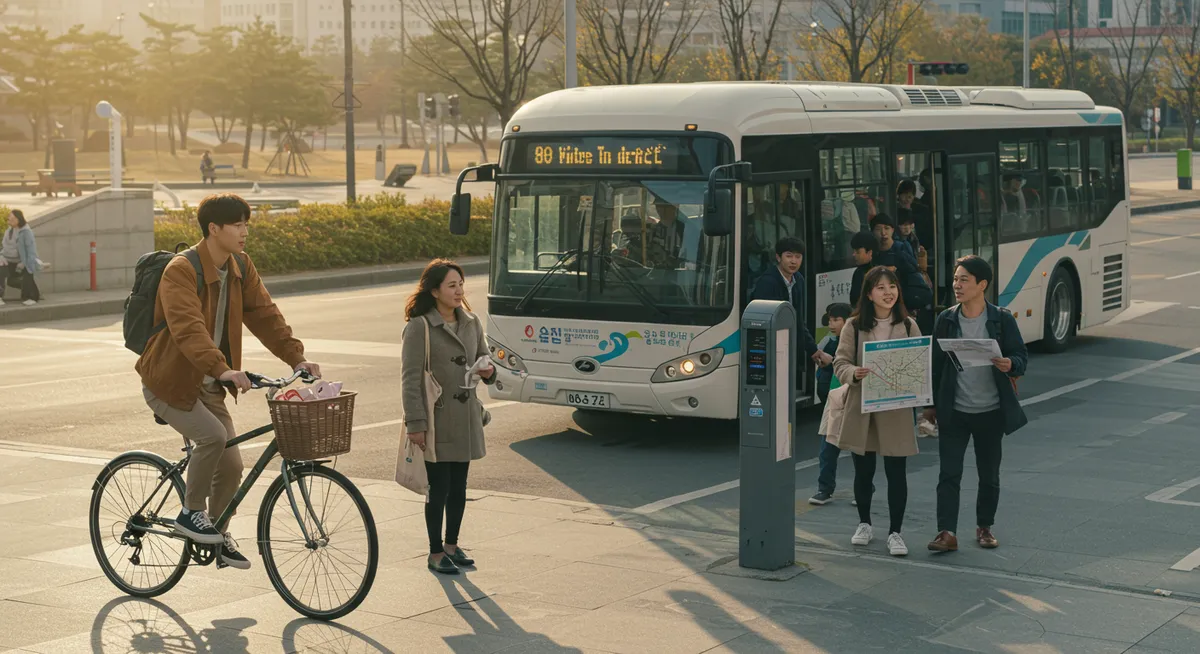
TL;DR: Daegu has three metro lines, a color-coded bus network, cheap taxis, and walkable downtown districts. Grab a T-Money card at any convenience store, download Naver Map, and you can reach every major attraction without renting a car. This 2026 guide covers fares, routes, apps, and insider tricks so you spend less time figuring out transport and more time enjoying the city.
Daegu is South Korea's fourth-largest city, yet it feels refreshingly compact compared to Seoul or Busan. With a modern metro system, an extensive bus network, affordable taxis, and increasingly bike-friendly infrastructure, getting around Daegu is straightforward even if you speak zero Korean. Whether you are spending a weekend downtown or planning a 5-day Daegu itinerary, understanding the local transport options will save you time and money. This updated 2026 guide breaks down every mode of transport, complete with current fares, recommended apps, and practical tips drawn from real on-the-ground experience.
The Daegu Metro: Your Main Way Around the City
Turn this guide into a personal route with our free Daegu itinerary planner.
The Daegu Metropolitan Transit Corporation operates three lines that form the backbone of public transport in the city. Line 1 (red) runs east to west, connecting Ansim to Seolhwa Myeonggok. Line 2 (green) runs north to south, linking Yeonam to Munyang. Line 3, a monorail that opened in 2015, loops through the city center and provides elevated views along the way. Together, these lines cover most major neighborhoods and tourist attractions.
Metro stations feature bilingual Korean-English signage, platform screen doors, and clear transfer indicators. Trains run from approximately 05:30 to midnight, with headways of 4 to 8 minutes during peak hours and up to 10 minutes off-peak. A single ride costs 1,400 KRW (about $1 USD) when paying with a T-Money card. If you are visiting for several days, the convenience of the metro makes it the default choice for moving between districts quickly.
Key stations to know: Jungangno (Line 1) sits in the heart of downtown Dongseongno shopping, Banwoldang is the main transfer hub where Lines 1 and 2 intersect, and Seomun Market station drops you right at Daegu's most famous traditional market. For travelers arriving by rail, Dongdaegu Station (Line 1) connects directly to the KTX high-speed network.
Daegu Buses: Reaching Every Corner of the City
While the metro handles the main corridors, Daegu's bus network fills in the gaps with over 100 routes that reach residential neighborhoods, university campuses, and suburban attractions the subway does not serve. Buses are color-coded by function: red express routes cover longer distances with fewer stops, blue trunk routes run along major arterials, green branch routes feed into metro stations, and yellow circular routes loop through specific districts.
The base fare in 2026 is 1,400 KRW with a T-Money card, and free transfers between bus and metro are available within 30 minutes. Buses run from roughly 05:00 to 23:00, with some late-night owl routes on weekends. Payment is tap-on, tap-off — touch your card when boarding and again when alighting so the system calculates the correct fare and registers your transfer.
The single most useful tool for bus travel is Naver Map or KakaoMap. Both apps display real-time bus positions, estimated arrival times, and walking directions to the nearest stop. Simply enter your destination, select "public transit," and follow the step-by-step instructions. Even if the route information is partly in Korean, the map interface is visual enough to follow without language skills. If you are visiting Daegu for the first time, relying on these apps removes almost all the confusion from bus travel.
Taxis and Ride-Hailing Apps
Taxis in Daegu are plentiful, metered, and affordable by international standards. The base fare starts at 4,800 KRW (raised from 4,000 KRW in late 2024), and a typical cross-city ride from Dongdaegu Station to Apsan Park costs around 8,000 to 12,000 KRW. A late-night surcharge of 20 percent applies between midnight and 04:00. Taxis accept both cash and T-Money cards, and many newer vehicles are also equipped with credit card readers.
For a smoother experience, use the Kakao T app to hail a taxi. You enter your pickup and drop-off points in the app, see the estimated fare before confirming, and can pay digitally. This eliminates the need to explain your destination in Korean. Kakao T also offers Kakao Black (premium vehicles) and Kakao Venti (large vans for groups), though standard taxis are perfectly comfortable for most trips. Uber is not widely available in Daegu, so Kakao T is the go-to ride-hailing platform.
Taxis are particularly useful for airport transfers, late-night returns from restaurants, or reaching trailheads outside the metro network. For groups of three or four, splitting a taxi fare often costs about the same per person as public transit, with significantly more convenience.
Getting to and from Daegu Airport
Daegu International Airport (TAE) is located just 10 kilometers east of the city center, making it one of the most conveniently located airports in South Korea. The simplest transfer option is a taxi, which takes 15 to 25 minutes and costs roughly 8,000 to 15,000 KRW depending on your downtown destination. There is a taxi stand directly outside the arrivals hall.
Public transit is also viable. Airport bus route 401 connects the airport to Dongdaegu Station and downtown in about 30 to 40 minutes. Alternatively, a short taxi or bus ride can get you to Ayanggyo Station on Metro Line 1, from which you can ride the metro to any connected station. If you are arriving on a domestic flight and traveling light, the bus-plus-metro combination is the most budget-friendly option at under 2,800 KRW total.
For travelers connecting through Dongdaegu Station on the KTX, note that the station has its own bus terminal and is a major regional hub. Direct buses run from Dongdaegu to destinations across Gyeongsang Province, making it easy to add day trips from Daegu to your schedule without renting a car.
Walking and Cycling in Daegu
Daegu's city center is surprisingly walkable. The Dongseongno shopping district, Seomun Market area, and the modern-history alley near Gyeongsang Gamyeong Park are all within comfortable walking distance of each other. During the best time to visit Daegu — spring (April to May) and autumn (September to November) — walking is arguably the most enjoyable way to explore, with mild temperatures and colorful foliage along the Sincheon River path.
Cycling infrastructure has improved steadily. The Sincheon River bike path runs nearly 20 kilometers through the city, connecting parks, cafes, and residential neighborhoods. Tasineum, Daegu's public bike-sharing system, offers short-term rentals via a mobile app starting at 1,000 KRW per hour. Docking stations are located near major metro stations and parks. Private rental shops near Apsan Park and Suseong Lake cater to visitors who want a full day of riding. Helmets are required by law in 2026, though enforcement is still inconsistent.
Essential Apps and the T-Money Card
Three tools will cover virtually all your transport needs in Daegu:
- T-Money card: Available at any convenience store (CU, GS25, 7-Eleven) for 2,500 KRW. Top up at the store or at metro station kiosks. Works on metro, bus, and most taxis. Refundable deposits and remaining balances can be cashed out at convenience stores when you leave.
- Naver Map: The most reliable navigation app in South Korea. Provides real-time public transit routing, walking directions, and street-level detail that Google Maps often lacks in Korea.
- Kakao T: The dominant ride-hailing app. Use it to call taxis, estimate fares, and pay digitally. Supports English interface.
If you prefer a physical reference, Daegu's tourist information centers at Dongdaegu Station and Jungangno metro station offer free English transit maps and can help plan routes.
Insider Tips for Navigating Daegu Efficiently
After multiple visits and extended stays, here are the practical tips that make the biggest difference. First, always check the last train time before heading out for dinner — the metro stops around midnight, and missing the last train means a taxi ride. Second, download offline maps in Naver Map before you arrive, so navigation works even in underground stations or areas with weak signal. Third, learn to read metro line colors rather than station names; color recognition is faster than scanning Korean text when you are in a rush.
If you plan to explore beyond the city, intercity buses from Dongdaegu Bus Terminal reach Gyeongju (1 hour), Busan (1.5 hours), and Andong (2 hours) frequently throughout the day. The KTX from Dongdaegu Station gets you to Seoul in under 2 hours. For a deeper look at nearby destinations, check our things to do in Daegu guide, which covers both in-city attractions and surrounding areas.
Finally, consider timing your visit around Daegu's accessibility. Summer (June to August) brings intense heat — Daegu is nicknamed "Africa of Korea" for its temperatures — making air-conditioned metro travel far more appealing than walking. Winter is cold but manageable with heated buses and metro cars. The shoulder seasons remain the sweet spot for mixed walking and transit exploration.
Frequently Asked Questions
Is Daegu easy to get around without speaking Korean?
How much does public transport cost in Daegu in 2026?
What is the best way to get from Daegu Airport to the city center?
Do I need a T-Money card or can I pay cash on buses and metro?
Is Daegu walkable?
Can I use Google Maps in Daegu?
Are there late-night transport options in Daegu?
Getting around Daegu is one of the easiest parts of visiting this underrated South Korean city. A T-Money card, Naver Map, and a basic understanding of the metro lines will carry you through nearly any itinerary. For first-time visitors, start with the metro to cover major distances, layer in buses for neighborhood exploration, and save taxis for late nights and airport runs. With transport sorted, you can focus on what matters — the food, the culture, and the unexpected discoveries that make Daegu worth the trip. If you are still deciding where to stay in Daegu, pick a hotel near Banwoldang or Jungangno station for the best transit access.