Daegu for First-Timers: The Complete 2026 Travel Guide
Planning your first trip to Daegu in 2026? This comprehensive guide covers top attractions, local food, neighborhoods, transport tips, and everything first-time visitors need to know about South Korea's fourth-largest city.
ItiMaker Team10 min read
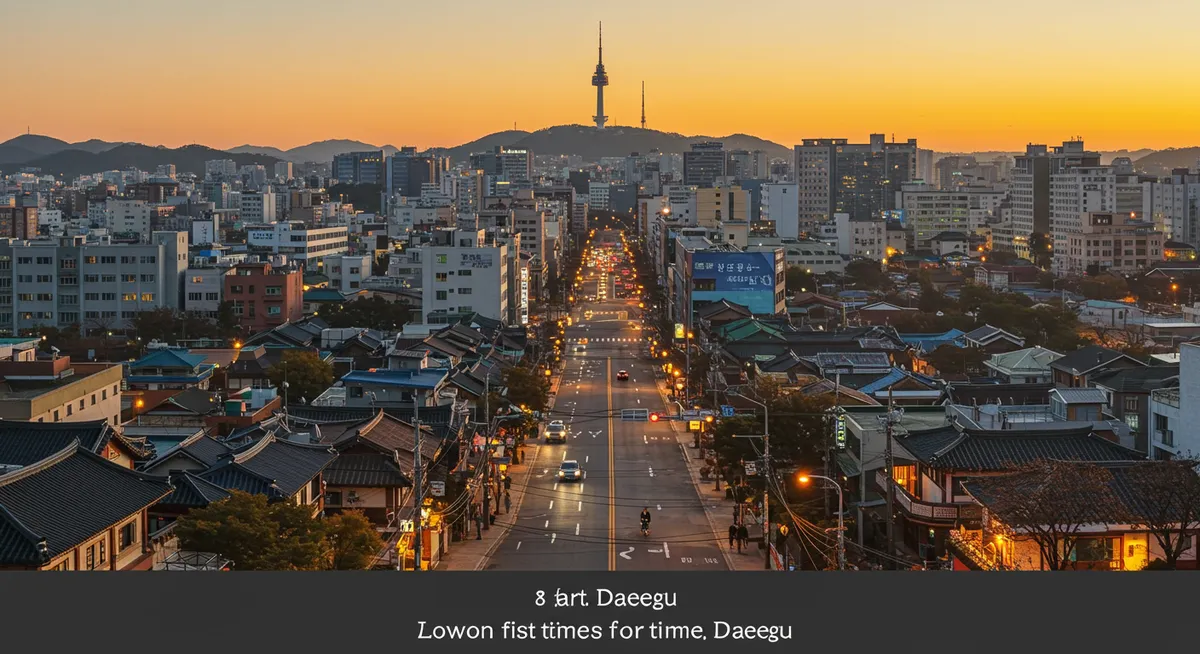
<p><strong>TL;DR:</strong> Daegu is South Korea's fourth-largest city and one of the best destinations for first-time visitors in 2026. Take the KTX from Seoul (under 2 hours), stay in Jung-gu for easy access to attractions, and budget 2-3 full days. Must-dos include Seomun Market, Apsan Park, Donghwasa Temple, and Kim Kwangseok Street. Spring (April-May) and autumn (September-October) offer the best weather. The city is safe, affordable, and far less crowded than Seoul or Busan.</p>
<h1>Daegu for First-Timers: The Complete 2026 Travel Guide</h1>
<aside class="affiliate-slot" data-nosnippet
data-affiliate-unit="experience_finder"
data-affiliate-provider="getyourguide"
data-affiliate-widget="getyourguide_city"
data-affiliate-format="widget"
data-affiliate-placement="primary"
data-affiliate-campaign="itimaker-com-unit-gcity-daegu-for-firsttimers"
data-affiliate-city="Daegu"
data-affiliate-location-id="136583"
style="min-height:400px">
<span class="affiliate-badge">Sponsored</span>
<div class="affiliate-skeleton" aria-hidden="true"></div>
<p class="affiliate-unit__loading" role="status">Loading live activities…</p>
<div class="affiliate-inner"><div
data-gyg-href="https://widget.getyourguide.com/default/city.frame"
data-gyg-location-id="136583"
data-gyg-locale-code="en-US"
data-gyg-widget="city"
data-gyg-partner-id="26CH4CT"
data-gyg-campaign="itimaker-com-unit-gcity-daegu-for-firsttimers"
data-gyg-cmp="itimaker-com-unit-gcity-daegu-for-firsttimers"
loading="lazy"></div></div>
</aside>
<p>If you are considering South Korea for your next trip but want something beyond the well-trodden paths of Seoul and Busan, Daegu deserves serious attention. Known locally as the "Apple City" for its premium apple orchards, this vibrant metropolis of 2.4 million people sits in a basin surrounded by scenic mountains, offering an authentic Korean experience without the tourist crowds. As someone who has explored South Korea extensively, I can confirm that <strong>Daegu for first-timers</strong> is an outstanding choice in 2026. The city rewards visitors with rich cultural heritage, distinctive regional cuisine, and a warm local hospitality that larger cities sometimes lack. This guide covers everything you need to plan a memorable first visit.</p>
<h2>How to Get to Daegu in 2026</h2>
<p>Getting to Daegu is straightforward from anywhere in South Korea. The KTX high-speed train from Seoul Station arrives at Dongdaegu Station in approximately 1 hour and 45 minutes, with departures every 10-20 minutes throughout the day. A one-way ticket costs around 43,500 KRW (roughly $33 USD). If you are flying into South Korea, Daegu International Airport (TAE) handles domestic flights from Jeju and a handful of international routes. From Busan, the KTX takes just 45 minutes, making Daegu an easy addition to any southern Korea itinerary. Dongdaegu Station is the main transport hub, directly connected to Subway Line 1, which takes you into the city center within 10 minutes. For a detailed breakdown of getting around once you arrive, see our <a href="/blog/how-to-get-around-daegu">complete Daegu transportation guide</a>.</p>
<aside class="affiliate-slot" data-nosnippet
data-affiliate-unit="experience_finder"
data-affiliate-provider="viator"
data-affiliate-widget="viator_widget"
data-affiliate-format="widget"
data-affiliate-placement="secondary"
data-affiliate-campaign="itimaker-com-unit-vauto-daegu-for-firsttimers"
data-affiliate-city="Daegu"
data-affiliate-location-id=""
style="min-height:600px">
<span class="affiliate-badge">Sponsored</span>
<div class="affiliate-skeleton" aria-hidden="true"></div>
<p class="affiliate-unit__loading" role="status">Loading live activities…</p>
<div class="affiliate-inner"><div
data-vi-partner-id="P00271059"
data-vi-widget-ref="W-d5dc59c4-3a04-417e-8a46-7be440461eba"
data-vi-search-term="Daegu"
data-vi-campaign="itimaker-com-unit-vauto-daegu-for-firsttimers"
data-campaign="itimaker-com-unit-vauto-daegu-for-firsttimers"></div></div>
</aside>
<h2>Best Neighborhoods and Where to Stay</h2>
<p>Choosing the right area to base yourself can make or break a first visit. For most first-timers, <strong>Jung-gu</strong> (the central district) is the clear winner. It puts you within walking distance of Dongseongno shopping street, Seomun Market, and the Daegu Heritage Trail, and the Banwoldang subway interchange connects you to everywhere else. Budget travelers will find clean guesthouses and hostels near the university areas, while mid-range and luxury options cluster around Dongdaegu Station. <strong>Suseong-gu</strong> offers a quieter alternative with the beautiful Suseong Lake, evening fountain shows, and lakeside cafes, ideal if you prefer a more relaxed atmosphere. <strong>Nam-gu</strong> is perfect for history and nature lovers, with proximity to Apsan Park. For detailed hotel recommendations and neighborhood comparisons, check our guide on <a href="/blog/where-to-stay-in-daegu">where to stay in Daegu</a>.</p>
<aside class="affiliate-slot" data-nosnippet
data-affiliate-unit="experience_finder"
data-affiliate-provider="getyourguide"
data-affiliate-widget="getyourguide_activities"
data-affiliate-format="widget"
data-affiliate-placement="tertiary"
data-affiliate-campaign="itimaker-com-unit-gact-daegu-for-firsttimers"
data-affiliate-city="Daegu"
data-affiliate-location-id="136583"
style="min-height:420px">
<span class="affiliate-badge">Sponsored</span>
<div class="affiliate-skeleton" aria-hidden="true"></div>
<p class="affiliate-unit__loading" role="status">Loading live activities…</p>
<div class="affiliate-inner"><div
data-gyg-href="https://widget.getyourguide.com/default/activities.frame"
data-gyg-location-id="136583"
data-gyg-locale-code="en-US"
data-gyg-widget="activities"
data-gyg-partner-id="26CH4CT"
data-gyg-campaign="itimaker-com-unit-gact-daegu-for-firsttimers"
data-gyg-cmp="itimaker-com-unit-gact-daegu-for-firsttimers" data-gyg-number-of-items="4"
loading="lazy"></div></div>
</aside>
<h2>Top Attractions Every First-Timer Should Visit</h2>
<p>Daegu packs a surprising amount of variety into a compact, walkable core. Here are the highlights no first-time visitor should miss:</p>
<ul>
<li><strong>Seomun Market:</strong> One of Korea's oldest and largest traditional markets, dating back over 350 years. Browse hundreds of stalls selling street food, textiles, and crafts during the day, then return for the famous Seomun Night Market on weekends when live music and illuminated food stalls transform the space.</li>
<li><strong>Apsan Park:</strong> Take the cable car or hike to the summit for sweeping panoramic views of the entire Daegu basin. The park also houses the Nakdonggang Victory Memorial Hall, offering insight into Korean War history. Sunset visits are particularly spectacular.</li>
<li><strong>Donghwasa Temple:</strong> Founded in 493 AD on the southern slopes of Palgongsan Mountain, this Buddhist temple complex features the striking 33-meter Tongil Daebul Buddha statue, a symbol of hope for Korean reunification. The forested mountain setting provides a peaceful escape from the city.</li>
<li><strong>Kim Kwangseok Street:</strong> A 350-meter mural alley dedicated to the beloved Korean folk singer. The colorful street art, busking performances, and quirky cafes make it one of Daegu's most photogenic spots and a fixture on Korea's top-100 attractions list.</li>
<li><strong>E-World and 83 Tower:</strong> Daegu's amusement park offers rides, seasonal festivals, and the 83 Tower observation deck with 360-degree city views. The Saturday fireworks shows are a local favorite.</li>
<li><strong>Suseong Lake:</strong> Created during the Japanese colonial period, this urban lake features walking trails, paddle boats, and a musical fountain show in the evenings. The surrounding cafes and restaurants make it a popular spot for relaxing after a day of sightseeing.</li>
<li><strong>Daegu Heritage Trail:</strong> A self-guided walking route connecting early-1900s missionary schools, churches, and colonial-era architecture in the old city center, perfect for history enthusiasts.</li>
</ul>
<p>For an even deeper dive into activities, browse our full list of <a href="/blog/things-to-do-in-daegu">things to do in Daegu</a>.</p>
<h2>What to Eat: Daegu's Signature Food Scene</h2>
<p>Daegu has one of the most distinctive regional food cultures in South Korea, and eating your way through the city is half the fun of visiting. The dishes you absolutely must try include:</p>
<ul>
<li><strong>Makchang (grilled pork intestines):</strong> Daegu's most iconic dish. Head to Anjirang Gopchang Alley, an entire street of restaurants dedicated to this smoky, savory specialty. The alley comes alive at night and the competition between restaurants means consistently excellent quality.</li>
<li><strong>Napjak Mandu (flat dumplings):</strong> Unlike the puffy dumplings found elsewhere in Korea, Daegu's version is pressed flat and pan-fried to a golden crisp. Find the best versions at Seomun Market.</li>
<li><strong>Ttaro Gukbap (separated rice soup):</strong> A hearty beef soup served with the rice on the side rather than in the broth, a uniquely Daegu tradition that lets you control the texture of each bite.</li>
<li><strong>Daegu Apple Desserts:</strong> Given the city's apple heritage, you will find apple-themed pastries, tarts, and drinks throughout local bakeries and cafes.</li>
</ul>
<p>Beyond these specialties, Daegu's cafe culture is booming in 2026. The neighborhoods around Keimyung University and Suseong Lake are filled with aesthetically designed coffee shops that rival anything in Seoul. Many smaller restaurants and market stalls are cash-only, so carry some Korean won alongside your card.</p>
<h2>Best Time to Visit Daegu</h2>
<p>Timing your visit matters because Daegu sits in a basin that amplifies seasonal temperatures. The ideal windows are <strong>spring (April to May)</strong> and <strong>autumn (late September to early November)</strong>, when temperatures hover between 15-25 degrees Celsius and clear skies prevail. Cherry blossoms typically arrive in late March to early April, painting the city in pink. Summers (June-August) are hot and humid, with temperatures regularly exceeding 35 degrees Celsius, earning Daegu its nickname as Korea's hottest city. Winters (December-February) are cold but less harsh than Seoul, and offer budget-friendly hotel rates with fewer tourists. For a month-by-month breakdown, consult our <a href="/blog/best-time-to-visit-daegu">best time to visit Daegu</a> guide.</p>
<h2>Planning Your Daegu Itinerary</h2>
<p>For first-timers, <strong>two to three full days</strong> is the sweet spot. This gives you enough time to explore the major attractions, sample the local food scene, and soak up the atmosphere without rushing. A suggested framework:</p>
<ul>
<li><strong>Day 1:</strong> Arrive at Dongdaegu Station, check in, explore Dongseongno and the Daegu Heritage Trail, evening at Seomun Night Market.</li>
<li><strong>Day 2:</strong> Morning hike or cable car at Apsan Park, afternoon at Kim Kwangseok Street and local cafes, evening at Anjirang Gopchang Alley.</li>
<li><strong>Day 3:</strong> Day trip to Donghwasa Temple and Palgongsan Mountain, return via Suseong Lake for the evening fountain show.</li>
</ul>
<p>If you have more time, extending to five days allows you to add day trips to Haeinsa Temple or Gyeongju. For a fully mapped-out schedule, see our <a href="/blog/daegu-3-day-itinerary">Daegu 3-day itinerary</a> or the expanded <a href="/blog/daegu-itinerary-5-days">5-day Daegu itinerary</a>.</p>
<h2>Practical Tips for First-Time Visitors in 2026</h2>
<p>These practical details will help your first Daegu trip go smoothly:</p>
<ul>
<li><strong>T-Money Card:</strong> Buy one at any convenience store upon arrival. It works on all subways, buses, and even some taxis, eliminating the need to buy individual tickets.</li>
<li><strong>Navigation Apps:</strong> Download Naver Map or KakaoMap before your trip. Google Maps has limited functionality in South Korea and will not provide accurate transit directions.</li>
<li><strong>Language:</strong> English signage exists at subway stations and major attractions, but is limited elsewhere. A translation app like Papago (by Naver) is invaluable for restaurant menus and conversations.</li>
<li><strong>Safety:</strong> Daegu is extremely safe, even late at night. Petty theft is rare, but keep normal precautions with your belongings in crowded markets.</li>
<li><strong>Budget:</strong> Daegu is notably cheaper than Seoul. Expect to spend 7,000-12,000 KRW per meal at local restaurants, 1,400 KRW per subway ride, and 40,000-100,000 KRW per night for decent accommodation.</li>
<li><strong>Cash vs. Card:</strong> While many restaurants accept cards, traditional markets and smaller shops often require cash. ATMs at convenience stores accept international cards.</li>
<li><strong>Comfortable Shoes:</strong> Between market wandering, temple visits, and mountain trails, you will walk significantly more than expected. Pack supportive footwear.</li>
<li><strong>Escalator Etiquette:</strong> Stand on the right, walk on the left, just like in Seoul.</li>
</ul>
<h2>Day Trips from Daegu</h2>
<p>Daegu's central location in the Gyeongsang region makes it an excellent base for exploring nearby attractions. Gyeongju, the ancient Silla dynasty capital, is just one hour away by bus and offers UNESCO World Heritage temples and royal tombs. Haeinsa Temple, home to the Tripitaka Koreana (over 80,000 woodblock Buddhist scriptures), is a 90-minute bus ride into the mountains. Even Busan is close enough for a day trip at just 45 minutes by KTX. For a complete rundown of options, visit our <a href="/blog/day-trips-from-daegu">day trips from Daegu</a> guide.</p>
<h2>Frequently Asked Questions</h2>
<div itemscope="" itemtype="https://schema.org/FAQPage">
<div class="faq-item" itemprop="mainEntity" itemscope="" itemtype="https://schema.org/Question">
<h3 itemprop="name">Is Daegu worth visiting for first-timers in 2026?</h3>
<div itemprop="acceptedAnswer" itemscope="" itemtype="https://schema.org/Answer">
<div itemprop="text">Absolutely. Daegu offers a more authentic and less overwhelming Korean experience than Seoul or Busan. Its excellent public transport, distinctive food scene, cultural attractions, and affordable prices make it one of the best destinations for first-time visitors to South Korea in 2026.</div>
</div>
</div>
<div class="faq-item" itemprop="mainEntity" itemscope="" itemtype="https://schema.org/Question">
<h3 itemprop="name">How many days do you need in Daegu?</h3>
<div itemprop="acceptedAnswer" itemscope="" itemtype="https://schema.org/Answer">
<div itemprop="text">Two to three full days is ideal for first-timers to cover the main attractions, markets, and food spots. If you want to include day trips to Gyeongju or Haeinsa Temple, plan for four to five days. A week or more allows a thorough exploration of the city and surrounding region.</div>
</div>
</div>
<div class="faq-item" itemprop="mainEntity" itemscope="" itemtype="https://schema.org/Question">
<h3 itemprop="name">Is Daegu safe for tourists?</h3>
<div itemprop="acceptedAnswer" itemscope="" itemtype="https://schema.org/Answer">
<div itemprop="text">Yes, Daegu is very safe for tourists. South Korea has one of the lowest crime rates in Asia, and Daegu is no exception. Streets feel safe even late at night, and violent crime targeting tourists is essentially nonexistent. Standard precautions with valuables in crowded markets are sufficient.</div>
</div>
</div>
<div class="faq-item" itemprop="mainEntity" itemscope="" itemtype="https://schema.org/Question">
<h3 itemprop="name">What food is Daegu famous for?</h3>
<div itemprop="acceptedAnswer" itemscope="" itemtype="https://schema.org/Answer">
<div itemprop="text">Daegu is most famous for makchang (grilled pork intestines), best enjoyed at Anjirang Gopchang Alley. Other signature dishes include napjak mandu (flat pan-fried dumplings), ttaro gukbap (separated rice soup), and apple-themed desserts reflecting the city's heritage as Korea's historic apple-growing region.</div>
</div>
</div>
<div class="faq-item" itemprop="mainEntity" itemscope="" itemtype="https://schema.org/Question">
<h3 itemprop="name">How do I get from Seoul to Daegu?</h3>
<div itemprop="acceptedAnswer" itemscope="" itemtype="https://schema.org/Answer">
<div itemprop="text">The fastest and most convenient option is the KTX high-speed train from Seoul Station to Dongdaegu Station, taking about 1 hour and 45 minutes with departures every 10-20 minutes. A one-way ticket costs approximately 43,500 KRW ($33 USD). Express buses are a cheaper alternative at around 20,000 KRW but take 3.5 to 4 hours.</div>
</div>
</div>
<div class="faq-item" itemprop="mainEntity" itemscope="" itemtype="https://schema.org/Question">
<h3 itemprop="name">What is the best time of year to visit Daegu?</h3>
<div itemprop="acceptedAnswer" itemscope="" itemtype="https://schema.org/Answer">
<div itemprop="text">Spring (April-May) and autumn (late September to early November) offer the most pleasant weather with mild temperatures and clear skies. Avoid summer if you dislike heat, as Daegu is one of South Korea's hottest cities with temperatures frequently exceeding 35 degrees Celsius from June through August.</div>
</div>
</div>
<div class="faq-item" itemprop="mainEntity" itemscope="" itemtype="https://schema.org/Question">
<h3 itemprop="name">Do I need to speak Korean to visit Daegu?</h3>
<div itemprop="acceptedAnswer" itemscope="" itemtype="https://schema.org/Answer">
<div itemprop="text">No, but basic Korean phrases help. English signage exists at subway stations and major tourist sites, but is limited in restaurants and shops. Download the Naver Papago translation app and KakaoMap for navigation before your trip to bridge any language gaps effectively.</div>
</div>
</div>
</div>
<p>A first trip to <strong>Daegu</strong> in 2026 promises an experience that is authentically Korean, endlessly flavorful, and refreshingly unhurried compared to South Korea's bigger cities. From the smoky grills of Anjirang Gopchang Alley to the misty trails of Palgongsan Mountain, this is a city that rewards curiosity. Whether you have a long weekend or a full week, Daegu will leave you with stories, flavors, and memories that the typical tourist trail simply cannot deliver. Start planning your visit today.</p>
Keep exploring
Make this guide part of your trip.
Turn the ideas you like into a personal day-by-day route, then edit every detail.
Build my itinerary