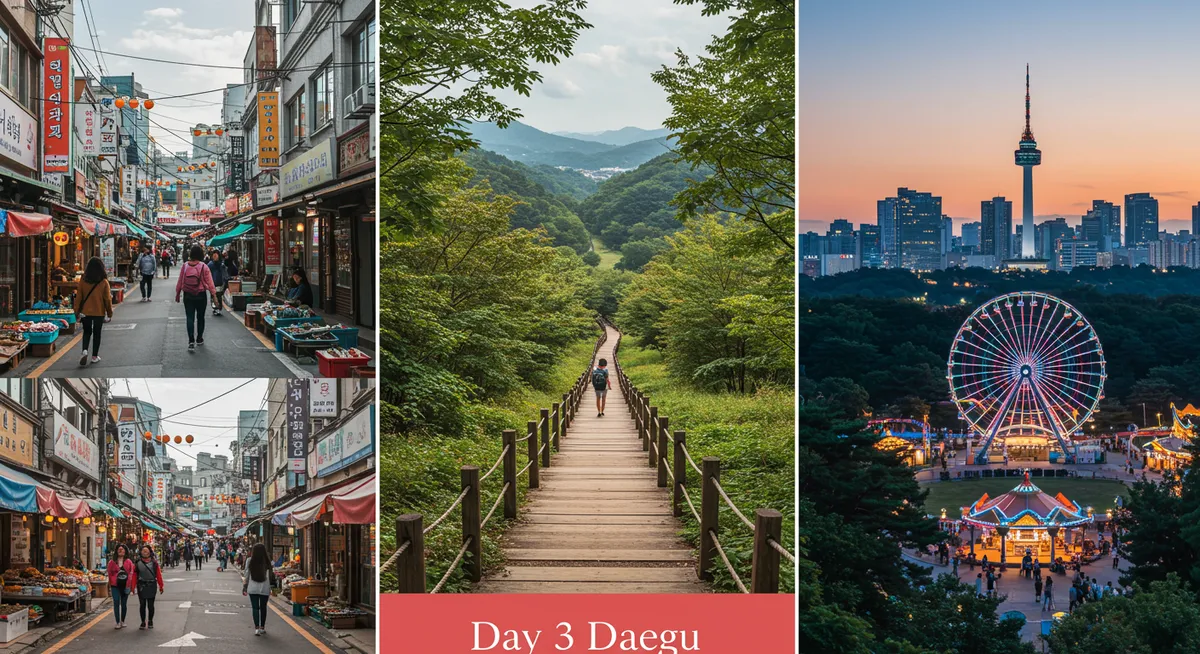
TL;DR: This Daegu 3 day itinerary covers the city's modern history streets, Apsan Park panoramas, Donghwasa Temple, Seomun Market street food, Kim Gwangseok-gil murals, and practical tips on getting around, where to stay, and what to eat. Three days is the sweet spot for experiencing Daegu's best without rushing.
Daegu is South Korea's fourth-largest city, yet it remains refreshingly under-the-radar compared to Seoul and Busan. Sitting in a basin surrounded by mountains, the city delivers a compelling mix of Joseon-era heritage, contemporary art, world-class street food, and hiking trails that reward you with sweeping valley views. Whether you are passing through on a larger Korea trip or dedicating a long weekend specifically to this city, a well-planned Daegu 3 day itinerary ensures you cover the highlights while leaving room for spontaneous discoveries. If you are visiting for the first time, our Daegu for first-timers guide pairs well with this itinerary.
Day 1: Modern History, Dongseongno & Night Markets
Turn this guide into a personal route with our free Daegu itinerary planner.
Start your Daegu 3 day itinerary by diving into the city's modern heritage. Head to the Daegu Modern History Streets in the Junggu district, where narrow alleys weave past preserved Japanese colonial-era buildings, old churches, and the poignant March 1st Movement Road that commemorates Korea's independence struggle. Allow roughly 90 minutes here — the area is compact but rich with plaques and photo ops.
From there, walk south to Dongseongno Street, Daegu's primary shopping and entertainment boulevard. This pedestrian-friendly stretch is lined with Korean cosmetics shops, fashion boutiques, and chain restaurants. Grab lunch at one of the jjim dak (braised chicken) restaurants near Dongseongno — this soy-braised, slightly sweet chicken dish originated in the nearby Anjirang alley and is a Daegu culinary icon you should not skip.
In the afternoon, visit the Gyeongsang-gamyeong Park, a tranquil pocket of greenery that once served as the provincial government complex during the Joseon Dynasty. The traditional pavilions and centuries-old zelkova trees make for a peaceful contrast to the surrounding urban energy. For dinner, head to Anjirang Gopchang Alley, where dozens of open-air restaurants grill gopchang and makchang (beef and pork intestines) over charcoal. The smoky, savory flavors paired with soju are a quintessential Daegu evening experience.
For a complete guide to navigating the city's buses and subway efficiently, see our post on how to get around Daegu.
Day 2: Apsan Park, Daegu Art Museum & Seomun Market
Day two of your Daegu 3 day itinerary balances nature, art, and the city's most iconic market. Start early at Apsan Park, a forested mountain on Daegu's southern edge. You can hike the moderate Apsan Summit trail (about 60 minutes up) or take the Apsan Cable Car for panoramic views of the city skyline framed by the Palgongsan mountain range to the north. The observatory deck at the top is particularly stunning at sunrise, but mid-morning light works beautifully for photos too.
After descending, take the subway to the Daegu Art Museum, one of Korea's top contemporary art institutions. The museum rotates exhibitions throughout the year — check their 2026 schedule before visiting — and the permanent collection features works by prominent Korean and international artists. Budget about 90 minutes here.
Spend the late afternoon and evening at Seomun Market, which has been operating since the late Joseon period and ranks among the country's three largest traditional markets. Navigate its four main buildings to find everything from hand-dyed textiles to herbal medicine. The real draw, however, is the Seomun Market Night Market (opens around 7 PM on most evenings), where vendor stalls serve 납작만두 nabjak mandu (flat dumplings), 칼국수 kalguksu (knife-cut noodle soup), hotteok, and grilled skewers. It is one of the best street food experiences in all of South Korea.
For extended trip ideas, check our Daegu 5-day itinerary to see what else you can add.
Day 3: Palgongsan, Donghwasa Temple & Kim Gwangseok-gil
On your final full day, venture outside the city center for a morning at Palgongsan Mountain and Donghwasa Temple. Located about 30 minutes north of downtown by bus, Donghwasa is an active Buddhist temple dating to 493 AD. The grounds are serene, shaded by ancient pines, and anchored by the 33-meter Tongil Daebul — a massive stone Buddha statue symbolizing Korean reunification. If time allows, hike the Gatbawi Trail from the temple toward the famous stone-hatted Buddha statue, believed to grant one wish to each visitor.
Return to the city for lunch, then stroll down Kim Gwangseok-gil, a mural-lined alley paying tribute to the beloved Korean folk singer Kim Gwangseok, who was born in Daegu. The street art installations, acoustic buskers, and cozy cafes create a wonderfully photogenic atmosphere. Nearby, Bangcheon Market offers a more local, less touristic market experience if you want a final taste of everyday Daegu life.
Wrap up your Daegu 3 day itinerary with a relaxing visit to Duryu Park and Daegu Tower (83 Tower). Ride the elevator to the observation deck for sunset views, then enjoy dinner at one of the restaurants in the tower complex or in the surrounding Duryu neighborhood. Browse our complete things to do in Daegu guide for additional activities to customize your final evening.
Where to Stay in Daegu
Choosing the right neighborhood makes a big difference in how smoothly your Daegu 3 day itinerary flows. Dongseongno / Junggu is the top pick for first-time visitors — it places you within walking distance of the modern history streets, shopping, and multiple subway stations. Budget travelers will find plentiful guesthouses and hostels here, while mid-range and luxury options cluster near Daegu Station and along the Suseong Lake area. For detailed neighborhood breakdowns and hotel recommendations, see our where to stay in Daegu guide.
Best Time to Visit Daegu
Daegu is famously one of the hottest cities in South Korea during summer, with temperatures regularly exceeding 35°C (95°F) in July and August. The ideal windows for a Daegu 3 day itinerary are spring (April–May) and autumn (September–November). Spring brings cherry blossoms to Apsan Park and Palgongsan, while autumn delivers vivid foliage across the mountain trails. Winter (December–February) is cold but dry, with smaller crowds and occasional snowfall adding charm to temple visits. For a deeper seasonal breakdown, read our best time to visit Daegu guide.
Getting to Daegu & Getting Around
Daegu is exceptionally well-connected. The KTX high-speed train from Seoul Station reaches Dongdaegu Station in about 1 hour 40 minutes, making it easy to slot into a broader South Korea trip. From Busan, the KTX takes just 45 minutes. Daegu also has a domestic airport with flights from Jeju.
Within the city, the two-line Daegu Metro covers most tourist areas efficiently. Pick up a T-Money card at any convenience store — it works on subways, buses, and even taxis. Most attractions on this itinerary are either directly on a subway line or a short bus ride away. For travelers planning connections to other Korean cities, our guides on day trips from Daegu and Busan 3-day itinerary are useful next reads.
Daegu Food Guide: What to Eat
No Daegu 3 day itinerary is complete without a deliberate food strategy. The city's culinary identity is distinct from Seoul and Busan, with several dishes you simply cannot find done as well anywhere else:
- Jjim dak (찜닭) — Soy-braised chicken with glass noodles and vegetables, originally from Anjirang Alley
- Makchang (막창) — Grilled pork intestines, smoky and chewy, best at Anjirang Gopchang Alley
- Nabjak mandu (납작만두) — Thin, crispy pan-fried dumplings unique to Daegu's markets
- Ttaro gukbap (따로국밥) — A Daegu-style rice and beef soup served with the rice separate from the broth
- Kalguksu (칼국수) — Hand-cut wheat noodles in anchovy broth, a Seomun Market staple
- Mungtiigi (뭉티기) — Raw beef served in chunky cuts rather than thin slices, a Daegu specialty
For a city-wide food exploration, pair this with our Daegu hidden gems guide, which covers lesser-known eateries off the tourist trail.
Budget Breakdown for 3 Days in Daegu (2026)
Daegu is significantly more affordable than Seoul. Here is a rough daily budget per person:
- Budget traveler: ₩60,000–80,000/day (~$45–60 USD) — guesthouse, street food, public transport
- Mid-range traveler: ₩120,000–160,000/day (~$90–120 USD) — 3-star hotel, sit-down restaurants, occasional taxi
- Comfort traveler: ₩250,000+/day (~$185+ USD) — 4-star hotel, upscale dining, private tours
Most museums and temples on this itinerary are free or under ₩5,000 admission. The Apsan Cable Car costs ₩9,000 round-trip (2026 pricing), and the Daegu Tower observation deck is ₩10,000.
Frequently Asked Questions
What are the must-try foods in Daegu?
Is 3 days enough for Daegu?
How do I get from Seoul to Daegu?
What is the best time of year to visit Daegu?
Is Daegu worth visiting compared to Seoul and Busan?
Can I use Daegu as a base for day trips?
A Daegu 3 day itinerary reveals a city that rewards curiosity — from the solemn history etched into its colonial-era streets to the joyful chaos of Seomun Market at night, from misty temple mornings on Palgongsan to sunset panoramas at 83 Tower. Daegu is not just a stopover between Seoul and Busan; it is a destination that deserves dedicated time. Use this guide as your framework, adjust based on season and personal interests, and prepare for one of South Korea's most underrated travel experiences in 2026.