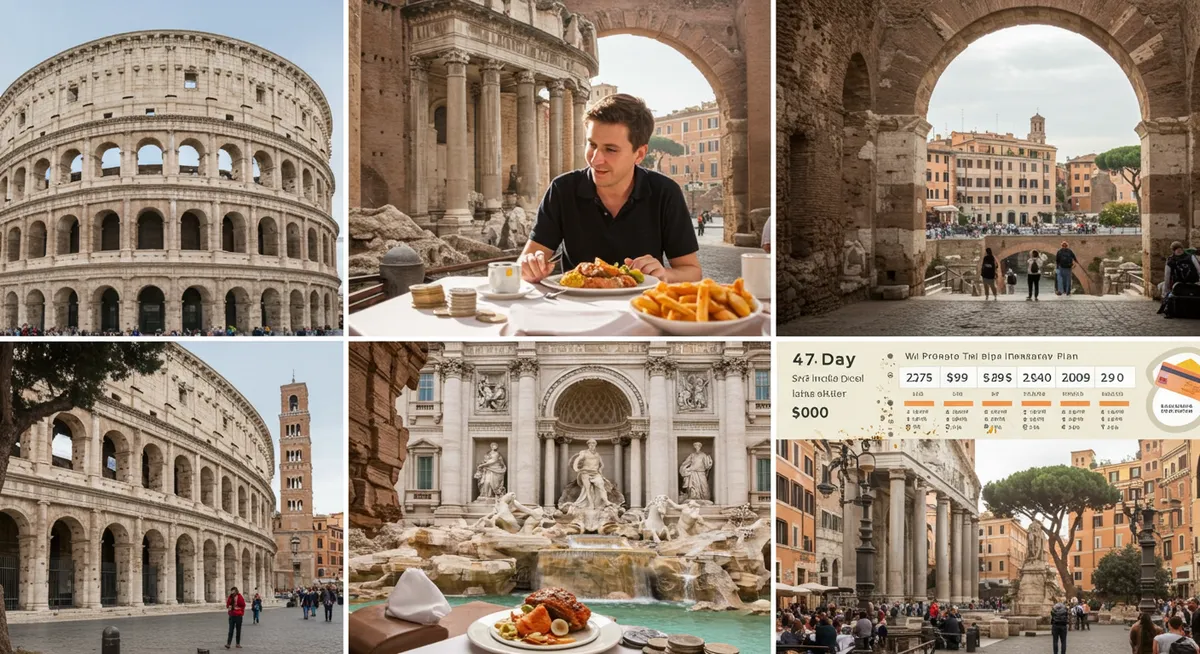
TL;DR: For 4 days in Rome in 2026, budget approximately €300–€400 per person on a tight budget, €560–€810 for a mid-range trip, or €1,000+ for a luxury experience. These figures cover accommodation, food, attractions, and local transport but exclude international flights. The biggest variables are where you sleep and where you eat. For a complete day-by-day plan, see our Rome itinerary for 4 days.
Planning a trip to Rome and wondering how much spending money for 4 days in Rome you actually need? Whether you are a backpacker stretching every euro or a couple looking for a comfortable getaway, this guide breaks down real 2026 costs across every major category so you can set a realistic budget before you arrive. Rome rewards the prepared traveler: knowing where to save and where to splurge means you can enjoy ancient ruins, world-class pasta, and Vatican masterpieces without stressing over your wallet. For more trip planning tools and itinerary templates, visit ItiMaker.
Quick Budget Summary Table for 4 Days in Rome
Turn this guide into a personal route with our free Rome itinerary planner.
Before diving into the details, here is a quick-reference table showing estimated spending money for 4 days in Rome across three travel styles. All figures are per person in euros and reflect 2026 prices.
| Category | Budget (€) | Mid-Range (€) | Luxury (€) |
|---|---|---|---|
| Accommodation (4 nights) | 100–160 | 320–560 | 800–1,200 |
| Food & Drink | 120–160 | 200–320 | 500–800 |
| Attractions & Tours | 40–60 | 80–140 | 200–400 |
| Local Transport | 15–25 | 30–50 | 80–150 |
| Miscellaneous | 25–40 | 50–80 | 100–200 |
| 4-Day Total | 300–445 | 680–1,150 | 1,680–2,750 |
The ranges above account for seasonal variations — summer and Easter week push prices higher, while January through March and November offer better value. Now let us break each category down in detail.
Accommodation Costs for 4 Nights in Rome
Accommodation typically accounts for 35–45% of your total spending money for 4 days in Rome. In 2026, expect these nightly rates per person:
- Hostels: €25–€40 per night for a dorm bed. Popular areas include Termini and Trastevere. Many hostels include a basic breakfast.
- Budget hotels and B&Bs: €50–€80 per night for a double room (€25–€40 per person sharing). Properties in Monti or San Lorenzo offer good value within walking distance of key sights.
- Mid-range hotels: €80–€140 per night for a double. Hotels near the Spanish Steps or Piazza Navona fall into this bracket during shoulder season.
- Luxury hotels: €200–€350+ per night. Five-star properties near Via Veneto or the Pantheon command premium rates, especially during peak season.
City tax: Rome charges a tourist tax of €3–€7 per person per night depending on accommodation type and star rating. For 4 nights, add €12–€28 to your total. This tax is paid directly at the hotel and is often not included in online booking prices.
For family-friendly options, see our guide to kid-friendly hotels in Rome. If you prefer to stay centrally, our where to stay in Rome guide covers the best neighborhoods by budget.
Food and Dining Budget in Rome
Italian food is one of Rome's greatest draws, and the good news is that eating well does not require spending a fortune. Here is what meals typically cost in 2026:
Breakfast (€3–€8 per day)
Romans traditionally eat a light breakfast at a bar: a cornetto (croissant) and cappuccino for €3–€5. Many hotels include breakfast, which saves €4–€8 per day. If your accommodation does not include it, local bakeries and cafes offer affordable pastries.
Lunch (€8–€20 per day)
The best budget strategy is pizza al taglio (pizza by the slice), which runs €3–€6 for a generous portion. A sit-down trattoria lunch with primo and water costs €12–€18. Alternatively, grab a panino or supplì (fried rice ball) from a street vendor for €3.50–€5.
Dinner (€15–€45 per day)
A casual trattoria dinner with pasta, house wine, and water averages €20–€35 per person. Upscale restaurants in the centro storico charge €45–€80+. To save money, order the house wine (vino della casa) instead of bottled, and avoid restaurants with picture menus directly facing major monuments — walk two or three blocks away for better quality at lower prices.
Snacks and Gelato (€5–€10 per day)
Budget €2–€4 for authentic gelato (avoid places with unnaturally bright, piled-high displays — they use artificial ingredients). Espresso costs €1–€1.50 at the bar. Rome's 2,500+ public water fountains (nasoni) provide free, clean drinking water, saving you €3–€5 per day on bottled water.
Total 4-day food budget: €120–€160 (budget), €200–€320 (mid-range), €500+ (luxury with fine dining). For a deeper culinary experience, check out our guide to the best food tours in Rome.
Attraction and Sightseeing Costs
Rome offers an extraordinary mix of free and ticketed attractions. Here are the major 2026 entrance fees to factor into your spending money for 4 days in Rome:
Paid Attractions
- Colosseum, Roman Forum & Palatine Hill (combined ticket): €18–€22. The full-experience ticket with arena floor access costs €24. EU citizens aged 18–25 pay a reduced fee; under-18s enter free.
- Vatican Museums & Sistine Chapel: €20–€25. Book online to skip queues (€4 booking fee). Free entry on the last Sunday of each month (arrive before 8 AM to avoid massive lines).
- St. Peter's Basilica dome: €8 (elevator + stairs) or €6 (stairs only). The basilica itself is free.
- Borghese Gallery: €15. Reservations are mandatory and sell out weeks ahead.
- Castel Sant'Angelo: €17.
- Pantheon: €5 (entry fee introduced in 2023).
Free Attractions
- Trevi Fountain, Spanish Steps, Piazza Navona, and all public piazzas
- St. Peter's Basilica (ground level)
- Churches including Santa Maria in Trastevere, San Clemente, and Sant'Ignazio
- Roman parks including Villa Borghese gardens and Giardino degli Aranci
- The first Sunday of each month: state museums offer free admission
City Passes Worth Considering
The Roma Pass (48-hour, €33 / 72-hour, €53) includes free entry to 1–2 attractions, discounted entry to others, and unlimited public transport. It pays for itself if you visit the Colosseum and one other paid site while using metro/bus. The Omnia Vatican & Rome Card (€149) adds Vatican Museums skip-the-line access and hop-on-hop-off bus — worthwhile only if you plan to see everything in a compressed schedule.
Plan your sightseeing route with our first-time 4-day Rome itinerary, or browse free things to do in Rome if you want to minimize entrance fees.
Transportation Costs in Rome
Rome is a walkable city — most major sights are within a 30–40 minute walk of each other. But public transport helps on longer stretches or hot days.
- Single metro/bus ticket: €1.50 (valid 100 minutes, including transfers)
- 24-hour pass: €7
- 48-hour pass: €12.50
- 72-hour pass: €18
- Airport transfer (Fiumicino): Leonardo Express train €14 one-way; Terravision/SIT bus €5–€7 one-way
- Airport transfer (Ciampino): Bus shuttle €5–€7 one-way
- Taxis: Fixed fare Fiumicino–city center €50; within the city, short rides €8–€15
Money-saving tip: Walk as much as possible. Rome's beauty reveals itself on foot — you will discover hidden piazzas, artisan gelaterias, and charming streets that no bus route covers. Most travelers only need 3–5 single tickets per day at most. A 48-hour or 72-hour pass saves money if you plan to use buses or metro frequently.
If you are considering day trips, read our guides on day trips from Rome to Florence and day trips from Rome to Naples.
Money-Saving Tips for Rome in 2026
These practical strategies can reduce your spending money for 4 days in Rome by 20–30%:
- Eat away from monuments. Restaurants within eyeshot of the Colosseum or Trevi Fountain charge 30–50% more for lower-quality food. Walk 3–4 blocks in any direction for authentic trattorias at local prices.
- Use the nasoni. Rome has over 2,500 free public drinking fountains with safe, fresh water. Carry a refillable bottle and skip buying plastic bottles entirely.
- Visit museums on free days. State museums are free on the first Sunday of each month. The Vatican Museums are free on the last Sunday.
- Book attraction tickets online. Skip-the-line tickets for the Colosseum and Vatican save hours of waiting and sometimes cost the same as walk-up prices.
- Shop at local supermarkets. A Conad or Carrefour Express carries wine from €3, sandwich ingredients for under €5, and snacks at a fraction of restaurant prices.
- Avoid the sit-down surcharge. In Italian cafes, drinking your espresso standing at the bar costs €1–€1.50; sitting at a table can double or triple the price.
- Travel in shoulder season. March, April (excluding Easter), October, and November offer pleasant weather with 20–40% lower accommodation rates than June through August.
- Use contactless payments. Italy widely accepts cards, but keep €50–€100 in cash for small purchases, street vendors, and the rare cash-only establishment.
Sample 4-Day Budget Breakdowns
To make the numbers concrete, here are three real-world examples of how much spending money for 4 days in Rome different travelers might need in 2026:
Solo Backpacker (Budget: ~€340)
- Hostel dorm: 4 nights × €30 = €120
- Food: €35/day × 4 = €140 (street food, markets, one trattoria dinner)
- Attractions: Colosseum + free sights = €45
- Transport: Airport bus + 8 single tickets = €22
- City tax + misc: €15
Couple, Mid-Range (Budget: ~€720 per person)
- 3-star hotel: 4 nights × €110 = €440 (€220/person)
- Food: €65/day × 4 = €260/person (cafe breakfast, trattoria lunch & dinner)
- Attractions: Roma Pass 72h + Borghese Gallery = €68/person
- Transport: 72-hour pass + airport Leonardo Express = €32/person
- City tax + gelato + souvenirs: €40/person
Luxury Traveler (Budget: ~€1,800 per person)
- 4-star boutique hotel: 4 nights × €280 = €1,120 (€560/person)
- Food: €150/day × 4 = €600/person (fine dining, wine bars)
- Attractions: Private guided tours + skip-the-line everything = €300/person
- Transport: Private airport transfer + taxis = €120/person
- City tax + shopping + experiences: €200/person
For a detailed cost breakdown specific to a 4-day trip, also see our 4-day trip to Rome cost guide. If you have 5 days, our 5 days in Rome budget article extends these numbers.
Frequently Asked Questions
How much spending money do I need per day in Rome in 2026?
Is €500 enough for 4 days in Rome?
Is Rome expensive compared to other European cities?
Should I bring cash or use cards in Rome?
What is the cheapest month to visit Rome?
Do I need to tip in Rome?
Is the Roma Pass worth it in 2026?
Determining how much spending money for 4 days in Rome ultimately depends on your travel style, the season you visit, and how much you embrace local habits like standing at the bar for espresso and drinking from the nasoni. With careful planning and the strategies outlined above, even budget travelers can experience the Eternal City's full splendor in 2026. For complete day-by-day planning, explore our 4-day Rome itinerary and start building your trip with ItiMaker.