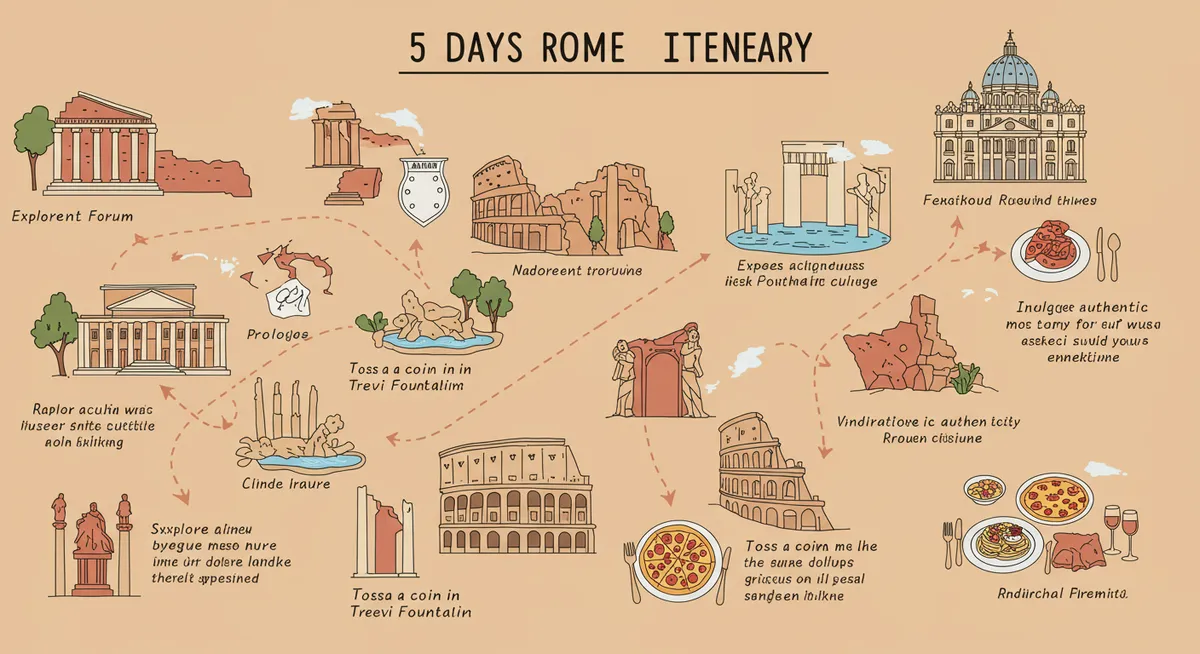
TL;DR: Five days in Rome lets you cover Ancient Rome, Vatican City, Baroque piazzas, Trastevere, the Appian Way, and a relaxed final morning of markets and gelato. Book Colosseum and Vatican tickets weeks ahead, wear comfortable shoes, and budget roughly 60-120 EUR per person per day excluding accommodation. This 2026 guide includes a day-by-day plan, money-saving tips, neighborhood restaurant picks, and answers to the most common traveler questions.
Rome rewards the traveler who plans ahead but leaves room for serendipity. With five full days, you can explore every major era of the city — from the gladiatorial arenas of antiquity to the Renaissance masterworks of the Vatican and the vibrant street life of modern Roman neighborhoods. This rome itinerary for 5 days balances must-see monuments with authentic local experiences, so you return home feeling like you truly lived in the Eternal City rather than just photographed it. Whether you are visiting Rome for the first time or returning after years away, this 2026 guide has you covered.
Day 1: Ancient Rome — Colosseum, Roman Forum, and Palatine Hill
Turn this guide into a personal route with our free Rome itinerary planner.
Start your rome itinerary for 5 days where the empire itself began. Arrive at the Colosseum by 8:30 AM, when the morning light hits the travertine arches and the crowds are still thin. In 2026, timed-entry tickets remain mandatory — book at least two weeks in advance through the official Parco Colosseo website or a licensed tour operator. The combined ticket covers the Colosseum, Roman Forum, and Palatine Hill, and is valid for two consecutive days.
After the Colosseum, walk through the Arch of Constantine and descend into the Roman Forum. Give yourself at least 90 minutes here: the Temple of Saturn, the House of the Vestal Virgins, and the Via Sacra all deserve close attention. Then climb Palatine Hill for sweeping views of Circus Maximus and the Forum below — one of the best panoramic spots in the entire city.
For lunch, skip the tourist traps on Via dei Fori Imperiali and walk ten minutes south to the Celio neighborhood. Trattorias here serve honest Roman cuisine at local prices. In the afternoon, stroll to Piazza Venezia and the Vittoriano monument (free entry, rooftop elevator costs 7 EUR), then continue to Piazza Navona for Bernini's Fountain of the Four Rivers as the golden hour begins. If you are wondering how many days you need to see Rome, this first day alone proves five is the sweet spot.
Day 2: Vatican City — Museums, Sistine Chapel, and St. Peter's Basilica
Dedicate your entire second day to Vatican City. The Vatican Museums contain over 70,000 works spanning two millennia, so an early start is essential. Gates open at 8:00 AM; aim to be in line by 7:30 AM or book a skip-the-line ticket. Follow the signed route through the Gallery of Maps, the Raphael Rooms, and finally the Sistine Chapel, where Michelangelo's ceiling fresco is even more overwhelming in person than any photograph suggests.
Exit the Sistine Chapel directly into St. Peter's Basilica (dress code enforced: shoulders and knees covered). Climb the dome — 551 steps if you skip the elevator for the first section — for the best aerial view in Rome. Budget about four hours total for the museums and basilica.
After lunch near Borgo Pio, cross the Tiber to Castel Sant'Angelo. Originally Emperor Hadrian's mausoleum, the castle offers rooftop views of St. Peter's dome that are especially dramatic at sunset. End the evening with dinner in the Prati neighborhood, where upscale trattorias are plentiful yet reasonably priced compared to the tourist center.
Day 3: Baroque Rome — Trevi Fountain, Pantheon, Spanish Steps, and Borghese Gallery
Day three of this rome itinerary for 5 days threads together the city's most photogenic Baroque and Renaissance landmarks. Start at the Trevi Fountain before 8:00 AM — the piazza is almost empty at this hour, and you can toss your coin in relative peace. From Trevi, it is a five-minute walk to the Pantheon, the best-preserved ancient Roman building in the world. Entry has been ticketed since 2023 (5 EUR in 2026); the oculus flooding the interior with natural light remains one of Rome's most magical sights.
Continue north to the Spanish Steps and the Trinita dei Monti church at the top. From here, enter the Villa Borghese gardens and make your way to the Borghese Gallery. Reservations are mandatory and sessions last two hours — book well in advance. Bernini's Apollo and Daphne and Caravaggio's Boy with a Basket of Fruit are highlights you will remember long after the trip.
In the late afternoon, descend to Piazza del Popolo for a classic Roman aperitivo. This expansive square connects three major streets and is the perfect place to people-watch as the city shifts into evening mode. For dinner, explore the side streets around Via del Corso for trattorias favored by locals. If you are curious about free things to do in Rome, many churches along this route — including Santa Maria del Popolo with its Caravaggio paintings — charge no admission.
Day 4: Trastevere, Jewish Ghetto, and the Appian Way
Your fourth day blends ancient underground history with Rome's most atmospheric neighborhoods. Begin with a morning ride or walk along the Appian Way (Via Appia Antica), one of the earliest Roman roads, dating to 312 BC. Rent a bicycle at the park entrance or join a guided tour that includes entry to the Catacombs of San Callisto or San Sebastiano — underground burial networks stretching for kilometers beneath the surface. This is a humbling, once-in-a-lifetime experience that most short itineraries skip.
Return to the city center by early afternoon and cross the Tiber into Trastevere. Cobblestone lanes draped in ivy, artisan workshops, and some of Rome's best street food define this neighborhood. Visit the Basilica of Santa Maria in Trastevere — one of the oldest churches in Rome — then get lost in the side streets. For lunch, try supplì (fried rice balls) from a street vendor and a plate of cacio e pepe at a neighborhood trattoria.
In the late afternoon, walk south to the Jewish Ghetto, one of Rome's most historically significant quarters. Sample deep-fried artichokes (carciofi alla giudia), a local specialty, and visit the Great Synagogue. End the day with dinner in Trastevere — the neighborhood truly comes alive after dark, with live music spilling out of bars and restaurants. For families considering a similar trip, our Rome itinerary with kids adapts many of these stops for younger travelers.
Day 5: Markets, Hidden Gems, and a Roman Farewell
Use your final day to soak up everyday Roman life and revisit any favorite spots. Start at Campo de' Fiori, where the morning market has been running since 1869. Browse stalls selling fresh produce, spices, handmade pasta, and local cheeses — perfect for edible souvenirs. From there, walk to the nearby Largo di Torre Argentina, a sunken archaeological site where Julius Caesar was assassinated and where a colony of rescue cats now lives among the ruins.
If you have not yet visited the Aventine Hill, now is the time. Peer through the keyhole of the Knights of Malta gate for a perfectly framed view of St. Peter's dome, then enjoy the quiet Orange Garden (Giardino degli Aranci) overlooking the Tiber. This hidden gem rarely appears in rushed itineraries but is a favorite among repeat visitors.
Spend your remaining hours on a final gelato crawl — Fatamorgana and Giolitti are perennial favorites — or revisit a piazza that captured your heart. If your flight is in the evening, confirm your transfer to Fiumicino (FCO) or Ciampino (CIA) the night before; the Leonardo Express train from Termini to FCO takes 32 minutes and costs 14 EUR in 2026. Those considering extending their trip may want to explore easy day trips from Rome or a longer 10-day Italy itinerary starting in Milan.
Budget Breakdown: How Much Does 5 Days in Rome Cost in 2026?
Understanding costs helps you plan smarter. Here is a realistic per-person daily budget for Rome in 2026:
- Accommodation: 60-150 EUR/night (hostel to mid-range hotel; book in Trastevere or Monti for the best value)
- Food: 30-60 EUR/day (espresso 1.20 EUR standing at the bar, lunch 12-18 EUR, dinner 20-35 EUR)
- Transport: 7 EUR for a 24-hour transit pass or 18 EUR for a 72-hour pass; taxis from Fiumicino ~50 EUR flat rate
- Attractions: Colosseum combo 18 EUR, Vatican Museums 17 EUR, Borghese Gallery 15 EUR, Pantheon 5 EUR
- Total estimate: 300-600 EUR for 5 days (excluding flights and accommodation)
For a detailed cost breakdown, see our dedicated guide on 5 days in Rome on a budget.
Getting Around Rome in 5 Days
Rome's historic center is compact enough to walk between most major sights — expect 15,000 to 20,000 steps per day. The Metro has three lines (A, B, and C); Line A connects the Vatican (Ottaviano) to the Spanish Steps (Spagna) and Termini. Buses fill the gaps, though they can be unreliable during peak hours. The Roma Pass (52 EUR for 72 hours in 2026) includes unlimited transit and free entry to one or two museums — worth it if you plan to use public transport frequently. Taxis are metered and relatively affordable for short hops, especially when splitting fares. Ride-hailing apps like Free Now also operate in Rome.
Frequently Asked Questions
What is the best time of year to visit Rome for 5 days?
Is 5 days enough to see Rome?
How do I get from Rome's airports to the city center?
Do I need to book attraction tickets in advance for Rome in 2026?
What are the best neighborhoods to stay in Rome for 5 days?
What should I eat in Rome?
Five days in Rome strikes the perfect balance between thorough sightseeing and the kind of slow, unplanned wandering that makes a trip truly memorable. Use this rome itinerary for 5 days as your framework, but leave space for the detours — the hidden courtyard, the neighborhood trattoria with no English menu, the sunset you stumble upon from an unexpected bridge. Rome has been welcoming travelers for nearly three thousand years, and in 2026 it remains one of the most rewarding cities on earth to explore. Start planning your trip with ItiMaker and turn this itinerary into your own personalized adventure.