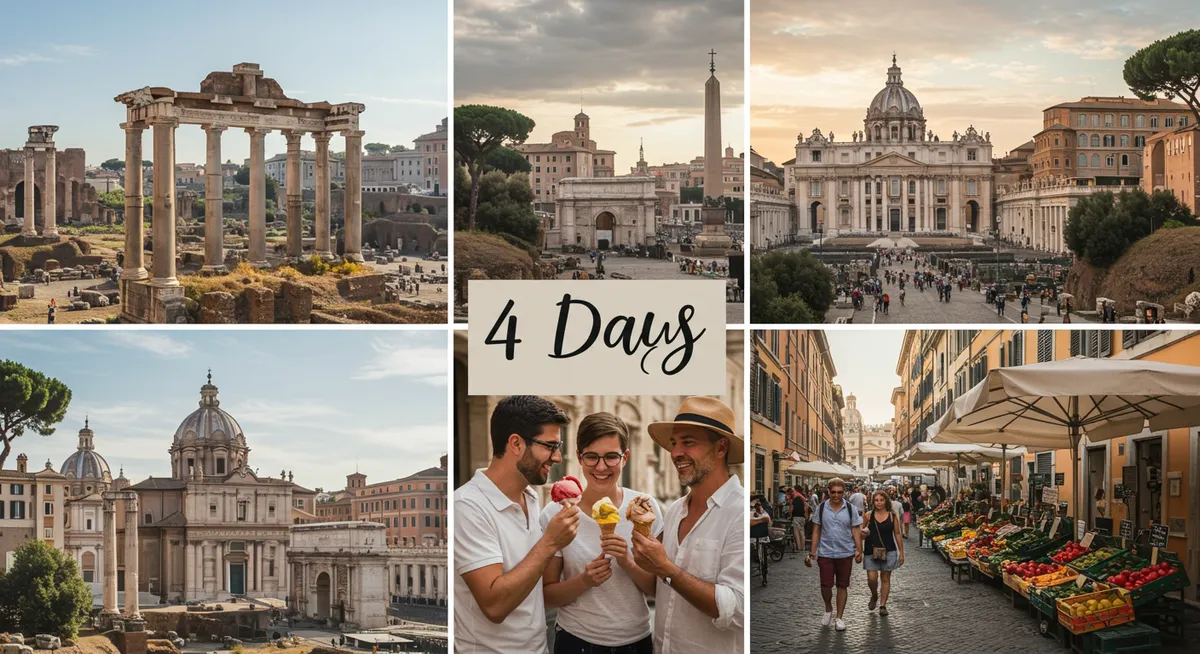
Four days in Rome strikes the ideal balance between thoroughness and pace. You get enough time to explore the ancient ruins, marvel at Renaissance masterpieces in the Vatican, wander through charming neighborhoods, and still have room for spontaneous gelato stops and long Italian lunches. Having visited Rome multiple times across different seasons, this Rome itinerary 4 days guide for 2026 reflects hard-won lessons on timing, ticket strategy, and the hidden corners most visitors miss. Whether you are a first-timer or returning for a deeper look, this day-by-day plan will help you make the most of every hour in the Eternal City. For more trip ideas, use ITI Maker to build a personalized travel plan.
Day 1: Ancient Rome — Colosseum, Roman Forum & Palatine Hill
Turn this guide into a personal route with our free Rome itinerary planner.
Start your 4-day Rome itinerary where the city itself began. Arrive at the Colosseum early (aim for the 8:30 AM opening) to beat the crowds that build from mid-morning. In 2026, combined tickets for the Colosseum, Roman Forum, and Palatine Hill cost around EUR 18 and should be booked online at least two weeks in advance since they sell out regularly. Walking through the Colosseum's underground chambers and arena floor brings the gladiatorial era to life in a way photos simply cannot capture.
From the Colosseum, cross directly into the Roman Forum, the political and religious heart of ancient Rome. Follow the Via Sacra past the Temple of Saturn and the Arch of Titus, then climb Palatine Hill for panoramic views over the Forum ruins and the Circus Maximus below. This combined visit takes roughly four hours at a comfortable pace.
After lunch in the nearby Monti neighborhood (one of Rome's trendiest quarters, packed with local trattorias and artisan coffee shops), walk to the Capitoline Museums atop Capitoline Hill. The collection of classical sculpture here is outstanding, and the terrace offers one of the best vantage points over the Forum. End the day with an evening stroll past the illuminated Imperial Forums along Via dei Fori Imperiali. For a broader look at planning your trip, check our complete Rome itinerary guide.
Day 2: Vatican City — St. Peter's, the Museums & Sistine Chapel
Day two of your Rome itinerary 4 days is dedicated entirely to Vatican City. Book Vatican Museums tickets online (around EUR 25 in 2026) and arrive for the earliest entry slot. The museums sprawl across 54 galleries, so allow at least three hours to see the highlights: the Gallery of Maps, the Raphael Rooms, and of course Michelangelo's breathtaking Sistine Chapel ceiling. An early start means you can admire the frescoes in relative quiet before the midday rush.
Exit the museums and walk to St. Peter's Basilica. The basilica itself is free to enter, but climbing the dome (EUR 8 via stairs, EUR 10 with the elevator shortcut) rewards you with the best aerial view in all of Rome. Inside, do not miss Michelangelo's Pieta and Bernini's towering bronze baldachin over the papal altar.
After the Vatican, cross Ponte Sant'Angelo to admire Castel Sant'Angelo, Hadrian's ancient mausoleum turned papal fortress. The bridge, lined with Bernini's angel statues, is one of Rome's most photogenic spots, especially in the golden hour light. Spend the evening in the Prati neighborhood just north of the Vatican, where excellent restaurants cater to locals rather than tourist crowds. If you are traveling with children, see our dedicated 4-day Rome itinerary with kids for family-friendly pacing and tips.
Day 3: Historic Center & Trastevere
Your third day covers Rome's most iconic piazzas, fountains, and one of its most charming neighborhoods. Begin at the Trevi Fountain early in the morning (before 9 AM) when the crowds are thin enough to actually appreciate Nicola Salvi's Baroque masterpiece. Toss a coin over your left shoulder with your right hand to guarantee your return to Rome.
From the Trevi, it is a short walk to the Pantheon, the best-preserved ancient Roman building in the city. The unreinforced concrete dome, nearly 2,000 years old, remains the largest of its kind in the world. Entry is free but requires a timed reservation in 2026. Continue north to Piazza Navona, home to Bernini's Fountain of the Four Rivers, and then onward to the Spanish Steps for the classic postcard view down Via Condotti.
In the afternoon, cross the Tiber into Trastevere, a bohemian neighborhood of narrow cobblestone lanes, ivy-covered facades, and some of Rome's best trattorias. Wander without a fixed plan here: peek into the golden mosaics of Santa Maria in Trastevere (one of Rome's oldest churches), browse vintage shops, and settle in for a long dinner at a sidewalk table. The neighborhood comes alive after dark with street musicians and a lively aperitivo scene. For a quick side trip, the nearby Jewish Ghetto is home to Rome's celebrated Roman-Jewish cuisine, including the legendary carciofi alla giudia (fried artichokes).
Day 4: Borghese Gallery, Hidden Gems & the Appian Way
Your final day balances art, nature, and Rome's lesser-known treasures. Start with a pre-booked morning slot at the Borghese Gallery (tickets are mandatory and limited to 360 visitors per two-hour slot). Bernini's Apollo and Daphne and Caravaggio's Boy with a Basket of Fruit are worth the visit alone. Afterward, stroll through the sprawling Villa Borghese gardens, rent a rowboat on the lake, or enjoy a coffee at the Pincio Terrace overlooking Piazza del Popolo.
For the afternoon, choose between two excellent options depending on your interests. History lovers should head to the Appian Way (Via Appia Antica), ancient Rome's first major highway, where you can walk among 2,000-year-old tombs and descend into the eerie Catacombs of San Callisto. Foodies should instead explore Testaccio, Rome's most authentic food neighborhood, where the Testaccio Market serves street-food staples like supplì (fried rice balls) and trapizzino at local prices. Either way, wrap up with a farewell aperitivo at Campo de' Fiori as the evening market vendors pack up and the piazza transitions into its nightlife mode.
Before you leave, stock up on culinary souvenirs: vacuum-packed guanciale, aged pecorino romano, and artisan pasta from shops around Testaccio or the historic center make excellent gifts. For more ideas on what to see, browse our guide to what to see in Rome in 4 days.
Where to Stay in Rome for 4 Days
Choosing the right neighborhood makes a huge difference in your daily logistics. Here are the best areas for a 4-day stay in 2026:
- Monti: Rome's trendiest rione sits between the Colosseum and Termini station. Great restaurants, easy metro access via Cavour station, and a local feel. Mid-range hotels run EUR 90-140 per night.
- Centro Storico: Walking distance to the Pantheon, Trevi Fountain, and Piazza Navona. More expensive (EUR 120-180/night) but unbeatable for convenience.
- Trastevere: Best nightlife and restaurant scene. Slightly less connected by metro but easily walkable to the historic center. EUR 80-130/night for mid-range options.
- Prati: Quiet, residential neighborhood next to the Vatican. Excellent value (EUR 80-120/night) and surprisingly good dining.
For detailed accommodation tips, see our where to stay in Rome guide.
Budget & Practical Tips for 2026
A realistic 4-day Rome budget for 2026 breaks down as follows:
- Accommodation: EUR 320-560 total (EUR 80-140/night at mid-range hotels)
- Food: EUR 160-280 total (EUR 40-70/day for meals, coffee, and gelato)
- Attractions: EUR 60-90 (Colosseum EUR 18, Vatican Museums EUR 25, Borghese Gallery EUR 15, plus smaller sites)
- Transportation: EUR 15-25 (48-hour metro/bus pass EUR 12.50, or a 24-hour pass at EUR 7)
- Tourist tax: EUR 12-28 (varies by hotel star rating)
Total estimate: EUR 570-900 per person for four days. Save money by eating where locals eat (walk two blocks from any major attraction for better prices and quality), visiting free-entry museums on the first Sunday of the month, and filling your water bottle at Rome's ubiquitous nasoni drinking fountains.
Rome's ATAC network of buses, trams, and three metro lines covers the city well, and most tap-to-pay cards work directly at metro turnstiles (EUR 1.50 per 100-minute ride). That said, the historic center is compact enough that walking is often faster than waiting for a bus. Comfortable shoes with good arch support are non-negotiable.
Frequently Asked Questions
What is the best time of year to visit Rome in 2026?
Is 4 days enough to see Rome?
How much does a 4-day trip to Rome cost in 2026?
What is the best way to get around Rome?
Do I need to book Colosseum and Vatican tickets in advance?
What are the best hidden gems in Rome?
A well-planned 4-day Rome itinerary in 2026 gives you time to experience the Eternal City the way it deserves: unhurried, curious, and open to surprise. From the ancient grandeur of the Colosseum to the quiet magic of a Trastevere backstreet at sunset, Rome rewards travelers who balance ambition with flexibility. Use this guide as your framework, but leave room for the unplanned moments that always end up being the best memories. For help planning the rest of your Italy trip, explore our first time in Italy itinerary or browse how many days you need in Rome to decide whether to extend your stay.