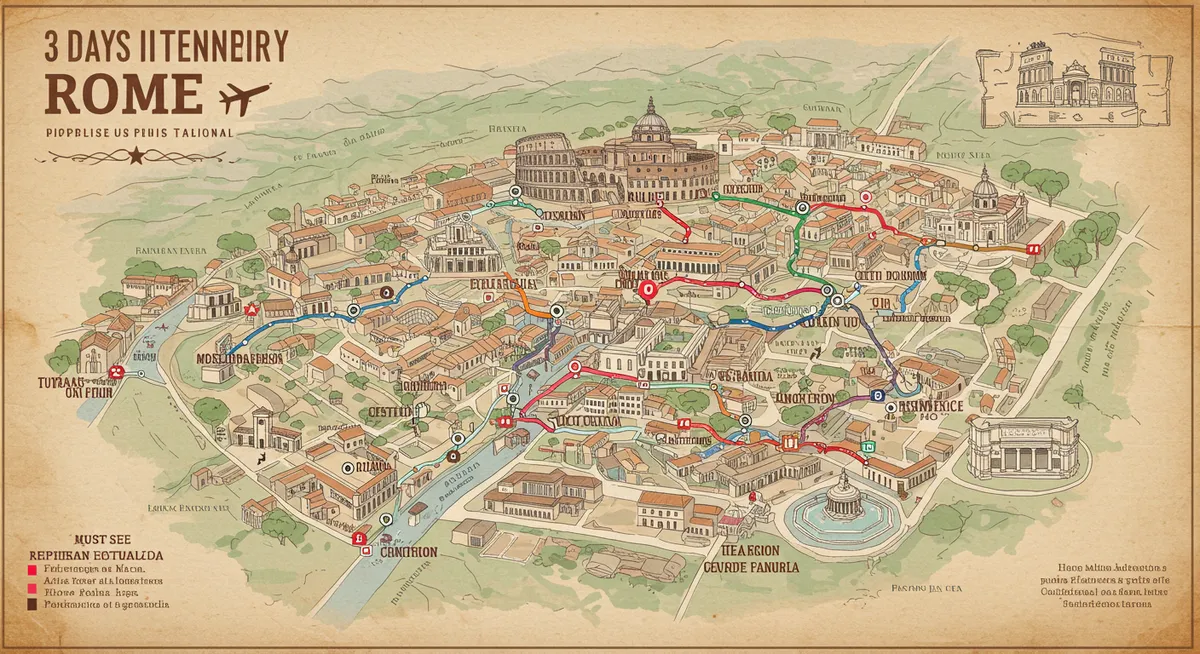
TL;DR: This 3-day Rome itinerary groups attractions geographically so you walk less and see more. Day 1 covers Ancient Rome (Colosseum, Roman Forum, Palatine Hill) plus the historic center. Day 2 tackles Vatican City and charming Trastevere. Day 3 explores Baroque masterpieces, Villa Borghese, and Rome's vibrant piazzas. Each day includes walking distances, a map reference, budget tips, and 2026-specific updates like the new Trevi Fountain admission fee.
Why You Need a Map-Based 3-Day Rome Itinerary in 2026
Turn this guide into a personal route with our free Rome itinerary planner.
Rome packs thousands of years of history into a walkable city center, but without a geographically organized plan you will waste hours zigzagging between neighborhoods. This Rome itinerary 3 days map guide solves that by clustering nearby attractions into logical daily routes. Each day covers roughly 4 to 6 kilometers of walking, keeping the pace comfortable while maximizing sightseeing time. For 2026 specifically, Rome has emerged as one of the best cities to visit following the 2025 Jubilee Year — infrastructure has been upgraded, landmarks restored, and crowd levels have returned to normal after the peak pilgrimage season. New changes like the Trevi Fountain admission ticket (introduced February 2026) and reopened museum spaces mean planning ahead matters more than ever.
Whether you are a first-time visitor or returning after a few years, use this day-by-day walking guide alongside an interactive map to navigate the Eternal City with confidence. For comprehensive trip planning and custom route optimization, visit ItiMaker.
Day 1: Ancient Rome and the Historic Center
Walking distance: approximately 6 km (3.7 miles) | Walking time: about 1.5 hours (excluding attraction visits)
Morning: Colosseum, Roman Forum, and Palatine Hill
Start your Rome itinerary 3 days at the Colosseum, the most iconic symbol of Imperial Rome. Arrive early — ideally by 8:30 AM — to beat the crowds. Combined tickets for the Colosseum, Roman Forum, and Palatine Hill cost around 18 euros per adult (free for EU citizens under 18) and must be booked in advance through the official CoopCulture website. Skip-the-line tickets or guided tours are strongly recommended for 2026, as demand remains high following the Jubilee-era infrastructure improvements.
After exploring the Colosseum's underground levels and arena floor, walk directly into the Roman Forum. This sprawling archaeological site was the political and commercial heart of ancient Rome. Continue uphill to Palatine Hill for panoramic views over the Forum and Circus Maximus. Budget roughly 3 hours for all three sites combined. For a deeper look at how many days Rome deserves, see our guide on how many days you need to see Rome.
Afternoon: Pantheon, Trevi Fountain, and Spanish Steps
From the Forum, walk north through Piazza Venezia (pausing to admire the Vittoriano monument) toward the Pantheon. This 2,000-year-old temple features the world's largest unreinforced concrete dome and is free to enter, though a small reservation fee applies in 2026.
Continue east to the Trevi Fountain. Important 2026 update: as of February 2026, visitors must purchase a 2-euro ticket to access the fountain's immediate viewing area. Credit card payment is accepted. You can still admire the fountain from a short distance for free, but the ticketed area provides the classic coin-tossing experience with controlled crowd sizes.
End the afternoon at the Spanish Steps and the elegant Via dei Condotti shopping street below. If energy permits, stroll through the Pincian Hill gardens for sunset views over Piazza del Popolo.
Evening: Dinner in Monti
The Monti neighborhood, just steps from the Colosseum, offers authentic trattorias without the tourist markup. Try local favorites like cacio e pepe or supplì (fried rice balls) at neighborhood restaurants. Monti is also one of the best areas to stay for first-time visitors thanks to its central location and metro access.
Day 2: Vatican City and Trastevere
Walking distance: approximately 4 km (2.5 miles) | Walking time: about 1 hour (excluding attraction visits)
Morning: Vatican Museums and the Sistine Chapel
Arrive at the Vatican Museums entrance by 7:30 AM if possible. The museums house one of the world's most extraordinary art collections, culminating in the Sistine Chapel with Michelangelo's ceiling frescoes and The Last Judgment. 2026 note: between January and March 2026, The Last Judgment underwent a conservation check-up, but by late March the frescoes should be fully visible again. Always verify current status before your visit.
Pre-booked tickets are essential — walk-up lines can stretch for 3 hours during peak season. Allow 3 to 4 hours for the full museum circuit. Wear modest clothing (covered shoulders and knees) as there is a strict dress code enforced at the entrance.
Late Morning: St. Peter's Basilica and St. Peter's Square
Exit the Sistine Chapel directly into St. Peter's Basilica (available with certain guided tours) or walk around to the main entrance. The basilica is free to enter and contains masterpieces including Michelangelo's Pietà. For spectacular views, climb the 551 steps to the dome — or take the elevator partway for 10 euros. Budget about 1 to 2 hours for the basilica and dome combined.
Afternoon: Castel Sant'Angelo and Trastevere
Walk along the Tiber River to Castel Sant'Angelo, the ancient mausoleum turned papal fortress. The rooftop terrace offers one of Rome's best panoramic views. Continue across the river to Trastevere, one of Rome's most photogenic neighborhoods. Wander the cobblestone streets, visit the Basilica di Santa Maria in Trastevere (one of Rome's oldest churches), and settle into a trattoria for a long Italian lunch.
In the evening, Trastevere transforms into a lively dining and nightlife district. This is the perfect neighborhood for an authentic Roman dinner — try dishes like carbonara, amatriciana, or artichokes alla giudia at a local favorite. For more on where to base yourself, check our guide to where to stay in Rome.
Day 3: Baroque Masterpieces and Villa Borghese
Walking distance: approximately 5 km (3.1 miles) | Walking time: about 1 hour 15 minutes (excluding attraction visits)
Morning: Borghese Gallery and Gardens
The Galleria Borghese is arguably Rome's finest art museum, housing masterworks by Bernini, Caravaggio, Raphael, and Titian in an intimate villa setting. Reservations are mandatory — the museum admits visitors in 2-hour time slots and sells out weeks in advance. Book the earliest slot (9:00 AM) for the most relaxed experience.
After your gallery visit, spend an hour wandering the surrounding Villa Borghese Gardens. Rent a rowboat on the lake, visit the Pincian Hill terrace for city views, or simply relax under the umbrella pines. This green oasis provides a welcome contrast to the bustling streets below.
Afternoon: Piazza Navona, Campo de' Fiori, and the Jewish Quarter
Head south to Piazza Navona, one of Rome's most beautiful squares, anchored by Bernini's Fountain of the Four Rivers. From here, walk to nearby Campo de' Fiori, home to a vibrant morning market (arrive before 2 PM) selling fresh produce, spices, and street food.
Continue to the Jewish Quarter (Ghetto), one of Rome's oldest and most atmospheric neighborhoods. Visit the Portico of Octavia, explore the narrow streets, and try traditional Roman-Jewish cuisine — the fried artichokes (carciofi alla giudia) here are legendary. This area is often overlooked by visitors following standard itineraries, but it offers some of Rome's most authentic food and history.
Evening: Aventine Hill Sunset
End your 3-day Rome itinerary with a visit to Aventine Hill. Peek through the famous Knights of Malta keyhole for a perfectly framed view of St. Peter's dome, then walk to the Orange Garden (Giardino degli Aranci) for a panoramic sunset over the city. It is one of Rome's most romantic and peaceful spots — the perfect way to close your trip.
How to Use the Map for Your Rome Itinerary
To get the most out of this Rome itinerary 3 days map, open Google Maps on your phone and save the key locations for each day as a custom list. Color-code pins by day: red for Day 1 (Ancient Rome and Historic Center), blue for Day 2 (Vatican and Trastevere), and green for Day 3 (Borghese, Baroque, and Aventine). This way you can see at a glance which attractions cluster together and plan your walking routes accordingly.
Most of Rome's major attractions sit within a 45-minute walk of each other, and the routes in this itinerary are designed to move logically from one site to the next without backtracking. If you need a break from walking, Rome's Metro Line A connects key stops including Termini, Spagna (Spanish Steps), and Ottaviano (Vatican). A single metro ticket costs 1.50 euros, or grab a 48-hour unlimited pass for 12.50 euros. For custom itinerary maps with optimized routes, try the ItiMaker trip planner.
Budget Tips for 3 Days in Rome (2026)
A realistic daily budget for Rome in 2026 is 150 to 200 euros per person, covering accommodation, meals, attractions, and local transport. Here are practical ways to save money without cutting corners on the experience:
- Book tickets online in advance. The Colosseum, Vatican Museums, and Borghese Gallery all offer cheaper rates when purchased directly from official websites versus third-party resellers.
- Eat lunch at sit-down restaurants, dinner at casual spots. Many of Rome's best restaurants serve the same menu at lunch for 30 to 40 percent less than dinner prices.
- Refill water bottles at public fountains. Rome's nasoni (drinking fountains) dispense clean, cold water throughout the city. No need to buy bottled water at 3 euros a pop.
- Visit free attractions. St. Peter's Basilica, the Pantheon (small reservation fee), many churches including Santa Maria Maggiore, and public piazzas cost nothing to enjoy.
- Consider a Roma Pass. The 48-hour Roma Pass (32 euros) includes one free attraction, discounts on others, and unlimited public transport — worthwhile if you plan to use buses and the metro frequently.
Practical Tips for Visiting Rome in 2026
- Best time to visit: April through May and September through October offer ideal weather (15 to 25 degrees Celsius) with manageable crowds. Summer months (June through August) bring temperatures above 35 degrees and peak tourist numbers.
- Where to stay: Monti, Trastevere, and the area near Termini Station are all excellent bases for a 3-day trip. Monti offers the best balance of walkability, authenticity, and metro access. See our Rome hotel recommendations for family-friendly options.
- Getting around: Walking is the best way to explore central Rome. For longer distances, use the Metro (Lines A and B) or buses. Taxis from Fiumicino Airport to the city center have a fixed fare of 50 euros.
- Post-Jubilee perks: Following the 2025 Jubilee Year, Rome benefits from restored landmarks, improved pedestrian paths, and new visitor infrastructure. Crowd levels in 2026 are expected to be lower than the Jubilee peak while the upgrades remain fresh.
- Comfortable shoes are essential. You will walk 15 to 20 kilometers over three days on cobblestone streets. Supportive walking shoes make a significant difference.
Extending Your Trip Beyond 3 Days
If you have additional time, Rome serves as an excellent base for day trips and extended Italian itineraries. Consider a day trip to Pompeii (about 2.5 hours by train), or extend to a 5-day Rome itinerary that adds Ostia Antica, the Appian Way, and deeper neighborhood exploration. For a multi-city Italian adventure, our Rome and Florence in 5 days guide and Rome, Florence, and Amalfi Coast 10-day itinerary offer tested routes with transport logistics.
Frequently Asked Questions
Is 3 days enough to see Rome?
What is the best time of year to visit Rome?
How much does 3 days in Rome cost in 2026?
How do I get around Rome during a 3-day trip?
Do I need to book Colosseum and Vatican tickets in advance?
What are the new changes for Rome visitors in 2026?
Where should I stay in Rome for 3 days?
This Rome itinerary 3 days map guide gives you everything you need to plan an efficient, memorable trip through the Eternal City in 2026. From ancient ruins to Baroque fountains, from Vatican masterpieces to neighborhood trattorias, three well-planned days reveal why Rome remains one of the world's most captivating destinations. Save this guide, build your custom map, and start booking your tickets — the Eternal City is waiting. For a personalized itinerary with optimized walking routes, try the ItiMaker trip planner.