Rome & Florence in 10 Days: The Complete 2026 Itinerary
Plan the perfect Rome and Florence trip in 10 days with this detailed 2026 itinerary covering must-see landmarks, Tuscan day trips, local food, budget tips, and a day-by-day schedule.
ItiMaker Team9 min read
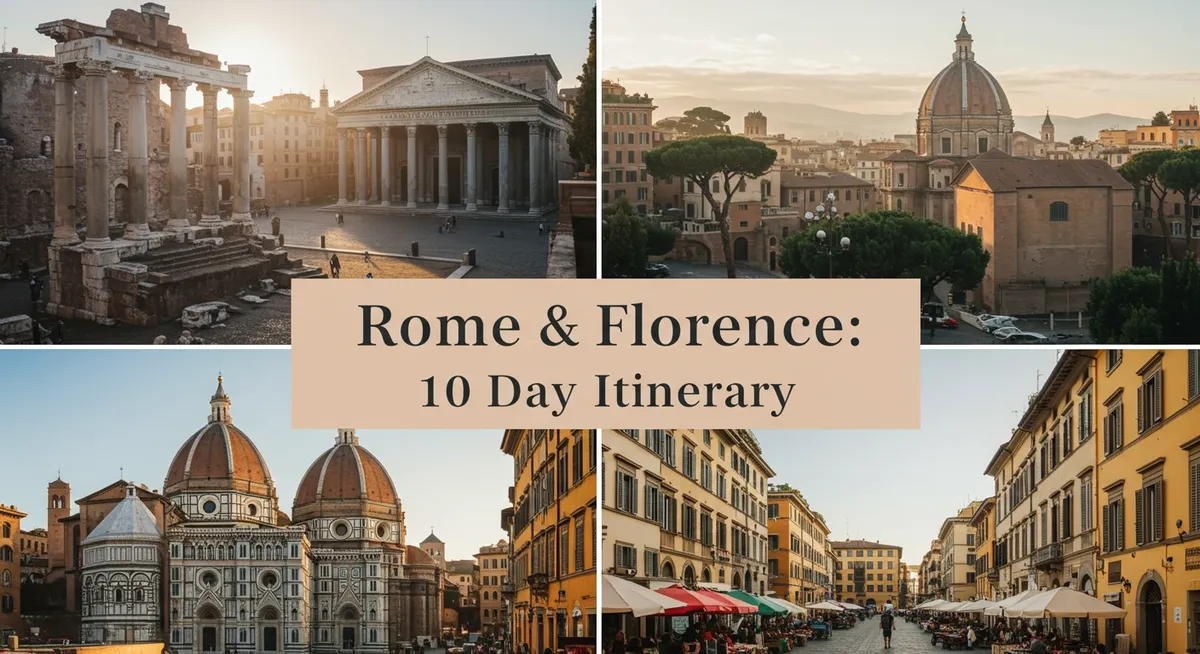
<p><strong>TL;DR:</strong> Spend days 1-4 in Rome (Colosseum, Vatican, Trastevere), take a high-speed train to Florence, explore art and architecture on days 5-7, venture into Tuscany on days 8-9, then wrap up with a final Florence day before departing on day 10. Budget roughly EUR 2,000-3,500 per person for mid-range comfort in 2026.</p>
<h1>Rome and Florence in 10 Days: The Complete 2026 Itinerary</h1>
<aside class="affiliate-slot" data-nosnippet
data-affiliate-unit="experience_finder"
data-affiliate-provider="getyourguide"
data-affiliate-widget="getyourguide_city"
data-affiliate-format="widget"
data-affiliate-placement="primary"
data-affiliate-campaign="itimaker-com-unit-gcity-rome-and-florence-in-10-days"
data-affiliate-city="Rome"
data-affiliate-location-id="33"
style="min-height:400px">
<span class="affiliate-badge">Sponsored</span>
<div class="affiliate-skeleton" aria-hidden="true"></div>
<p class="affiliate-unit__loading" role="status">Loading live activities…</p>
<div class="affiliate-inner"><div
data-gyg-href="https://widget.getyourguide.com/default/city.frame"
data-gyg-location-id="33"
data-gyg-locale-code="en-US"
data-gyg-widget="city"
data-gyg-partner-id="26CH4CT"
data-gyg-campaign="itimaker-com-unit-gcity-rome-and-florence-in-10-days"
data-gyg-cmp="itimaker-com-unit-gcity-rome-and-florence-in-10-days"
loading="lazy"></div></div>
</aside>
<p>Italy rewards slow travel, and splitting 10 days between Rome and Florence is one of the best ways to experience the country in 2026. You get ancient history, Renaissance art, world-class food, and the rolling hills of Tuscany without the stress of constant city-hopping. This day-by-day guide covers exactly what to see, where to eat, how to get around, and what to budget so you can plan with confidence.</p>
<h2>How to Split 10 Days Between Rome and Florence</h2>
<p>The ideal split is four full days in Rome, five in Florence (with Tuscan day trips), and one travel or flex day. Rome's major sights are dense and walkable, so four days gives you thorough coverage without burnout. Florence is smaller but serves as the perfect base for Tuscany, which is why it gets the extra day. If you are arriving and departing from the same airport, open-jaw flights — flying into Rome Fiumicino and out of Florence's Peretola (or Pisa) — save you a backtrack trip and free up half a day.</p>
<aside class="affiliate-slot" data-nosnippet
data-affiliate-unit="experience_finder"
data-affiliate-provider="viator"
data-affiliate-widget="viator_widget"
data-affiliate-format="widget"
data-affiliate-placement="secondary"
data-affiliate-campaign="itimaker-com-unit-vauto-rome-and-florence-in-10-days"
data-affiliate-city="Rome"
data-affiliate-location-id=""
style="min-height:600px">
<span class="affiliate-badge">Sponsored</span>
<div class="affiliate-skeleton" aria-hidden="true"></div>
<p class="affiliate-unit__loading" role="status">Loading live activities…</p>
<div class="affiliate-inner"><div
data-vi-partner-id="P00271059"
data-vi-widget-ref="W-d5dc59c4-3a04-417e-8a46-7be440461eba"
data-vi-search-term="Rome"
data-vi-campaign="itimaker-com-unit-vauto-rome-and-florence-in-10-days"
data-campaign="itimaker-com-unit-vauto-rome-and-florence-in-10-days"></div></div>
</aside>
<h2>Days 1-2: Ancient Rome and the Historic Centre</h2>
<p>Start at the Colosseum, Roman Forum, and Palatine Hill — book a combined ticket online at least two weeks ahead for 2026 peak season (April through October). An early morning slot (8:30 AM) lets you photograph the amphitheatre before crowds swell. After lunch in the Monti neighbourhood, walk to the Pantheon and Piazza Navona. End the day at the Trevi Fountain after sunset when the marble glows under floodlights.</p>
<aside class="affiliate-slot" data-nosnippet
data-affiliate-unit="experience_finder"
data-affiliate-provider="getyourguide"
data-affiliate-widget="getyourguide_activities"
data-affiliate-format="widget"
data-affiliate-placement="tertiary"
data-affiliate-campaign="itimaker-com-unit-gact-rome-and-florence-in-10-days"
data-affiliate-city="Rome"
data-affiliate-location-id="33"
style="min-height:420px">
<span class="affiliate-badge">Sponsored</span>
<div class="affiliate-skeleton" aria-hidden="true"></div>
<p class="affiliate-unit__loading" role="status">Loading live activities…</p>
<div class="affiliate-inner"><div
data-gyg-href="https://widget.getyourguide.com/default/activities.frame"
data-gyg-location-id="33"
data-gyg-locale-code="en-US"
data-gyg-widget="activities"
data-gyg-partner-id="26CH4CT"
data-gyg-campaign="itimaker-com-unit-gact-rome-and-florence-in-10-days"
data-gyg-cmp="itimaker-com-unit-gact-rome-and-florence-in-10-days" data-gyg-number-of-items="4"
loading="lazy"></div></div>
</aside>
<p>On day two, explore the Capitoline Museums for a deeper look at Roman sculpture, then stroll through the Jewish Ghetto for some of Rome's best street food — the fried artichokes at Nonna Betta are legendary. Cross the Tiber to Trastevere in the evening for dinner at a traditional trattoria. Budget tip: the Roma Pass (48-hour version, roughly EUR 33 in 2026) covers your first two museum entries and unlimited public transport.</p>
<h2>Days 3-4: Vatican City, Borghese, and Hidden Rome</h2>
<p>Dedicate day three entirely to Vatican City. The Vatican Museums and Sistine Chapel require a minimum of three hours; add St. Peter's Basilica and the dome climb and you have a full day. Book skip-the-line tickets — the official Vatican website sells timed entries that are significantly cheaper than third-party tours. Arrive when doors open at 8 AM to see the Raphael Rooms in relative peace.</p>
<p>Day four is your chance to see the Rome most tourists miss. Reserve the Borghese Gallery in advance (entry is by two-hour time slot only), then wander through Villa Borghese park afterward. In the afternoon, visit the Appian Way and the Catacombs of San Callisto for a haunting perspective on early Christian history. Finish with aperitivo in the Pigneto neighbourhood, a local favourite far from the tourist trail. If you are looking for family-specific tips, our <a href="https://itimaker.com/blog/2-day-rome-itinerary-with-kids">2-day Rome itinerary with kids</a> covers child-friendly logistics in detail.</p>
<h2>Day 5: Rome to Florence by High-Speed Train</h2>
<p>The Frecciarossa from Roma Termini to Firenze Santa Maria Novella takes 1 hour 32 minutes and costs EUR 20-50 when booked early on Trenitalia or Italo. Morning departures around 9 AM give you time for a relaxed breakfast in Rome and an afternoon in Florence. Upon arrival, check into your hotel and take a gentle orientation walk: cross Ponte Vecchio, circle Piazza della Signoria, and grab gelato at one of the artisan shops along Via dei Neri. For more on this journey, see our guide on <a href="https://itimaker.com/blog/how-to-travel-between-rome-and-florence">how to travel between Rome and Florence</a>.</p>
<h2>Days 6-7: Florence's Art, Architecture, and Food</h2>
<p>Day six is your Renaissance immersion day. Start at the Accademia Gallery to see Michelangelo's David (book timed entry), then walk to the Duomo complex. Climbing Brunelleschi's dome (463 steps, no lift) rewards you with a 360-degree panorama of Florence and the surrounding hills — reserve your slot on the Opera del Duomo website. After lunch, spend the afternoon at the Uffizi Gallery. Two to three hours is enough to cover the highlights: Botticelli's Birth of Venus, Caravaggio's Medusa, and the Tribuna room.</p>
<p>On day seven, cross the Arno to the Oltrarno district. Visit the Palazzo Pitti and Boboli Gardens in the morning, then explore the artisan workshops on Via Maggio and Borgo San Jacopo. For lunch, try lampredotto (tripe sandwich) from a street cart — it is Florence's iconic working-class food. In the afternoon, climb to Piazzale Michelangelo or continue up to San Miniato al Monte for the best sunset view in the city. Planning your Florence days in detail? Our <a href="https://itimaker.com/blog/florence-itinerary-3-days">Florence 3-day itinerary</a> breaks down logistics and timing.</p>
<h2>Days 8-9: Tuscan Day Trips from Florence</h2>
<p>Tuscany's hill towns and wine country are within easy reach of Florence by train or car. On day eight, take the bus or train to Siena (75 minutes). Walk the shell-shaped Piazza del Campo, visit the Duomo's stunning marble interior, and have lunch in one of the contrade (neighbourhood) restaurants. Return to Florence by late afternoon.</p>
<p>Day nine is for the Chianti wine region. Rent a car or join a small-group tour that stops at two or three vineyards between Greve in Chianti and Castellina. Most tours include olive oil tastings and a light lunch of local pecorino, salumi, and fresh bread. If wine is not your priority, swap this day for San Gimignano (famous for its medieval towers) or Lucca (a walled city perfect for cycling). Budget approximately EUR 80-120 per person for a guided Chianti day tour in 2026.</p>
<h2>Day 10: Final Morning and Departure</h2>
<p>Use your last morning for anything you missed or simply want to revisit. The Mercato Centrale (ground floor) opens early and is ideal for picking up vacuum-packed porcini, truffle paste, or Tuscan olive oil as gifts. If you are flying from Florence airport, it is only 20 minutes by tram from the city centre. Pisa airport is about an hour by direct train from Santa Maria Novella. Either way, book transport the night before so your departure is stress-free.</p>
<h2>Budget Breakdown for Rome and Florence in 10 Days (2026)</h2>
<p>Here is a realistic mid-range budget per person for 2026:</p>
<ul>
<li><strong>Flights:</strong> EUR 300-600 (round trip from within Europe; USD 600-1,200 from North America)</li>
<li><strong>Accommodation:</strong> EUR 80-150 per night for a 3-star hotel or quality Airbnb (EUR 800-1,500 total)</li>
<li><strong>Train (Rome to Florence):</strong> EUR 20-50</li>
<li><strong>Food:</strong> EUR 40-70 per day (EUR 400-700 total, mixing trattorias and market lunches)</li>
<li><strong>Attractions and tours:</strong> EUR 150-250 total (museum entries, skip-the-line tickets, one day tour)</li>
<li><strong>Local transport:</strong> EUR 50-80 total (metro, bus, tram)</li>
<li><strong>Estimated total:</strong> EUR 1,800-3,200 per person</li>
</ul>
<h2>Practical Tips for 2026</h2>
<ul>
<li><strong>Best months:</strong> April-May and September-October offer mild weather and thinner crowds. July and August are hot (35 C+) and packed.</li>
<li><strong>Book early:</strong> Colosseum, Vatican Museums, Uffizi, Accademia, and Borghese Gallery all sell out weeks ahead in high season.</li>
<li><strong>Dress codes:</strong> Shoulders and knees must be covered to enter St. Peter's Basilica and many Italian churches. Carry a light scarf or shawl.</li>
<li><strong>Cash vs. card:</strong> Most restaurants and shops accept cards in 2026, but small gelaterias, market stalls, and churches for candle donations are cash-only. Withdraw from bank ATMs (Bancomat) to avoid high fees.</li>
<li><strong>SIM or eSIM:</strong> EU roaming rules apply for European visitors. Others should grab a prepaid eSIM (Airalo or Holafly) for reliable data throughout the trip.</li>
<li><strong>Pickpockets:</strong> Stay alert on Rome metro Line A (especially Termini and Spagna stations) and near major tourist spots. Use a crossbody bag with a zip.</li>
</ul>
<h2>Frequently Asked Questions</h2>
<div itemscope="" itemtype="https://schema.org/FAQPage">
<div class="faq-item" itemprop="mainEntity" itemscope="" itemtype="https://schema.org/Question">
<h3 itemprop="name">What is the best way to travel between Rome and Florence in 2026?</h3>
<div itemprop="acceptedAnswer" itemscope="" itemtype="https://schema.org/Answer">
<div itemprop="text">The Frecciarossa or Italo high-speed trains are the fastest and most convenient option, covering the distance in about 1.5 hours. Book on Trenitalia or Italo at least two weeks ahead for fares as low as EUR 20 one way. Driving takes roughly three hours and adds toll and parking costs, so the train is almost always the better choice.</div>
</div>
</div>
<div class="faq-item" itemprop="mainEntity" itemscope="" itemtype="https://schema.org/Question">
<h3 itemprop="name">Should I spend more days in Rome or Florence?</h3>
<div itemprop="acceptedAnswer" itemscope="" itemtype="https://schema.org/Answer">
<div itemprop="text">A 4-day Rome / 5-day Florence split works best for most travellers because Florence doubles as a base for Tuscan day trips. If you care more about ancient history and nightlife, shift to 5 days Rome and 4 days Florence. Either way, 10 days total gives comfortable coverage of both cities without rushing.</div>
</div>
</div>
<div class="faq-item" itemprop="mainEntity" itemscope="" itemtype="https://schema.org/Question">
<h3 itemprop="name">How much does 10 days in Rome and Florence cost in 2026?</h3>
<div itemprop="acceptedAnswer" itemscope="" itemtype="https://schema.org/Answer">
<div itemprop="text">A mid-range budget is approximately EUR 1,800-3,200 per person including flights from Europe, 3-star hotels, meals at local trattorias, train travel, and museum entries. Budget travellers staying in hostels and eating market lunches can trim this to around EUR 1,200. Luxury travellers should expect EUR 4,000 or more.</div>
</div>
</div>
<div class="faq-item" itemprop="mainEntity" itemscope="" itemtype="https://schema.org/Question">
<h3 itemprop="name">Do I need to book museum tickets in advance?</h3>
<div itemprop="acceptedAnswer" itemscope="" itemtype="https://schema.org/Answer">
<div itemprop="text">Yes. The Colosseum, Vatican Museums, Uffizi Gallery, Accademia Gallery, and Borghese Gallery all require or strongly recommend advance booking, especially from April to October. Walk-up availability is limited and queues can exceed two hours. Book through official websites for the lowest prices and most reliable timed entries.</div>
</div>
</div>
<div class="faq-item" itemprop="mainEntity" itemscope="" itemtype="https://schema.org/Question">
<h3 itemprop="name">What is the best time of year to visit Rome and Florence?</h3>
<div itemprop="acceptedAnswer" itemscope="" itemtype="https://schema.org/Answer">
<div itemprop="text">Spring (April-May) and early autumn (September-October) are ideal. Temperatures are comfortable at 18-25 C, crowds are manageable, and airfares are lower than peak summer. July and August bring intense heat above 35 C and maximum tourist density. Winter (November-February) is cheapest but some attractions have reduced hours.</div>
</div>
</div>
<div class="faq-item" itemprop="mainEntity" itemscope="" itemtype="https://schema.org/Question">
<h3 itemprop="name">Is it worth adding a Tuscan day trip during a 10-day Rome and Florence itinerary?</h3>
<div itemprop="acceptedAnswer" itemscope="" itemtype="https://schema.org/Answer">
<div itemprop="text">Absolutely. With Florence as your base, towns like Siena, San Gimignano, and Lucca are 60-90 minutes away by bus or train. A Chianti wine tour is another popular choice. Dedicating one or two days to Tuscany adds variety to the trip and is one of the highlights most travellers remember best.</div>
</div>
</div>
</div>
<p>Ten days split between Rome and Florence gives you the best of ancient and Renaissance Italy in a single trip. Follow this 2026 itinerary, book your key tickets early, and leave room for spontaneous discoveries — that is where the real magic of Italy lives. For more curated trip plans, explore our full collection at <a href="https://itimaker.com">ItiMaker</a>.</p>
Keep exploring
Make this guide part of your trip.
Turn the ideas you like into a personal day-by-day route, then edit every detail.
Build my itinerary