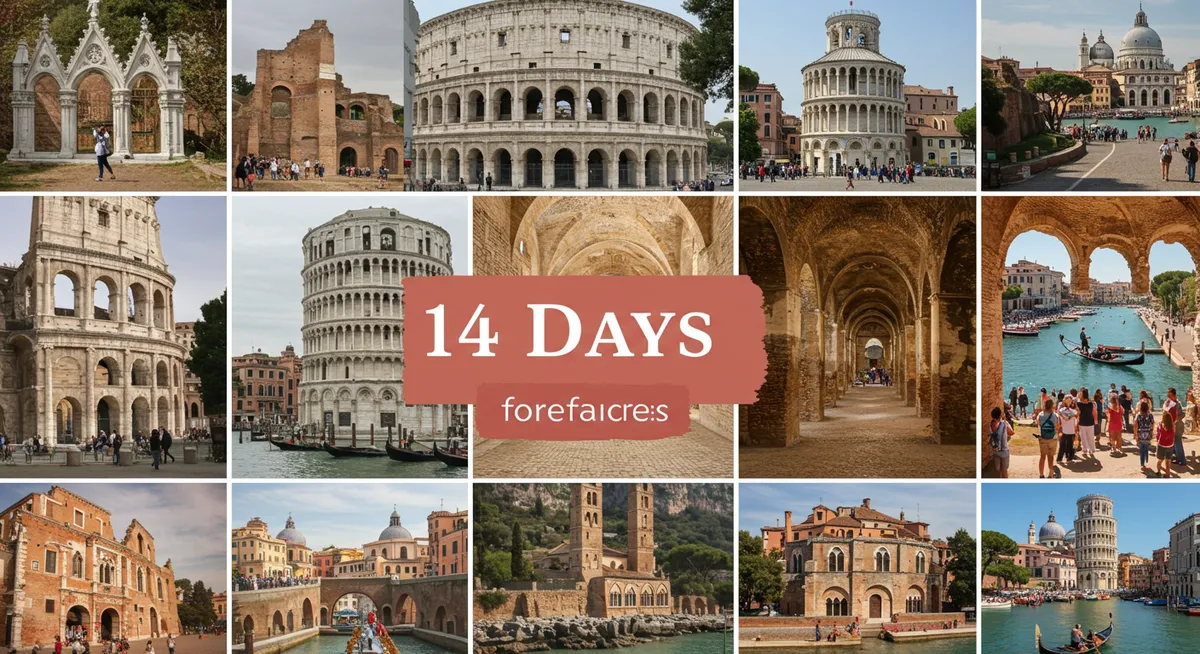
TL;DR: Two weeks in Italy is enough to experience Rome (3 days), a day trip to Naples and Pompeii, Florence and Tuscany (4 days), the Cinque Terre (2 days), and Venice (3 days). Budget roughly 2,000–3,500 EUR per person. Travel between cities on Italy's high-speed rail network for speed and comfort. Book major attractions in advance for 2026 to skip the queues.
Figuring out what to see in Italy in 14 days can feel overwhelming — the country packs thousands of years of history, world-class art, and stunning coastlines into a surprisingly compact geography. After helping thousands of travelers plan their Italian trips through ItiMaker, we have distilled the best two-week route that balances iconic landmarks with authentic local experiences. This 2026 itinerary is designed so you spend more time exploring and less time in transit, hitting five distinct regions without ever feeling rushed.
Rome: Ancient Grandeur and Modern Energy (Days 1–3)
Turn this guide into a personal route with our free Multi-City itinerary planner.
Every great Italian adventure starts in Rome. The Eternal City rewards those who linger, so give it a full three days. On your first day, tackle the ancient core: the Colosseum, Roman Forum, and Palatine Hill form a single archaeological zone that takes a solid half-day to appreciate. In the afternoon, wander toward the Pantheon and toss a coin into the Trevi Fountain.
Day two belongs to Vatican City. St. Peter's Basilica, the Sistine Chapel, and the Vatican Museums demand at least five hours. Book a timed entry for early morning to beat the crowds — in 2026, the Vatican has expanded its online reservation system, making skip-the-line tickets easier to secure. Spend your evening in Trastevere, sampling Roman-style pizza and pasta at family-run trattorias.
On day three, explore neighborhoods most tourists miss. The Aventine Hill offers a peaceful keyhole view of St. Peter's dome, while the Testaccio district serves some of Rome's best street food. If you want a deeper dive into the capital, check out our first-time Rome itinerary for a day-by-day breakdown. For a shorter stay, our 2-day Rome itinerary covers the essentials.
Naples and Pompeii Day Trip (Day 4)
A highlight that many 14-day Italy itineraries miss is a quick detour south. The high-speed Frecciarossa train connects Rome to Naples in just over an hour. Spend the morning in Naples — visit the National Archaeological Museum, which houses the finest Pompeii artifacts, and grab an authentic Neapolitan pizza at a spot along Via dei Tribunali.
In the afternoon, take the Circumvesuviana train 30 minutes to Pompeii. Walking through this remarkably preserved Roman city, frozen since 79 AD, is one of those once-in-a-lifetime experiences. Return to Rome by evening, or if you want more time in the south, see our Naples itinerary and our guide to day-tripping from Rome to Naples.
Florence and Tuscany: Art, Wine, and Hill Towns (Days 5–8)
Board a morning train from Rome to Florence — the Frecciarossa covers the distance in 90 minutes. Florence is the cradle of the Renaissance, and it deserves four full days when you factor in Tuscan side trips.
In Florence itself, prioritize the Uffizi Gallery (book timed tickets), the Duomo and its Brunelleschi dome climb, the Galleria dell'Accademia to see Michelangelo's David, and the Ponte Vecchio at sunset. For first-time visitors, our Florence itinerary for first-timers maps out the ideal walking route. If you have five days, our 5-day Florence itinerary includes deeper museum dives.
Dedicate one or two days to the Tuscan countryside. Siena, with its shell-shaped Piazza del Campo, is an hour by bus. The Chianti wine region is best explored by rental car — stop at family vineyards for tastings and long lunches among olive groves. San Gimignano's medieval towers and Volterra's Etruscan heritage make excellent half-day additions. For detailed planning, read our guide on how many days you need in Tuscany.
Cinque Terre: Coastal Color and Cliff Trails (Days 9–10)
From Florence, a train to La Spezia (about 2.5 hours) puts you at the gateway to the Cinque Terre — five pastel-colored fishing villages clinging to the Ligurian coastline. This is a destination competitors to our 14-day Italy itinerary consistently feature, and for good reason: the scenery is unmatched.
Spend two days hiking between villages (the Sentiero Azzurro trail connects all five), swimming in the turquoise coves of Monterosso, and eating fresh pesto and focaccia in Vernazza. The Cinque Terre Card (around 16 EUR in 2026) covers trail access and local trains between villages. Stay in Manarola or Riomaggiore for the most photogenic sunsets.
Venice: Canals, Art, and Island Escapes (Days 11–13)
Train from La Spezia to Venice (about 4 hours, or 3 via a Florence connection). Venice is unlike anywhere else on Earth — a city built on water with no cars, just boats, bridges, and centuries of art. Give it three days.
Start at St. Mark's Square: the Basilica, the Doge's Palace, and the Campanile bell tower. On day two, explore the quieter sestieri (neighborhoods) of Dorsoduro and Cannaregio, visit the Peggy Guggenheim Collection for modern art, and get lost in the alleyways — getting lost in Venice is half the fun. For a first-timer's walkthrough, see our best Venice attractions guide.
On your third day, take a vaporetto to the outer islands. Murano is famous for centuries-old glassblowing workshops, while Burano dazzles with its rainbow-colored houses and delicate lacework tradition. If time allows, Torcello offers a haunting, near-deserted cathedral with Byzantine mosaics. Our guide on the best time to visit Venice can help you avoid the worst crowds.
Day 14: Departure or Bonus Stop
Use your final day for last-minute Venice exploring, souvenir shopping at the Rialto Market, or a leisurely Venetian breakfast before heading to Marco Polo Airport. If your flight departs from Rome or Milan instead, factor in the train transfer — Venice to Milan is 2.5 hours, and Venice to Rome is about 3.5 hours on high-speed rail.
Alternatively, if you want to extend your trip, consider a night in Milan to see the Last Supper and the Duomo, or a detour to Lake Como for alpine scenery. Our 10-day Italy itinerary starting in Milan covers the northern route in detail.
Budget, Transport, and Practical Tips for 2026
Understanding the logistics makes planning what to see in Italy in 14 days far less stressful. Here is what to expect in 2026:
- Budget: A mid-range 14-day trip costs roughly 2,000–3,500 EUR per person (excluding flights). This covers 3-star hotels, meals at local restaurants, attraction tickets, and intercity trains. Budget travelers staying in hostels can cut this to 1,200–1,800 EUR.
- Trains: Italy's high-speed network (Trenitalia Frecciarossa and Italo) is the fastest way between major cities. Book 2–4 weeks ahead on Trenitalia or Italo for the best fares. A Rome-to-Florence ticket can be as low as 19 EUR if you book early.
- Accommodation: Book at least 2 months ahead for summer 2026, especially in Venice and the Cinque Terre. Shoulder season (April–May, September–October) offers pleasant weather at 20–40% lower hotel prices.
- Tickets: Pre-book the Colosseum, Vatican Museums, Uffizi Gallery, and Galleria dell'Accademia online. Walk-up queues can exceed two hours in peak season.
- Travel insurance: Always recommended for a two-week trip. EU travelers benefit from EHIC coverage, but comprehensive travel insurance covers trip cancellations and lost luggage.
For more general planning advice, read our first time in Italy itinerary or explore how many days you need in Italy to customize the trip length to your schedule.
Frequently Asked Questions
Is 14 days enough to see Italy?
What is the best way to travel between Italian cities in 2026?
When is the best time to visit Italy for 14 days?
How much does a 14-day Italy trip cost in 2026?
Should I add the Amalfi Coast to a 14-day Italy itinerary?
Do I need to speak Italian to travel in Italy?
Planning what to see in Italy in 14 days comes down to smart routing and advance booking. This itinerary moves efficiently from south to north — Rome, Naples, Florence, the Cinque Terre, and Venice — using Italy's excellent rail network to minimize travel time. Whether you are a first-time visitor or returning for a deeper look, two weeks gives you enough time to experience Italy's history, art, cuisine, and coastlines at a pace that still leaves room for spontaneous discoveries. For personalized itinerary planning, visit ItiMaker.