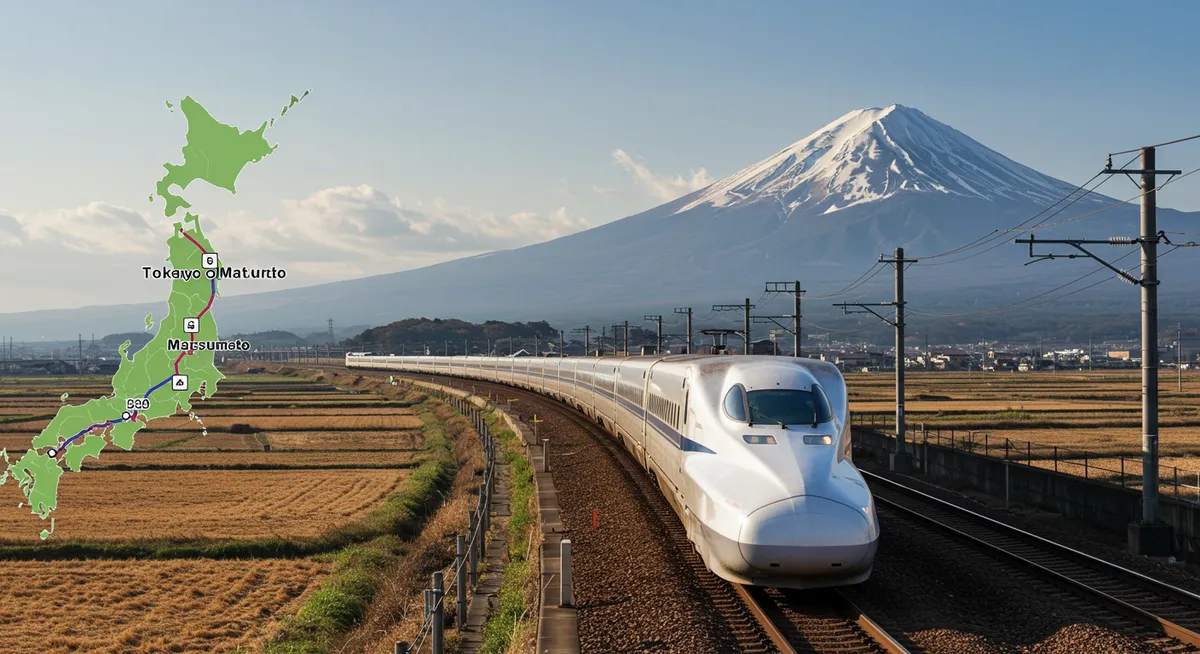
TL;DR — The fastest way to reach Matsumoto from Tokyo in 2026 is the JR Limited Express Azusa from Shinjuku (about 2 h 40 min, around 6,620 yen). The cheapest is the highway bus from Busta Shinjuku (about 3 h 20 min, from 3,500 yen). A third option runs via the Hokuriku Shinkansen to Nagano plus a Limited Express Shinano transfer (about 2 h 30 min, around 11,000 yen). All three are covered in detail below, along with driving tips and a quick-comparison table.
Matsumoto sits at the eastern edge of the Japanese Alps in Nagano Prefecture, famous for Matsumoto Castle — one of only twelve original castles remaining in Japan. Whether you are drawn by the castle's striking black walls, the gateway to Kamikochi, or the craft-beer scene along Nakamachi Street, you first need a reliable way to get there from Tokyo. This guide breaks down every practical transport option for 2026 so you can pick the one that best fits your schedule, budget, and travel style.
Quick Comparison Table: Tokyo to Matsumoto
Turn this guide into a personal route with our free Matsumoto itinerary planner.
| Option | Departure | Time | Cost (one-way) | Best For |
|---|---|---|---|---|
| JR Limited Express Azusa | Shinjuku Station | ~2 h 40 min | ~6,620 yen | Speed and scenery |
| Shinkansen + Shinano | Tokyo Station | ~2 h 30 min | ~11,000 yen | JR Pass holders already in central Tokyo |
| Highway bus | Busta Shinjuku | ~3 h 20 min | ~3,500-5,000 yen | Budget travelers |
| Rental car | Flexible | ~3-4 h | Varies (tolls ~4,000 yen) | Flexibility and countryside stops |
Option 1: JR Limited Express Azusa — Fastest Direct Route
The Limited Express Azusa is the most popular way to travel from Tokyo to Matsumoto. As of 2026, JR East operates 16 round trips daily on the Chuo Main Line between Shinjuku and Matsumoto. All seats are reserved, so you will need to book before boarding.
Key details
- Departure station: Shinjuku Station (some services also stop at Tokyo and Tachikawa)
- Arrival station: Matsumoto Station
- Travel time: approximately 2 hours 40 minutes
- Fare: around 6,620 yen (base fare + limited express surcharge)
- First / last departure: 07:00 / 21:00 from Shinjuku
- JR Pass compatible: Yes — fully covered by the Japan Rail Pass and the JR East Pass (Nagano/Niigata Area)
The route threads through the mountains of western Tokyo and Yamanashi Prefecture before climbing into Nagano. Grab a window seat on the right side when departing Shinjuku for sweeping views of the Southern Alps and, on clear days, a glimpse of Mount Fuji near Kofu. The final stretch descends into the Matsumoto basin with the Northern Alps visible ahead — a fitting preview of things to do in Matsumoto.
Pro tip: JR East offers a discounted "e-ticket" (ticketless) booking through the Eki-Net system. In 2025 the express surcharge was available at half price when booked in advance online. Check Eki-Net for current promotions before your trip.
Option 2: Shinkansen to Nagano + Limited Express Shinano
If you are staying near Tokyo Station or already hold a Japan Rail Pass, the Shinkansen route via Nagano can be slightly faster door to door, though it costs more and requires one transfer.
How it works
- Tokyo Station to Nagano Station — Board the Hokuriku Shinkansen (Kagayaki, Hakutaka, or Asama service). The Kagayaki is fastest at around 80 minutes; the Asama makes more stops and takes about 100 minutes.
- Nagano Station to Matsumoto Station — Transfer to the JR Limited Express Shinano. Trains run roughly once per hour, taking about 50 minutes.
Key details
- Total travel time: around 2 hours 30 minutes (with a good connection)
- Total cost: approximately 11,000 yen
- JR Pass compatible: Yes — both legs are covered
This route makes the most sense for travelers who are already at Tokyo Station or who plan to visit Nagano (for example, the Zenko-ji temple or nearby day trips) before heading to Matsumoto. Otherwise, the Azusa from Shinjuku is simpler and cheaper.
Option 3: Highway Bus — Best for Budget Travelers
Highway buses running between Shinjuku and Matsumoto are frequent, comfortable, and roughly half the price of the train.
Key details
- Departure terminal: Busta Shinjuku (Shinjuku Expressway Bus Terminal, directly connected to Shinjuku Station's south exit)
- Arrival terminal: Matsumoto Bus Terminal (a short walk from Matsumoto Station)
- Travel time: approximately 3 hours 20 minutes (longer during peak traffic)
- Fare: around 3,500 to 5,000 yen one-way, depending on the operator and time of day
- Frequency: roughly 10 services per day
Modern highway buses in Japan offer reclining seats, charging outlets, free Wi-Fi on many services, and a toilet on board. Alpico Kotsu and Keio Bus are the main operators on this route. You can book online through Highway-buses.jp or Willer Express — online bookings sometimes come with a discount.
Budget hack: If you plan to continue from Matsumoto to Takayama, Shirakawa-go, Kanazawa, and Toyama, look into the Three-Star Route Ticket (9,500 yen for adults) which bundles the entire scenic loop starting from Shinjuku.
Option 4: Driving from Tokyo to Matsumoto
Renting a car gives you the freedom to stop at places like Lake Suwa or the Hara Village vineyards along the way. The drive takes roughly 3 to 4 hours via the Chuo Expressway, depending on traffic.
What to know
- Route: Chuo Expressway from central Tokyo toward Suwa, then the Nagano Expressway north to Matsumoto IC
- Tolls: approximately 4,000 yen each way
- Parking: Matsumoto has paid parking lots near the castle and station; expect 500-1,000 yen per day
- International driving permit: required for most foreign visitors
Driving makes the most sense if you plan to explore the broader region — for instance, combining Matsumoto with a Takayama itinerary or heading up to Kamikochi (note that private cars are restricted beyond Sawando; you must park and take a shuttle bus).
Arriving in Matsumoto: Getting Around the City
Matsumoto Station is compact and well signed in English. The city center, including Matsumoto Castle, Nakamachi Street, and most hotels, is within a 15-to-20-minute walk from the station. You can also use the Town Sneaker bus (flat fare, roughly 200 yen) that loops through the main sightseeing areas.
IC cards such as Suica and Pasmo work on JR lines at Matsumoto Station and on city buses. From spring 2026, IC card coverage is expanding to all stations on the Shinano Line, making cashless travel even easier.
Once you have settled in, check our Matsumoto itinerary for a day-by-day plan, or browse Matsumoto budget travel tips to stretch your yen further.
When to Visit Matsumoto
Matsumoto is a year-round destination, but timing affects your transport experience too:
- Spring (late March to mid-April): Cherry blossom season around the castle draws crowds. Book Azusa seats and hotels well in advance.
- Summer (July-August): Gateway season for Kamikochi and alpine hiking. Highway buses can be busy on weekends.
- Autumn (October-November): Stunning fall foliage in the surrounding mountains. The Azusa ride itself becomes a scenic highlight.
- Winter (December-February): Snow-covered castle views and easy access to Norikura and Shiga Kogen ski areas. Trains run normally; roads may require snow tires or chains.
Travel Tips for a Smooth Journey in 2026
- Book the Azusa early. All seats are reserved; popular morning departures sell out during Golden Week, Obon, and New Year holidays.
- Use Eki-Net for discounts. JR East's online reservation system sometimes offers the express surcharge at reduced rates when you book at least a day ahead.
- Pack light. Overhead luggage space on the Azusa is limited. If you have large suitcases, use a takkyubin (luggage forwarding) service from your Tokyo hotel.
- Consider a rail pass. The full Japan Rail Pass or the JR East Pass (Nagano/Niigata Area) covers the Azusa and the Shinkansen+Shinano route. If you are making multiple long-distance trips, the pass pays for itself quickly.
- Check schedules on the day. Natural disasters or maintenance can affect train and bus services. The JR East app and Hyperdia (or NAVITIME) provide real-time updates in English.
- Explore beyond Matsumoto. The city is an ideal base for day trips from Matsumoto to Kamikochi, Hotaka, and the Azumino wasabi farms.
Frequently Asked Questions
How long does it take to get to Matsumoto from Tokyo?
What is the cheapest way to get from Tokyo to Matsumoto?
Is the Japan Rail Pass valid for the journey to Matsumoto?
Can I use a Suica card on trains and buses in Matsumoto?
Should I book train or bus tickets in advance?
Which route has the best scenery?
Is there a night bus from Tokyo to Matsumoto?
Getting from Tokyo to Matsumoto is one of the most straightforward journeys in Japan, with multiple options to suit every traveler. The Azusa delivers speed and mountain scenery in a single ride, the highway bus keeps costs low, and the Shinkansen route via Nagano adds flexibility for those exploring more of the region. Whichever option you choose, you will arrive in a city that rewards exploration — from the iconic black castle to Nakamachi Street's craft shops and the local food scene. Plan your full visit with our 3-day Matsumoto itinerary and make the most of your time in the heart of the Japanese Alps.