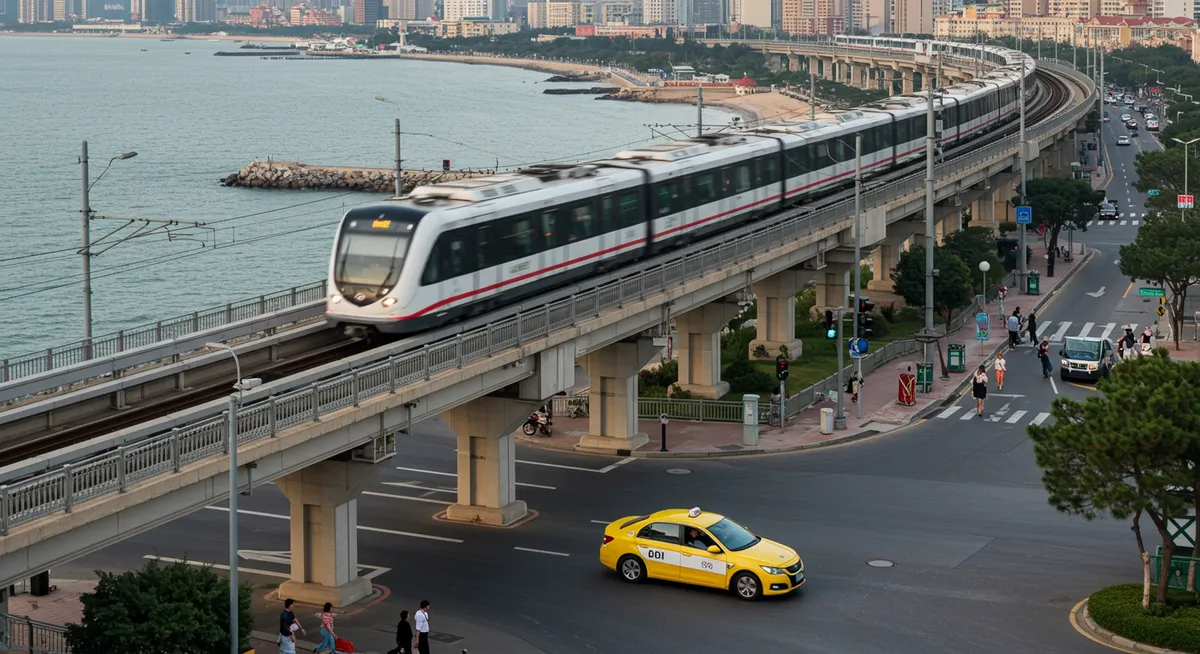
Getting around Qingdao is easiest by metro for long daytime journeys, walking within compact sightseeing areas, and a licensed taxi or DiDi for the final leg. The city stretches along the coast, so choose transport by exact station and entrance—not by district name alone.
The most useful mental map has three zones: old town around Qingdao Railway Station and Zhanqiao, the eastern coast around May Fourth Square and Shilaoren, and outer-trip zones such as Laoshan, the West Coast and Jiaodong Airport. This 2026 guide protects that practical approach while replacing stale line, fare, payment and airport advice with official-source checks.
Getting Around Qingdao: Quick Transport Decision
Turn this guide into a personal route with our free Qingdao itinerary planner.
| Journey | Best default | Why | Important check |
|---|---|---|---|
| Old town, Zhanqiao and cathedral area | Metro to Qingdao Station, then walk | Line 1 and Line 3 reach the old-town rail hub | Expect hills and choose the exit closest to your first stop |
| May Fourth Square and eastern coast | Line 2 or Line 3, plus walking | Predictable travel through the central coastal corridor | Confirm the correct direction and station exit |
| Shilaoren Bathing Beach | Line 2, then walk | Shilaoren Bathing Beach Station is the useful rail anchor | Check the live route to your exact beach entrance |
| Laoshan Dahedong entrance | Line 4 to Dahedong | The line reaches the visitor-center area | Scenic-area admission, shuttles and other Laoshan gates are separate |
| Golden Beach or beer-festival area | Line 1 to the West Coast, then bus or ride-hailing | Line 1 crosses Jiaozhou Bay | Use a current map for the final connection from Tianmushan Road area |
| Jiaodong Airport | Line 8 via Qingdao North | Reliable rail link to the airport terminal complex | Verify both the Line 8 train and your connecting line's last train |
| Late dinner, rain, luggage or a poor station fit | DiDi or licensed taxi | Door-to-door and easier with bags | Set the exact entrance pin and confirm payment before booking |
Qingdao Metro in 2026: The Lines Visitors Need
As checked on July 31, 2026, Qingdao Metro's official website reported eight operating lines, 172 stations and 352 kilometers. Its list comprises Lines 1, 2, 3, 4, 6 and 8, plus the Blue Valley Express and West Coast Express, commonly known as Lines 11 and 13.
This corrects competitor maps that still label Lines 4 and 6 as under construction or count only seven lines. Construction announcements are not proof that a new extension carries passengers; use the official live network map for your travel date.
Main-city lines
- Line 1: the cross-bay backbone linking the West Coast with Qingdao Station, Taidong and Qingdao North Railway Station.
- Line 2: useful for Taidong, May Fourth Square, Fushansuo, the eastern coast and Shilaoren Bathing Beach.
- Line 3: connects Qingdao Railway Station and Qingdao North Railway Station through Zhongshan Park and May Fourth Square.
- Line 4: an east-west route from the old-city side toward Shazikou and Dahedong, the useful metro endpoint for one Laoshan approach.
Airport and outer-district lines
- Line 8: links Qingdao North with Hongdao Railway Station, Jiaodong Airport and Jiaozhou North. Central-city travelers still need a transfer at Qingdao North as of this update.
- Line 6: serves part of the West Coast. It is not a shortcut from central Qingdao and did not yet provide a direct metro connection to Qingdao West Railway Station on July 31, 2026.
- Blue Valley Express / Line 11: useful for eastern and northeastern approaches, including Beijiushui direction planning, but it does not serve every Laoshan gate.
- West Coast Express / Line 13: useful for longer journeys within the West Coast; it is not normally the first line to choose for Golden Beach from central Qingdao.
Line names and extensions are easy to confuse. Qingdao Metro stated that the Line 8 southern section and Line 2 eastern extension were due to open later in 2026, but they were not shown as operating on the official network when this article was checked. Do not route through them until the operator confirms passenger service.
Qingdao Metro Fares, Tickets and Payment
Qingdao Metro uses distance-based fares. The operator's ticket rules set the starting fare at CNY 2 for up to 5 kilometers, then increase the price by distance. A central sightseeing ride is often inexpensive, while airport and cross-bay journeys cost more.
| Distance | Official single-journey fare |
|---|---|
| Up to 5 km | CNY 2 |
| More than 5 km to 10 km | CNY 3 |
| More than 10 km to 17 km | CNY 4 |
| More than 17 km to 27 km | CNY 5 |
| More than 27 km to 38 km | CNY 6 |
| Beyond 38 km | Add CNY 1 for each additional 20 km band |
The least complicated payment option
For an occasional ride, buy a single-journey ticket from a station ticket machine or service point. This avoids making an airport or railway connection depend on app registration, identity verification or a newly linked foreign card.
Official electronic and day-ticket options
The 2025 Qingdao Metro ticket rules list the Qingdao Metro app ride code, an Alipay Qingdao Metro ride code, compatible transport cards and other approved electronic tickets. They also list physical one-day and three-day tickets sold at station service centers for CNY 15 and CNY 35.
Availability does not guarantee friction-free setup for every overseas visitor. Activate and test any ride code before an urgent journey, and ask the service center to confirm current day-ticket validity before buying. Do not assume a foreign contactless bank card can be tapped directly at the fare gate.
Payment troubleshooting at the station
- Use one ticket or code for both gates. The official rules require the same medium for entry and exit.
- If a code will not load, step away from the gate. Buy a single-journey ticket or ask the station service center instead of repeatedly changing payment methods.
- If the exit gate rejects the ticket, keep it. Staff can check an underpaid, damaged, timed-out or incomplete journey.
- Remember the journey time limit. The published rule allows up to 240 minutes from entry to exit; an over-time journey can require an additional payment.
- One rider needs one valid ticket. Do not pass one single-use ticket back through the gate for another traveler.
How to Check the Last Train Without Guessing
There is no reliable citywide “Qingdao Metro closes at” answer. First and last trains vary by line, station, direction, season and special-event operating plan. A time copied from one terminus does not prove that a different station still has a useful connection.
Use this verification sequence
- Open the official Qingdao Metro operating-information page.
- Select your line, starting station and travel direction; check the station-specific last train.
- If transferring, repeat the check for the interchange station and onward line. The second line may finish earlier.
- Look for a dated operator notice covering summer, a festival, a concert or a holiday. Extended service on one event night does not apply automatically to another date.
- At the station, treat the electronic display and staff instruction as the final authority. Leave a buffer rather than aiming for the last possible connection.
For a flight or reserved train, do this check the evening before and again on departure day. If the connection is marginal, use a licensed taxi or pre-tested ride-hailing setup rather than assuming every line runs until 23:00.
Taxis in Qingdao: Metered Fares and Airport Queues
Licensed street taxis are useful for rain, luggage, short station gaps and late returns. Qingdao distinguishes ordinary and premium-class cruising taxis, so the starting price depends on the queue or vehicle type.
Current government notices support these planning figures: an ordinary taxi starts at CNY 10 for the first 3 kilometers, then the 2025 adjusted distance rate is CNY 2 per kilometer. A premium-class taxi starts at CNY 12 and uses a CNY 2.50 per-kilometer rate. Waiting, long-distance and night charges can also affect the meter.
- Use a marked, licensed vehicle and check that the meter is running.
- Save the destination name, street address and entrance in Chinese.
- Ask for the printed receipt; it helps identify the vehicle if you leave something behind.
- At Jiaodong Airport, follow signs to the official taxi rank outside Level 1, Gate 2. Choose the ordinary or premium queue deliberately.
- The airport's official taxi page lists a night addition from 22:00 to 05:00 and says the meter total is controlling.
Do not publish or rely on a fixed airport-to-hotel taxi price. Traffic, vehicle class, waiting, the exact hotel and the metered route all change the result.
Using DiDi in Qingdao
DiDi is most useful when the station is poorly placed, you have luggage, or your return is after the practical metro connection. The app shows a pickup pin, vehicle plate and price information before confirmation, which reduces—but does not remove—language and routing problems.
Choose the mainland-China product
Do not confuse DiDi China with the international DiDi Rider app. DiDi's own privacy notice says DiDi Rider does not provide ride-hailing within mainland China and directs mainland users to the China-market DiDi app. WildChina's setup guide makes the same distinction.
DiDi may also appear as a mini program inside Alipay or WeChat. Interfaces, identity checks and accepted payment methods can change, so set it up and test a small non-urgent trip before depending on it for an airport departure.
Booking without a shared language
- Place the pickup pin on the legal curb or designated ride-hailing zone, not in the middle of a station or park.
- Choose the exact destination entrance; “Laoshan,” “Golden Beach” or a railway station name alone may be too broad.
- Match the license plate and vehicle description in the app before boarding.
- Keep the booking phone number's last four digits available in case the driver asks for confirmation.
- Use in-app messaging where available, but keep the destination written in Chinese as backup.
Ride-hailing prices are market-based and can change with traffic, demand, tolls and vehicle category. Use the current in-app quote instead of a fare range copied from a blog.
Jiaodong Airport and Qingdao Railway Stations
Qingdao's airport and railway stations are far enough apart that the wrong station assumption can cost an hour. Read the station name on the ticket, not just “Qingdao,” and keep the Chinese name saved.
Jiaodong Airport by metro
Line 8 serves Jiaodong Airport. For the old town, take Line 8 to Qingdao North and change to Line 1 or Line 3. For May Fourth Square, Line 3 is the straightforward onward line from Qingdao North. Allow transfer and walking time on top of the scheduled train ride.
As of July 31, 2026, travelers should not assume Line 8 runs directly from the airport to May Fourth Square. The southern extension was still awaiting confirmed passenger opening. Compare alternatives in the dedicated Qingdao airport transport guide.
Which railway station?
| Station on your ticket | Useful city connection | Best suited area |
|---|---|---|
| Qingdao Railway Station / 青岛站 | Metro Line 1 and Line 3 | Old town, Zhanqiao and heritage streets |
| Qingdao North / 青岛北站 | Lines 1, 3 and 8 | High-speed rail transfers, airport connection and northern districts |
| Hongdao / 红岛站 | Line 8 | North-shore destinations and selected rail services |
| Qingdao West / 青岛西站 | Road transfer; verify current local connection | West Coast destinations, not central Qingdao |
Use our Qingdao train stations guide before booking accommodation or an early departure. Qingdao West was not directly connected to the operating metro network when this article was checked.
Metro Routes for Beaches, Laoshan and Sightseeing
Qingdao rewards geographic grouping. Old town works as a walking loop, the eastern coast works as a metro-and-walk day, and Laoshan or the West Coast deserves its own transport block.
Old town and Zhanqiao
Use Qingdao Station on Line 1 or Line 3, then walk toward Zhanqiao, St. Michael's Cathedral and the historic streets. The route contains slopes and busy crossings, so a short map distance can take longer than expected. Use the Zhanqiao Pier guide to order the stops.
May Fourth Square, Badaguan and Shilaoren
Lines 2 and 3 serve May Fourth Square. Zhongshan Park on Line 3 is a useful anchor for Badaguan and nearby coast, although the final section is on foot. Shilaoren Bathing Beach is on Line 2; choose the exit based on your beach entrance.
Compare beach locations before leaving in our Qingdao beaches guide. A taxi or DiDi can be worth using for the return when you have children, wet gear or a long walk to the station.
Golden Beach and the West Coast
Line 1 crosses the bay to the West Coast. For the Golden Beach and beer-festival area, official event guidance has used Tianmushan Road Station followed by a bus connection. Outside a special event, check the current final bus or use ride-hailing from the most practical Line 1 station.
Do not route to Golden Beach via Line 13 by default; that can add unnecessary West Coast transfers. The Golden Beach guide helps decide whether the travel time fits your day.
Laoshan is not one destination pin
Line 4 reaches Dahedong, but Laoshan also includes Taiqing, Jufeng, Yangkou, Beijiushui and other access areas. Confirm the named scenic gate, ticketing point, shuttle arrangement and return route before leaving central Qingdao.
Use the Laoshan day-trip guide to choose the entrance. A metro station in Laoshan District is not proof that it serves your trail.
Buses and Walking: Useful, but Keep the Plan Simple
Buses fill the final kilometer to beaches, mountain gates and neighborhoods beyond the metro. For a first visit, use one only when a current Chinese map shows a direct route and you can identify the boarding and destination stops.
- Save the stop name in Chinese and follow your live location during the ride.
- Do not use an unfamiliar bus for a tight flight or railway connection.
- Check event notices for temporary shuttles; a beer-festival connection may not operate on an ordinary weekday.
- Ask the station service center about the simplest ticket option if your mobile payment is not ready.
Walking is best within old town, Badaguan and a single waterfront section. Qingdao's hills, wind, stairways and large intersections make a two-kilometer route feel longer than the map suggests. Shared-bike access and parking rules vary by operator, so treat a bike as an optional extra rather than essential transport.
Accessibility, Luggage and Traveling With Children
Do not assume every entrance or transfer is step-free. Qingdao Metro's official operating page provides station-level exit and facility information, while street conditions outside the network vary sharply between modern districts, old-town hills and scenic areas.
- Before the trip: check the exact origin, interchange and destination station—not only the line.
- At the station: follow signs for the accessible route and ask staff before entering if the required lift is unavailable or distant.
- With luggage: avoid the busiest commute period when possible and allow time for lifts and long interchange corridors.
- For assistance: Qingdao Metro publishes an “assistance reservation” service through its app and service hotline; confirm current arrangements with the operator.
- Outside stations: use a taxi or DiDi for steep old-town approaches, beach equipment or a scenic entrance with a difficult final walk.
Accessibility to a metro station does not guarantee step-free access throughout a historic attraction or Laoshan route. Contact the destination separately when a lift, wheelchair route or vehicle transfer is essential.
Common Qingdao Transport Problems and Fixes
| Problem | Best response |
|---|---|
| The metro code will not activate | Buy a single-journey ticket or ask at the service center; do not test repeatedly at the gate |
| The exit gate rejects your ticket | Keep the ticket and ask staff to update or inspect the journey |
| The DiDi driver cannot find you | Move the pin to a legal, recognizable curb and send the Chinese pickup landmark |
| Your destination is “Laoshan” | Stop and identify the exact gate before booking any vehicle |
| Your rail ticket says Qingdao West | Plan a West Coast road transfer; do not navigate to central Qingdao Station |
| The last train looks close | Check every line and direction in the transfer, then choose a car if the margin is poor |
| Heavy rain raises ride-hailing demand | Move indoors, compare the live quote and allow a longer pickup time |
Build Transport Into Your Qingdao Itinerary
Use the Qingdao itinerary hub to group old town, the central coast, the West Coast and Laoshan into separate route blocks. The three-day Qingdao itinerary shows how that grouping protects sightseeing time.
A practical rule is metro for the first long move, walking inside one compact area, and a car only when it solves a real final-leg problem. Use ItiMaker's trip planner to place travel buffers between stops rather than treating transfer time as invisible.
Frequently Asked Questions
What is the best way to get around Qingdao?
Use the metro for long daytime journeys, walk within old town or one coastal area, and use DiDi or a licensed taxi for luggage, rain, late returns and destinations far from a station. Choose by exact station and entrance.
How many Qingdao Metro lines operate in 2026?
Qingdao Metro's official website showed eight operating lines on July 31, 2026: Lines 1, 2, 3, 4, 6 and 8, plus the Blue Valley and West Coast express lines, commonly called Lines 11 and 13.
Can a foreign visitor buy a Qingdao Metro ticket without an app?
Yes. Single-journey tickets are sold through station ticket machines or service points. This is the simplest backup if an Alipay code, Qingdao Metro app account or foreign payment method is not ready.
How much does Qingdao Metro cost?
The official distance fare starts at CNY 2 for up to 5 kilometers, CNY 3 for more than 5 to 10 kilometers, and continues by distance bands. Airport and cross-bay journeys cost more than short central trips.
How do I reach Jiaodong Airport by metro?
Use Line 8 between Qingdao North and Jiaodong Airport. From Qingdao Station, take Line 1 or Line 3 to Qingdao North first. From May Fourth Square, Line 3 connects to Qingdao North. Verify both lines' last trains.
What time is the last Qingdao Metro train?
There is no single network-wide last-train time. It varies by line, station, direction and operating plan. Check the official Qingdao Metro operating page for your starting station and every transfer line, then confirm the station display.
Which DiDi app works in mainland China?
Use the mainland-China DiDi product or an available DiDi mini program, not the international DiDi Rider app. DiDi's official notice says DiDi Rider does not provide ride-hailing within mainland China. Test registration and payment before an urgent ride.
How much does a taxi cost in Qingdao?
An ordinary cruising taxi starts at CNY 10 for the first 3 kilometers, with a current government-adjusted distance rate of CNY 2 per kilometer after that. Waiting, long-distance and night charges can increase the metered total.
Is Qingdao Metro accessible with a wheelchair or stroller?
Station facilities and exits vary, so check the official station-level information for the complete route and ask staff about the accessible path. Old-town streets, beaches and Laoshan approaches may still have slopes, steps or uneven surfaces after you exit.
Official Sources and Verification Notes
This article was operationally reviewed on July 31, 2026. Recheck schedules, new-line openings and payment interfaces close to travel.
- Qingdao Metro official website — live network, operating-line count and system scale.
- Qingdao Metro operating information — station, exit and first/last-train checks.
- Qingdao Metro ticket rules — distance fares, valid tickets, day tickets and gate-use rules.
- Qingdao municipal government: ten years of Qingdao Metro — current network and Line 8 airport transfer context.
- Qingdao taxi fare adjustment notice — current ordinary and premium distance rates.
- Qingdao Jiaodong International Airport transport page — official taxi queue and charge notes.
- DiDi official privacy notice — distinction between DiDi Rider and the mainland-China service.