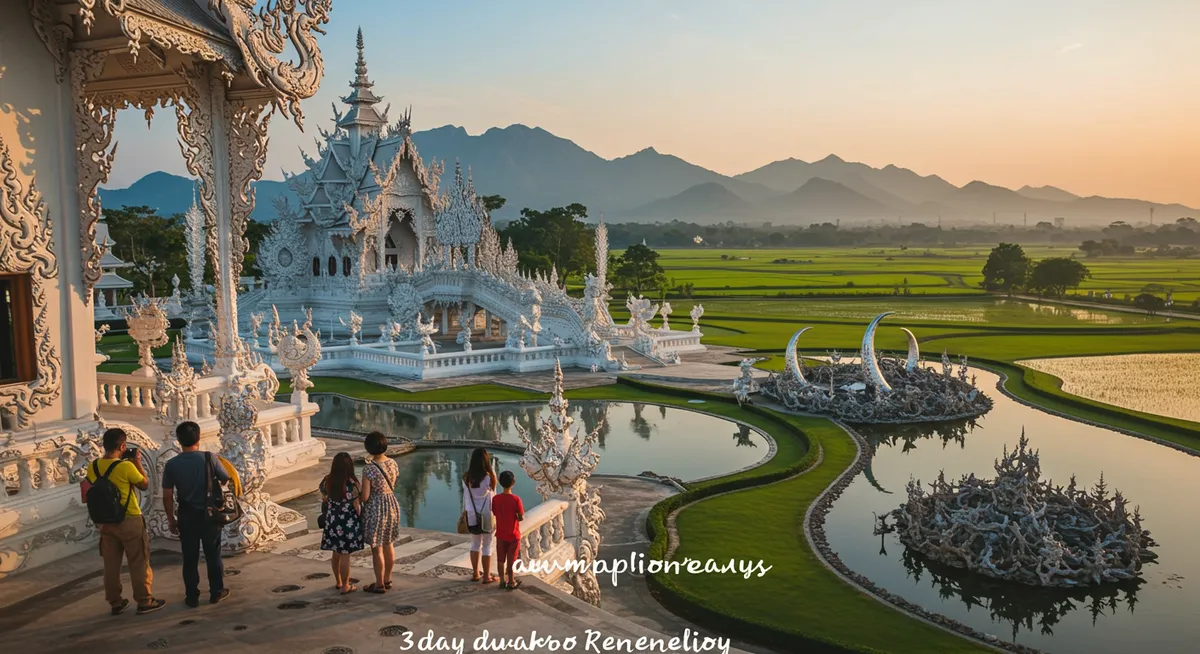
Chiang Rai sits at the northernmost tip of Thailand, a city that has quietly evolved from a transit stop into a destination in its own right. While Chiang Mai hogs the spotlight among northern Thai cities, Chiang Rai rewards visitors with world-class contemporary art, lush mountain scenery, authentic hill tribe culture, and far fewer crowds. Whether you are arriving by bus from Chiang Mai, flying in from Bangkok, or crossing the border from Laos, a well-planned Chiang Rai 3 day itinerary ensures you experience the best the region has to offer in 2026. For a broader overview of everything the city has in store, start with our comprehensive Chiang Rai travel guide.
Day 1: Temples, Art, and the City's Creative Soul
Turn this guide into a personal route with our free Chiang Rai itinerary planner.
Your first day focuses on the three architectural landmarks that put Chiang Rai on the global tourism map. Begin early at Wat Rong Khun, the White Temple, located about 13 kilometers south of the city center. Designed by artist Chalermchai Kositpipat, this glittering white structure blends traditional Buddhist architecture with surreal pop-culture references. Arrive before 9 AM to beat tour-bus crowds and capture the temple reflecting in its surrounding pool.
Next, head to Wat Rong Suea Ten, the Blue Temple, back in town. Completed in 2016, its deep sapphire interior and towering white Buddha are mesmerizing. Unlike the White Temple, the Blue Temple is free to enter and rarely overcrowded, making it a relaxing mid-morning stop. After the Blue Temple, drive north to the Baan Dam Museum (Black House), the late artist Thawan Duchanee's sprawling estate of dark, surreal structures filled with animal bones, pelts, and provocative sculptures. Together, these three sites offer a vivid introduction to Chiang Rai's identity as an art city. For a deeper dive into each venue, see our dedicated guide to the White Temple, Blue Temple, and Black House.
In the afternoon, explore the compact old town on foot. Visit Wat Phra Kaew, the temple where Thailand's most sacred Emerald Buddha was originally discovered, and stroll along the riverside promenade. As evening falls, make your way to the Chiang Rai Night Bazaar on Phahonyothin Road. Unlike its Chiang Mai counterpart, this market feels genuinely local — hill tribe handicrafts, hand-woven textiles, and live traditional music performances fill the open-air stage area. Street food stalls serve northern Thai specialties like sai ua (herbal sausage), khao soi, and grilled sticky rice.
Day 2: Hill Tribe Villages and Tea Plantation Highlands
Day two takes you into the misty highlands surrounding Chiang Rai, where the culture shifts dramatically from lowland Thai to the diverse traditions of the Akha, Lahu, Yao, and Karen peoples. Hiring a private driver or joining a small-group tour is the most practical way to cover these scattered sites. For all your transport options, check our guide on getting around Chiang Rai.
Start with a morning visit to an Akha or Lahu hill tribe village. Many communities welcome visitors and offer homestay experiences where you can learn about traditional weaving, natural dyeing, and animist spiritual practices. Always engage respectfully — ask permission before photographing, purchase handicrafts directly from artisans, and follow your guide's lead on cultural etiquette.
After lunch, continue to the Choui Fong Tea Plantation, the largest and most scenic tea estate in northern Thailand. Row upon row of manicured tea bushes blanket rolling hillsides, creating a landscape that feels more like the highlands of Japan or Sri Lanka than Southeast Asia. The on-site cafe serves excellent matcha lattes, oolong brews, and tea-infused cakes with panoramic valley views. If time allows, visit the smaller Doi Chaang coffee village nearby, where Akha farmers produce award-winning single-origin coffee beans.
Return to town for dinner at one of Chiang Rai's standout restaurants. Northern Thai cuisine here leans spicier and more herbaceous than Bangkok fare, with dishes like nam prik ong (tomato-pork chili dip), laab moo (minced pork salad), and gaeng hang lay (Burmese-influenced pork curry). Browse our curated list of the best restaurants in Chiang Rai for specific recommendations.
Day 3: The Golden Triangle and Mekong River
Your final day ventures to the Golden Triangle, roughly 60 kilometers northeast of the city, where the borders of Thailand, Laos, and Myanmar converge at the confluence of the Ruak and Mekong rivers. This region was once the world's largest opium-producing area, and its complex history is preserved at the Hall of Opium Museum, a modern, well-curated facility that traces the global story of opium from ancient medicinal use through colonial-era trade to modern narcotics enforcement. Allow at least 90 minutes for the full exhibition.
After the museum, walk to the riverside viewpoint where a large golden Buddha statue marks the exact tri-border point. From here, you can take a longtail boat cruise along the Mekong, passing the Laotian shore and the small Myanmar trading post of Tachileik. Some boat operators offer a brief stop at a tiny Laotian island with a market — a fun novelty, though prices are inflated. For a comprehensive guide to this entire area, see our Golden Triangle tour guide.
On the drive back to Chiang Rai, stop at Wat Huay Pla Kang, a massive hilltop temple complex featuring a nine-tiered pagoda and a 69-meter-tall Guan Yin statue visible from kilometers away. The views from the upper levels span across the entire Chiang Rai valley. It is an unforgettable way to close out your three days in the north.
Practical Tips for Your 2026 Chiang Rai Trip
Best time to visit: The cool, dry season from November through February offers the most comfortable weather, with daytime temperatures around 25-28°C and cool evenings. March to May is the hot and smoky season (burning season haze can reduce visibility). June through October brings monsoon rains but also lush green landscapes and fewer tourists.
Getting there: Mae Fah Luang International Airport (CEI) receives direct flights from Bangkok (Suvarnabhumi and Don Mueang). Buses from Chiang Mai take approximately three hours via the scenic Route 118. Cross-border arrivals from Laos via the Fourth Thai-Lao Friendship Bridge are also straightforward.
Budget: Chiang Rai is significantly cheaper than Chiang Mai or Bangkok. Budget travelers can manage on 800-1,200 THB per day (accommodation, food, local transport). Mid-range visitors should budget 2,000-3,500 THB per day including private transport and nicer restaurants.
Accommodation: The city center near the Clock Tower and Night Bazaar is the most convenient base. For a quieter experience, consider riverside guesthouses along the Kok River. Our where to stay in Chiang Rai guide breaks down the best neighborhoods and hotels by budget.
Beyond 3 Days: Extending Your Stay
If your schedule allows extra time, Chiang Rai province has far more to offer beyond this core itinerary. The Doi Tung Royal Villa and Mae Fah Luang Garden showcase the late Princess Mother's reforestation and community development projects in stunning mountain gardens. Phu Chi Fah, a dramatic cliff-edge viewpoint near the Laotian border, rewards early risers with a sea of clouds at sunrise — it is one of the most photogenic spots in all of Thailand. The hot springs at Huai Mae Sai offer a relaxing half-day excursion, and the border town of Mae Sai lets you walk across into Myanmar for a few hours of market browsing. For unique experiences most visitors miss entirely, explore our guide to Chiang Rai hidden gems and local experiences. If you have five full days, our Chiang Rai 5-day itinerary incorporates all of these additions into a detailed plan.
Frequently Asked Questions
What is the best time to visit Chiang Rai in 2026?
Is 3 days enough for Chiang Rai?
How do I get from Chiang Mai to Chiang Rai?
What should I budget for 3 days in Chiang Rai?
Do I need a car to get around Chiang Rai?
Is Chiang Rai safe for solo travelers in 2026?
A Chiang Rai 3 day itinerary in 2026 strikes the perfect balance between cultural immersion, natural beauty, and historical exploration. From the dazzling White Temple to the misty highlands and the storied Golden Triangle, northern Thailand's quieter capital delivers experiences that rival — and often surpass — its more famous neighbors. Pack light layers for cool mornings, bring a sense of curiosity, and let Chiang Rai surprise you at every turn.