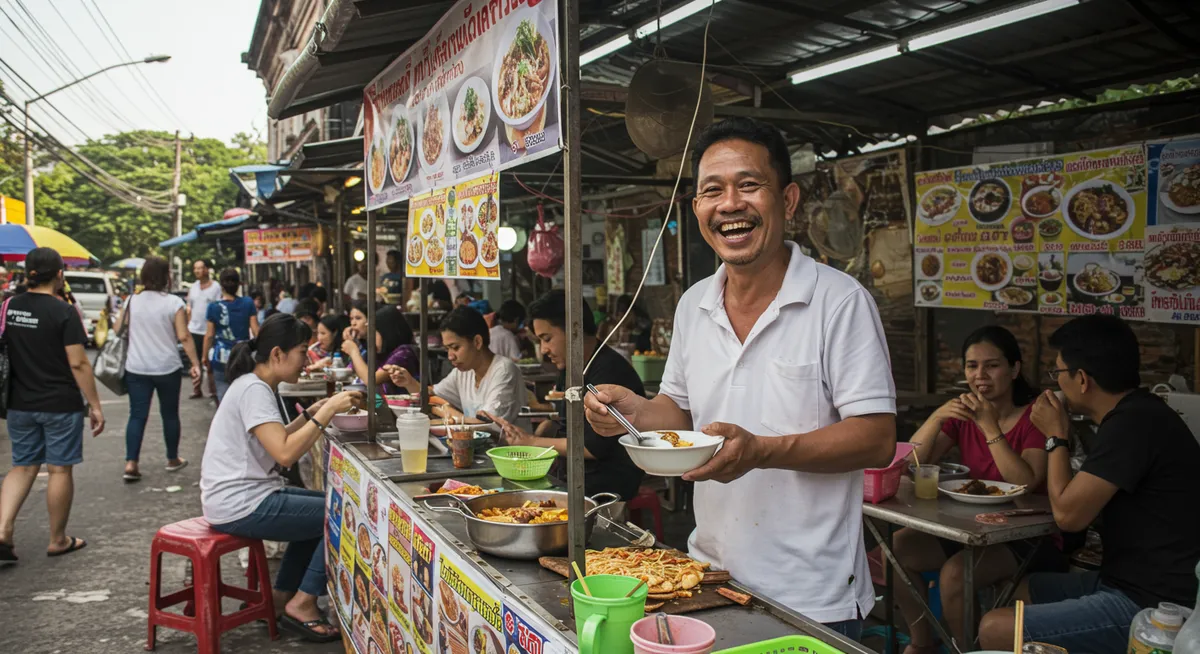
TL;DR: Ayutthaya is a food destination as rich as its temple ruins. The must-try dishes in 2026 include boat noodles (Kuay Tiao Ruea), giant freshwater prawns, Roti Sai Mai, and fiery som tam. Head to Hua Ro Market for heritage street food, Kong Khong Market for traditional desserts, and the riverside restaurants along Uthong Road for grilled prawns. Budget roughly 100–300 THB per meal at local eateries — cash only at most stalls.
Ayutthaya's UNESCO-listed temples draw millions of visitors each year, but the ancient capital's culinary heritage is equally impressive — and far less crowded. As a former Siamese capital that once hosted traders from China, Portugal, Japan, and Persia, Ayutthaya developed a layered food culture that survives in its markets, riverside kitchens, and street stalls to this day. This guide covers the best local food in Ayutthaya for 2026, including signature dishes, the best markets and restaurants, practical dining tips, and answers to the most common questions travelers ask.
Signature Dishes You Must Try in Ayutthaya
Turn this guide into a personal route with our free Ayutthaya itinerary planner.
Every Thai city has its own food identity, and Ayutthaya's revolves around river cuisine, Muslim-influenced sweets, and central Thai flavors. These are the dishes that define the city's culinary character.
Boat Noodles (Kuay Tiao Ruea)
Boat noodles are Ayutthaya's most famous contribution to Thai cuisine. Originally sold from wooden sampans gliding through the city's canals, these small bowls of intensely flavored noodle soup feature rice noodles in a dark pork or beef broth enriched with roasted pig's blood, dried spices, and herbs. The portions are intentionally small — roughly the size of a teacup — so the tradition is to order multiple bowls and stack them as you go. Pa Lek, located at Khlong Makham Riang Road, is considered the benchmark for authentic boat noodles in Ayutthaya. Most bowls cost just 15–20 THB each in 2026, making it one of the most affordable meals in the city.
Giant Freshwater Prawns (Kung Mae Nam)
Ayutthaya sits at the confluence of three rivers, and the surrounding waterways support farms producing enormous freshwater prawns prized across Thailand. These prawns — often as long as your forearm — are typically grilled over charcoal and served with a spicy seafood dipping sauce (nam jim seafood). The head contains a rich, creamy paste that locals consider the best part. Several large riverside restaurants along Uthong Road on the south side of the island specialize in these prawns, with Ban Mai Lim Nam being one of the most popular. Expect to pay 400–800 THB per plate depending on size, but the experience is worth every baht.
Roti Sai Mai
This iconic Ayutthaya sweet reflects the city's historic Muslim community. Delicate threads of hand-spun palm sugar candy are wrapped inside thin, colorful crepes. The process of spinning the sugar into gossamer strands is mesmerizing to watch — vendors twirl the molten sugar around two metal poles at remarkable speed. Modern variations now include pandan, strawberry, chocolate, and coconut flavors. The epicenter is "Roti Road" along Uthong Road, where dozens of vendors sell fresh Roti Sai Mai from morning until late evening. A bag of crepes with sugar threads typically costs 40–60 THB, making it an ideal souvenir or on-the-go snack.
Som Tam and Isaan-Style Street Food
While som tam (papaya salad) originated in Thailand's northeast, Ayutthaya's version has its own character. Ban Somtum, a local favorite, serves fiery Isaan-style papaya salad with fermented fish sauce (pla ra), dried shrimp, and crushed peanuts alongside sticky rice and grilled chicken (gai yang). The combination of sour, spicy, sweet, and salty flavors in a single plate makes this one of the best local food in Ayutthaya experiences for those who enjoy bold, punchy tastes.
Moo Sarong (Deep-Fried Pork in Noodle Wraps)
This Ayutthaya specialty features seasoned minced pork wrapped in thin egg noodles and deep-fried until golden and crispy. The result is a satisfying crunch giving way to juicy, well-spiced pork. You will find Moo Sarong at most night market stalls and local restaurants. It is often served as an appetizer or snack alongside sweet chili sauce.
Best Markets and Food Streets in Ayutthaya (2026)
Ayutthaya's markets are where the city's food culture truly comes alive. Each market has a distinct personality, and visiting at least two or three gives you the widest range of flavors.
Hua Ro Market
Established over a century ago, Hua Ro Market is Ayutthaya's most historic fresh market. Hawkers who have been selling their specialties for over 40 years serve fried clams, pad Thai, fried tofu, noodle soup, and traditional fresh coconut ice cream. The market is busiest in the early morning, making it a perfect first stop before you begin exploring Ayutthaya's must-see temples.
Kong Khong Market
Kong Khong Market specializes in traditional Thai desserts and heritage snacks. Vendors dress in period costumes, and the market is designed to evoke the atmosphere of old Ayutthaya. Look for khanom buang (crispy Thai crepes), khanom krok (coconut pudding cups), and mango sticky rice during the mango season from April to June.
Ayutthaya Night Market
The night market near Phra Nakhon Si Ayutthaya train station is the most accessible evening food destination. Stalls line both sides of the road offering grilled meats, seafood, fried insects, fruit shakes, and Thai-style crepes. Prices rarely exceed 60 THB per dish, and the atmosphere is lively without being overwhelmingly crowded. If you are deciding between an Ayutthaya day trip or overnight stay, the night market alone is a compelling reason to stay the night.
Ayutthaya Floating Market
While more tourist-oriented than Hua Ro or Kong Khong, the Floating Market offers a scenic waterfront setting where you can sample Thai desserts, grilled meats on sticks, and local coconut-based sweets. It is a pleasant stop if you are combining food exploration with the Ayutthaya river boat trip experience.
Top Restaurants and Dining Spots
Beyond the markets, several sit-down restaurants in Ayutthaya serve excellent local cuisine in more comfortable settings.
- Ban Mai Lim Nam — Riverside restaurant famous for grilled giant prawns, tom yum kung, and stir-fried morning glory. Tables overlook the river, and the sunset views are outstanding.
- Pa Lek Boat Noodles — The gold standard for boat noodles. Simple, no-frills shop where you can easily eat 8–10 bowls and still pay under 200 THB.
- Baan Kao Nhom — A charming traditional Thai house turned restaurant serving central Thai dishes including massaman curry, green curry, and pad kra pao in a garden setting.
- Coffee Old City — A cafe near the temple zone serving Thai fusion dishes, quality coffee, and homemade cakes — a good option when you need a break from street food.
- Lung Lek — Locals queue here for tom yum boat noodles and braised pork leg over rice. Portions are generous and prices stay under 80 THB.
For a well-rounded food itinerary, pair your culinary exploration with a visit during the best time to visit Ayutthaya — the cool season from November to February offers the most comfortable weather for market hopping.
Bang Ian Night Market and Krungsri Night Market — Where to Go After Dark
Ayutthaya's two principal night markets serve distinct crowds, and knowing which to choose saves time.
Bang Ian Night Market (Bang Lan Road)
This is the market most locals mean when they say "Ayutthaya Night Market." It runs along Bang Lan Road near the western edge of the historic island, coming alive around 17:00 every evening. The stalls are dense and cheap: khao mok gai (Thai-Muslim chicken biryani, ~60 THB), muu ping (grilled pork skewers, 10–15 THB each), corn on the cob, fresh-pressed sugarcane juice (~30 THB), and several dessert stalls doing khanom buang and khanom krok. Look for the stalls selling pad see ew with wide rice noodles and crispy pork belly — a reliable 60 THB plate. The market wraps up by 22:00.
Krungsri Night Market
The Krungsri Night Market near the Krungsri River Hotel caters to a slightly more varied crowd and runs Thursday through Sunday. It is notably calmer than Bang Ian, with more seating. Standout stalls here include grilled river fish (pla chon / snakehead fish, whole grilled, 80–150 THB), Thai-style oyster omelette (hoy tod, ~70 THB), and a rotating cast of regional dessert vendors. It is a good option mid-week when Bang Ian is quieter. From here you are also a short walk from the main Roti Sai Mai cluster on Uthong Road, so combine the two in one evening circuit.
Chao Phrom Market
Chao Phrom Market, near the Chao Phrom boat pier, is a workaday fresh market rather than a tourist-oriented night market. Go early — 06:00 to 09:00 — and you will find vendors selling fresh herbs, local dried fish, pre-packed sticky rice, and made-to-order joke (rice congee, ~40 THB). It is also where locals pick up ingredients, so prices are the lowest you will find anywhere on the island. Pair a Chao Phrom morning stop with a 08:00 departure on the public ferry to the west bank temples to make the most of your morning.
Roti Sai Mai — Ayutthaya's Most Unique Sweet
No other city in Thailand produces Roti Sai Mai at this scale or with this level of craft, which is why it warrants its own section beyond the quick mention in the dish list above.
What it is: "Sai mai" literally means "silk thread" — an apt description of the gossamer strands of palm sugar candy that are the heart of this sweet. Vendors melt palm sugar with colour-giving natural ingredients (pandan for green, roselle for pink, butterfly pea flower for purple), then spin the molten sugar around two horizontal rods at remarkable speed until it forms fine, dry, slightly sticky threads. These threads are bundled and placed inside a thin, soft roti (more crepe than flatbread) and rolled up. The result is chewy, lightly sweet, and faintly floral.
Where to buy it: The highest concentration of Roti Sai Mai vendors lines Uthong Road between Chee Kun Road and U-Thong Road — locals call this stretch "Roti Road." Vendors operate from roughly 08:00 to 19:00. A bag of eight to ten crepes with a generous bundle of sugar threads costs 40–60 THB in 2026. For a MICHELIN-verified experience, seek out Roti Sai Mai Abeedeen–Pranom Sangaroon, one of the longest-running family operations on the strip. Packaged versions are also sold at Hua Ro Market and the Bang Ian Night Market, though the freshness is best at the dedicated roadside stalls.
Shelf life tip: Roti Sai Mai does not travel well — the threads absorb moisture and clump within a few hours. Buy it close to your departure time, or eat it immediately. It makes an excellent breakfast paired with a glass of hot Thai tea from a nearby stall.
Ayutthaya Dish Guide — Quick Reference Table
Use this table to plan your eating stops before you arrive. All prices are 2026 estimates at local stalls and restaurants.
| Dish | What it is | Where to try | Approx 2026 price |
|---|---|---|---|
| Boat Noodles (Kuay Tiao Ruea) | Small bowls of dark, blood-enriched pork/beef broth with rice noodles; eat 5–10 bowls | Pa Lek Boat Noodles, Lung Lek | 15–20 THB per bowl |
| Giant River Prawns (Kung Mae Nam) | Whole freshwater prawns grilled over charcoal, served with spicy seafood dipping sauce | Ban Mai Lim Nam, riverside restaurants on Uthong Road | 400–800 THB per plate |
| Roti Sai Mai | Thin crepes wrapped around hand-spun palm sugar threads; naturally gluten-flexible | Roti Road (Uthong Road), Roti Sai Mai Abeedeen–Pranom Sangaroon | 40–60 THB per bag |
| Moo Sarong | Seasoned minced pork wrapped in egg noodles and deep-fried until golden-crispy | Bang Ian Night Market, most local restaurants | 40–60 THB per portion |
| Khao Mok Gai (chicken biryani) | Thai-Muslim spiced rice with braised chicken and cucumber relish | Bang Ian Night Market (look for the Muslim stalls) | 50–70 THB |
| Grilled River Fish (Pla Chon) | Whole snakehead fish stuffed with lemongrass and grilled over charcoal | Krungsri Night Market, riverside restaurants | 80–150 THB |
| Oyster Omelette (Hoy Tod) | Crispy egg and tapioca omelette with fresh oysters or mussels, served with sriracha | Krungsri Night Market, Hua Ro Market | 60–80 THB |
| Som Tam (Papaya Salad) | Green papaya shredded and pounded with lime, chili, pla ra (fermented fish), peanuts | Ban Somtum, street stalls near markets | 40–60 THB |
| Mango Sticky Rice (Khao Niao Mamuang) | Sweet glutinous rice with fresh mango slices and warm coconut cream; best Apr–Jun | Kong Khong Market, Hua Ro Market dessert stalls | 50–80 THB |
| Rice Congee (Joke) | Silky rice porridge with minced pork, ginger, and spring onion; ideal breakfast | Chao Phrom Market, early-morning stalls near the ferry pier | 35–50 THB |
Vegetarian and Halal Food in Ayutthaya
Ayutthaya's Muslim-Thai heritage makes it one of central Thailand's better cities for halal food, and the vegetarian scene has improved steadily as visitor numbers have grown.
Halal options
Ayutthaya has a significant Thai-Muslim population centred around the Uthong Road corridor and the area west of the palace ruins. The same vendors who produce Roti Sai Mai typically operate within halal guidelines. At the Bang Ian Night Market, look for stalls flying the green crescent-moon flag — these serve khao mok gai (chicken biryani), massaman curry, and khanom jeen nam ya (rice noodles with fish curry sauce), all prepared to halal standards. The Krungsri Night Market also has a halal food cluster on its north side. Avoid the blood-enriched boat noodle broth (the non-blood version "mai sai lueat" is available on request at Pa Lek).
Vegetarian options
Look for signs reading "อาหารเจ" (ahaan jay) — a Thai Buddhist vegetarian label that means no meat, no fish sauce, and no pungent vegetables (garlic, onion). Jay stalls appear most frequently at Hua Ro Market and Kong Khong Market. Reliable meat-free dishes across any stall:
- Pad pak ruam — stir-fried mixed vegetables with oyster sauce (ask for jay sauce instead), ~50 THB
- Pad Thai jay — vegetarian pad Thai with tofu, ~60 THB
- Khanom krok — coconut pudding cups (inherently vegetarian), ~30 THB for six
- Mango sticky rice — naturally vegan, ~50–80 THB
- Roti Sai Mai — the sugar-thread version is egg-free and dairy-free; the roti itself contains egg, so ask if that matters to you
Several cafes near the Chao Sam Phraya National Museum display English vegetarian menus. If you need to verify ingredients, showing a vendor a Thai vegetarian card (widely available to download) removes any language barrier. For broader budget planning including meals, see our Ayutthaya budget travel guide.
Practical Tips for Eating in Ayutthaya
A few practical pointers will help you get the most from your Ayutthaya food journey in 2026.
- Carry cash. Most street food vendors and smaller restaurants accept only Thai baht in small denominations (20, 50, 100 THB notes). ATMs are available near the train station and major temples.
- Follow the queues. A long line at a stall is the most reliable quality signal. Thais are discerning eaters, and popular stalls turn over ingredients faster, meaning fresher food.
- Start mild, adjust later. If you are sensitive to spice, order "mai phet" (not spicy) or "phet nit noy" (a little spicy). Most cooks are happy to adjust.
- Eat early at markets. Hua Ro Market peaks between 6:00 and 9:00 AM. Night markets typically open around 5:00 PM. Arriving early gets you the freshest options.
- Rent a bicycle. The best way to food-hop across Ayutthaya's island is by bicycle — most guesthouses rent them for 50–80 THB per day. Check our Ayutthaya bike rental tips for details.
- Budget wisely. A full day of eating at markets and street stalls typically costs 300–500 THB (roughly 8–14 USD). Sit-down riverside restaurants run 200–800 THB per person depending on whether you order prawns.
Getting to Ayutthaya is easy from Bangkok — check our full Ayutthaya itinerary to plan your transport and fit the best markets into a single day.
Where to Stay for the Best Food Access
Your accommodation choice significantly affects your food experience. Staying on the historic island puts you within walking or cycling distance of Hua Ro Market, the night market, and most boat noodle shops. Riverside guesthouses along U-Thong Road offer easy access to the prawn restaurants and Roti Sai Mai vendors. For recommendations on neighborhood choices and budget-friendly options, see our where to stay in Ayutthaya guide. If you are on a tighter budget, our Ayutthaya budget travel guide covers affordable accommodation that keeps you close to the best eating spots.
Frequently Asked Questions
What is the most famous food in Ayutthaya?
Is street food safe to eat in Ayutthaya?
How much does food cost in Ayutthaya in 2026?
Are there vegetarian food options in Ayutthaya?
Is Ayutthaya food very spicy?
What is the best market for food in Ayutthaya?
What is the best night market in Ayutthaya?
Where can I eat breakfast in Ayutthaya?
Ayutthaya's food scene in 2026 remains one of central Thailand's best-kept secrets. While the temples rightly dominate most itineraries, the city's boat noodle shops, riverside prawn restaurants, and bustling markets deserve equal billing. Whether you squeeze this into a day or spend the night, arrive hungry, carry cash, and let the local flavors of this ancient capital guide your journey. Start your planning with our full Ayutthaya itinerary.