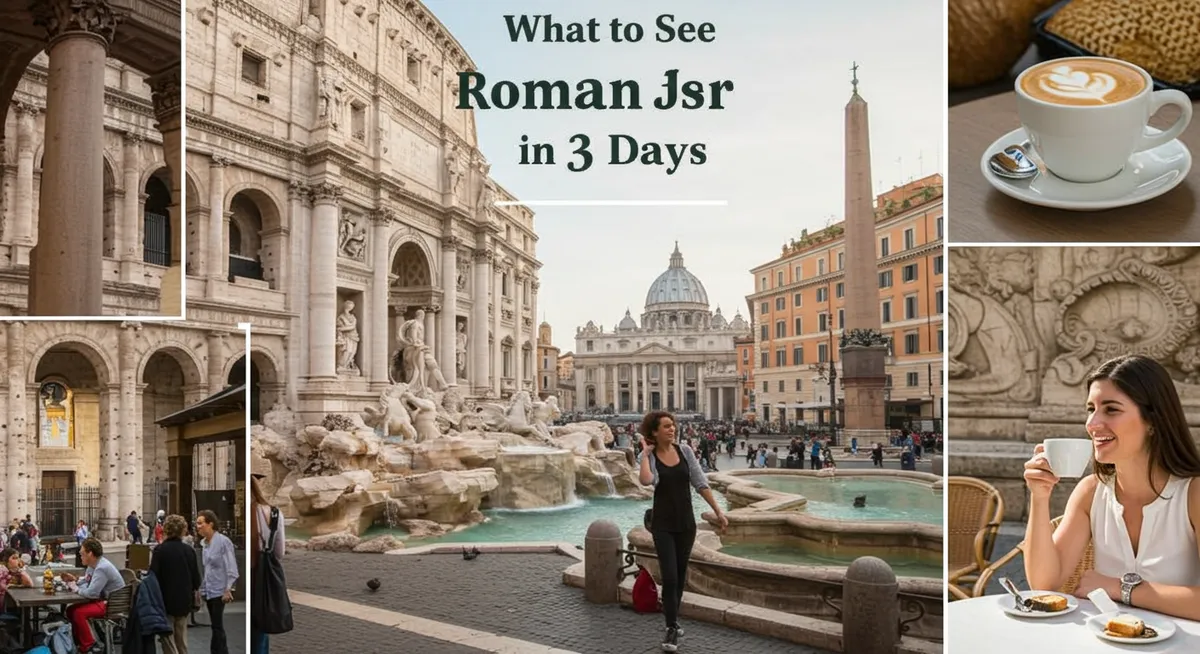
TL;DR: In 3 days in Rome, focus Day 1 on the historic center (Pantheon, Trevi Fountain, Spanish Steps, Piazza Navona), Day 2 on Ancient Rome (Colosseum, Roman Forum, Palatine Hill, Capitoline Museums), and Day 3 on Vatican City plus Trastevere. Book Colosseum and Vatican tickets well in advance, start each morning early to beat crowds, and wear comfortable walking shoes — you will cover 10+ km daily. Note the new 2026 Trevi Fountain entry fee of €2.
Why 3 Days in Rome Is the Sweet Spot in 2026
Turn this guide into a personal route with our free Rome itinerary planner.
If you are wondering what should I see in Rome in 3 days, you are in the right place. Three days gives you enough time to experience Rome's greatest hits — from ancient ruins to Renaissance masterpieces and authentic neighborhood trattorias — without feeling rushed. Rome is compact enough that the major sights cluster into logical daily routes, letting you cover the Eternal City's 2,800 years of history at a comfortable pace. Whether you are visiting Rome for the first time or returning after a few years, this 2026 itinerary balances iconic landmarks with local favorites that most tourists miss. For a broader overview of planning your trip, check out our first-time Rome itinerary guide.
Day 1: Rome's Historic Center — Fountains, Piazzas, and the Pantheon
Start your first morning at the Pantheon, one of the best-preserved ancient Roman buildings. Arrive right when it opens to experience the famous oculus light beam without jostling for position. The building, originally completed in 125 AD, remains an engineering marvel — its unreinforced concrete dome is still the largest in the world. As of 2026, entry requires a timed ticket at €5, so book ahead online.
From the Pantheon, walk five minutes to Piazza Navona, Bernini's theatrical masterpiece. The square's three fountains — including the dramatic Fountain of the Four Rivers — make it one of the most photogenic spots in Rome. Grab a coffee at one of the surrounding cafes but avoid eating a full meal here, as the tourist-trap restaurants are overpriced.
After lunch at a side-street trattoria (try the Rione Ponte neighborhood), head to the Trevi Fountain. A major 2026 update: there is now a €2 entry fee to access the fountain viewing area, introduced to manage overcrowding. Despite the fee, tossing a coin remains a Rome rite of passage. The best time to visit is early morning or after 8 PM when the crowds thin out and the fountain glows under floodlights.
End your first day climbing the Spanish Steps for sunset views over the city, then stroll down Via dei Condotti for window shopping among Rome's luxury boutiques. For dinner, head to the Monti neighborhood — just a 15-minute walk — where you will find authentic Roman restaurants at local prices. If you want to dive deeper into what is possible in a single day, see our guide on what to do in Rome in 1 day.
Day 2: Ancient Rome — Colosseum, Roman Forum, and Palatine Hill
Day two is dedicated to the ancient heart of Rome. Start at the Colosseum with a pre-booked timed entry (required in 2026). The Full Experience ticket at €22 includes access to the arena floor, underground chambers, and upper tiers — worth every cent for the perspective it provides. Arriving at 8:30 AM opening lets you explore the hypogeum tunnels before the midday crowds descend. Budget at least 90 minutes here.
Your Colosseum ticket includes same-day entry to the Roman Forum and Palatine Hill, which sit directly adjacent. Walk through the Forum's ancient temples, basilicas, and market squares where Julius Caesar once addressed the Roman people. Then climb Palatine Hill for panoramic views over the Forum below and the Circus Maximus beyond — it is the best free viewpoint in central Rome.
After lunch, cross over to the Capitoline Museums on Capitoline Hill, home to the iconic bronze statue of Marcus Aurelius and Caravaggio's painting of St. John the Baptist. The museum occupies buildings designed by Michelangelo and offers a stunning terrace view of the Forum from above.
If you still have energy, walk 10 minutes south to the Aventine Hill for one of Rome's best-kept secrets: the Keyhole of the Knights of Malta (Buco della Serratura). Peer through the keyhole in the green door of the Priory of the Knights of Malta to see a perfectly framed view of St. Peter's dome. It is free, quick, and unforgettable. Nearby, the Orange Garden (Giardino degli Aranci) offers sweeping sunset views over the city. For travelers who want to extend their stay, our 4-day Rome itinerary adds even more depth to these experiences.
Day 3: Vatican City and Trastevere
Your final day splits between the world's smallest country and Rome's most charming neighborhood. Arrive at Vatican Museums before the 8 AM opening — the line forms early, but pre-booked skip-the-line tickets eliminate the wait entirely. Budget at least 2.5 hours to walk through the Gallery of Maps, Raphael Rooms, and the awe-inspiring Sistine Chapel. Michelangelo's ceiling and Last Judgment fresco are even more powerful in person than any photograph suggests.
From the Sistine Chapel exit, head directly into St. Peter's Basilica (free entry, but expect a security line). Stand beneath the largest church dome in the world, admire Michelangelo's Pietà, and if you have the stamina, climb the 551 steps to the top of the dome for a 360-degree panorama of Rome. The Vatican is closed on Sundays except for the last Sunday of each month, when entry is free but extremely crowded — plan accordingly.
Cross the Tiber River after lunch to spend your afternoon in Trastevere, Rome's bohemian heart. Wander the ivy-draped cobblestone streets, peek into the golden mosaics of the Basilica di Santa Maria in Trastevere (one of Rome's oldest churches), and browse artisan shops along Via della Scala. For an off-the-beaten-path experience, climb up to Gianicolo Hill (Janiculum) for breathtaking 360-degree views of the entire city — arguably Rome's finest panorama, yet far less crowded than most viewpoints.
End your 3 days in Rome with a traditional dinner in Trastevere. Order cacio e pepe or carbonara at a neighborhood trattoria — Da Enzo al 29, Tonnarello, or Da Teo are reliable local favorites in 2026. For more dining ideas, explore our guide to the best food tours in Rome.
Hidden Gems Worth Adding to Your 3-Day Rome Itinerary
Beyond the headliner attractions, Rome rewards curious visitors with lesser-known treasures. The Galleria Doria Pamphilj, tucked behind an unassuming facade on Via del Corso, houses a private collection of Caravaggio, Raphael, and Titian works in ornate gilded rooms — it is far less crowded than the Vatican Museums and equally stunning. The Basilica di San Clemente near the Colosseum reveals three layers of history: a 12th-century church built over a 4th-century basilica built over a 1st-century Roman house and Mithraic temple. Descending through the layers feels like traveling through time itself.
For a quieter morning, visit the Protestant Cemetery (Cimitero Acattolico), where poets Keats and Shelley rest among towering cypress trees and wandering cats. It is one of the most peaceful places in Rome and only asks for a small donation. If rainy weather changes your plans, check our guide on what to do in Rome on a rainy day.
Practical Tips for Visiting Rome in 2026
Getting the logistics right makes the difference between a stressful trip and a magical one. Here is what you need to know for your 2026 visit:
- Book tickets early: The Colosseum, Vatican Museums, and Borghese Gallery all require advance reservations in 2026. Book at least 2-3 weeks ahead, especially for spring and summer visits.
- Best time to visit: April-May and September-October offer mild weather and smaller crowds. July and August bring extreme heat (35°C+) and peak tourist season. Read our complete best time to visit Rome guide for month-by-month details.
- Getting around: Rome's centro storico is best explored on foot. For longer distances, the Metro Line B connects Termini station to the Colosseum in two stops. Buy a 72-hour transit pass (€18) if you plan on using buses and metro frequently.
- Stay in the right neighborhood: Monti, Trastevere, and Centro Storico are ideal bases for a 3-day trip — all put major sights within walking distance. See our where to stay in Rome guide for neighborhood comparisons.
- Dress code: Shoulders and knees must be covered at St. Peter's Basilica, the Vatican Museums, and most major churches. Carry a light scarf or shawl to drape over bare shoulders.
- Water: Rome has over 2,500 public drinking fountains called nasoni (big noses). Bring a reusable bottle and refill for free throughout the day.
- Budget tip: Many churches and piazzas are free to visit. Our free things to do in Rome guide lists dozens of no-cost experiences.
Day Trips Worth Considering From Rome
If you have flexibility to extend beyond 3 days, Rome makes an excellent base for day trips. Tivoli (45 minutes by train) is home to Hadrian's Villa and the spectacular Villa d'Este with its 500+ Renaissance fountains. Pompeii and Naples are reachable in just over an hour on the high-speed train — see our guide to doing a day trip to Naples from Rome. For Tuscan scenery, our guide on day trips from Rome to Tuscany covers the best options. For a comprehensive list, see our easy day trips from Rome roundup.
Frequently Asked Questions
Is 3 days enough to see Rome?
What is the best way to get around Rome in 2026?
How much does a 3-day trip to Rome cost in 2026?
What should I pack for Rome?
Do I need to book Rome attractions in advance?
Is Rome safe for tourists in 2026?
Spending 3 days in Rome in 2026 lets you experience the Eternal City at its finest — ancient wonders, world-class art, and some of the best food on earth. With smart planning and advance bookings, you will see everything that matters while leaving room for the spontaneous discoveries that make Rome unforgettable. For help planning your complete Italy adventure, visit ItiMaker to build a custom itinerary tailored to your travel style.