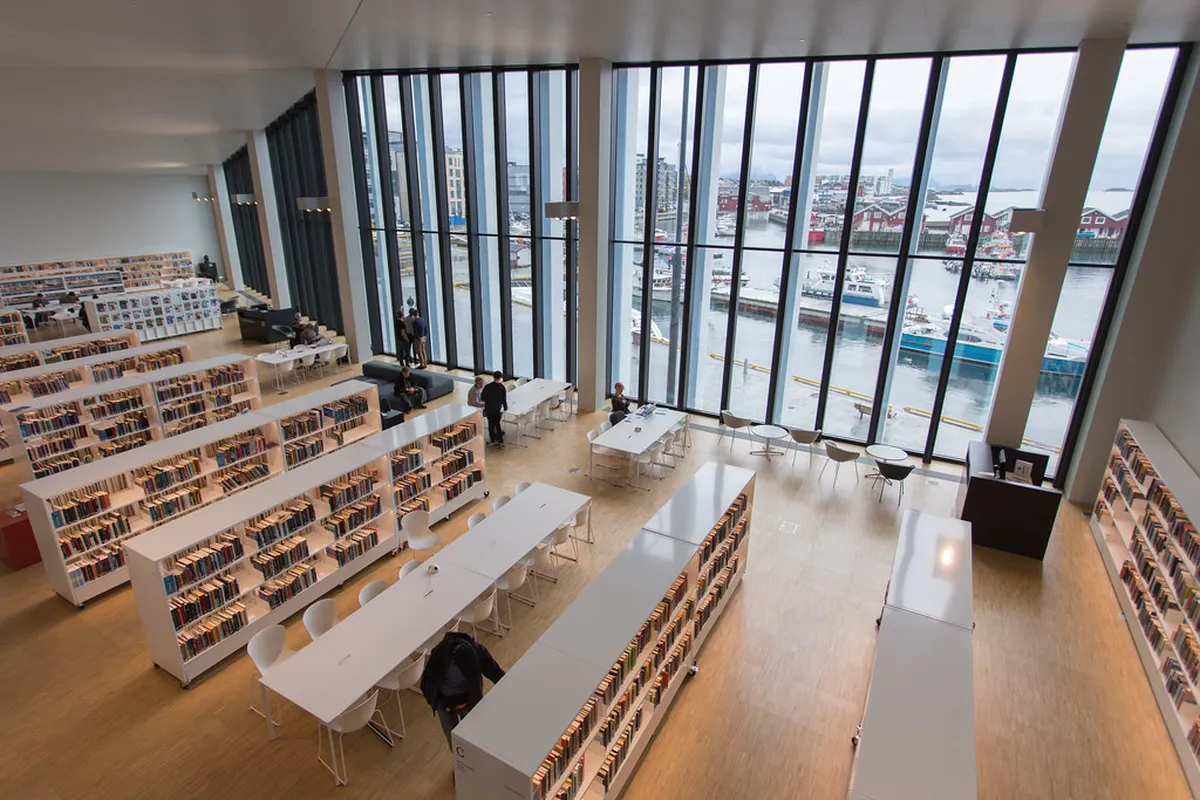
TL;DR: Stormen Library in Bodø, Norway, is a striking cultural complex designed by DRDH Architects that combines a public library and concert hall under one architectural vision. Its transparent glass facade, sculptural interiors, and deep connection to the Arctic coastal landscape make it one of Northern Norway's most important contemporary buildings. Entry is free, and the building is open year-round — making it an essential stop on any 2026 Bodø itinerary.
The Architectural Vision Behind Stormen Library
Turn this guide into a personal route with our free Bodø itinerary planner.
Stormen Library opened in 2014 as the centerpiece of Bodø's ambitious cultural quarter redevelopment. London-based DRDH Architects won the international competition to design the complex, which includes both the public library and the adjacent Stormen Concert Hall. The architects set out to create a building that would respond directly to Bodø's extraordinary Arctic setting — the vast skies, shifting light conditions, and dramatic views across the Saltfjorden to the Lofoten Wall.
The design philosophy centers on transparency and openness. Rather than creating an inward-looking institution, DRDH oriented the building to frame panoramic views of the harbor and surrounding mountains from every floor. Large glazed surfaces allow the midnight sun of summer and the deep blue twilight of polar winter to define the interior atmosphere throughout the year. This sensitivity to place distinguishes Stormen from generic modern library designs found elsewhere in Scandinavia.
The complex also represented a deliberate act of urban repair. Bodø was heavily bombed during World War II and rebuilt in a utilitarian modernist style during the 1950s. By the early 2000s, the city center felt disconnected from its waterfront. Stormen was conceived as a bridge between the commercial core and the harbor, pulling civic life toward the sea. The project succeeded: the surrounding area has since attracted new restaurants, hotels, and public spaces, fundamentally reshaping how residents and visitors experience the city center.
If you are exploring Bodø's broader built environment, the principles behind Stormen connect to wider trends in Northern Norway architecture, where designers increasingly balance contemporary ambition with Arctic environmental realities.
Key Design Features and Materials
Stormen's most immediately striking feature is its facade. The building wraps itself in floor-to-ceiling glass panels set within a grid of pale concrete. This creates an effect of layered transparency — from outside, you can see activity on multiple floors simultaneously. At night, the building glows like a lantern against Bodø's dark winter sky, serving as a literal beacon for the cultural quarter.
Inside, the material palette shifts to warm Scandinavian timber combined with exposed concrete structural elements. Oak flooring, birch shelving, and pine ceiling panels create an intimate warmth that counterbalances the building's generous scale. The architects deliberately avoided the clinical feel of many contemporary libraries by ensuring that natural materials dominate the surfaces visitors actually touch and inhabit.
A sculptural central staircase connects the library's three main floors. More than a functional element, this staircase acts as the building's social spine — a place where sightlines cross, where visitors pause to look out at the harbor, and where the vertical movement through the building becomes a spatial experience in itself. The staircase is open on all sides, reinforcing the sense of visual continuity that defines the interior.
The ground floor operates as a generous public living room. It houses the main library collection, a popular cafe, comfortable reading areas, and children's sections. The upper floors contain quieter study spaces, meeting rooms, and administrative offices. This vertical organization moves from the most public and social spaces at street level to progressively more focused environments above — a thoughtful gradient that serves different visitor needs without requiring rigid separation.
The adjacent Stormen Concert Hall shares the same architectural language but introduces acoustic requirements that produce a different spatial character. Its main auditorium seats approximately 950 people and has earned praise for its excellent sound quality. The hall's exterior cladding uses darker materials that complement the library's lighter tones, creating a visual dialogue between the two buildings.
Energy efficiency was integrated from the outset. The building uses ground-source heat pumps, high-performance glazing to manage heat gain and loss in Bodø's extreme seasonal temperature swings, and mechanical ventilation systems with heat recovery. Locally sourced materials reduced transportation emissions during construction. These sustainability credentials align with Norway's national building standards and Bodø's own climate commitments.
Stormen as a Community and Cultural Hub
What sets Stormen apart from many award-winning library buildings is how thoroughly it functions as a living community space rather than a monument. On any given day in 2026, you will find teenagers studying in groups, families browsing the children's section, retirees reading newspapers by the harbor-facing windows, and tourists photographing the architecture. The building genuinely serves its city.
The library hosts a robust calendar of cultural programming throughout the year. Regular events include author readings, art exhibitions, film screenings, music performances, and workshops for children and adults. During Bodø's annual Nordland Music Festival, Stormen Concert Hall becomes a primary venue, drawing performers and audiences from across Norway and beyond.
Stormen played a significant role in Bodø's successful bid to become a European Capital of Culture in 2024. The complex demonstrated that a small Arctic city could sustain world-class cultural infrastructure. The legacy of that designation continues into 2026, with an expanded program of international exhibitions and performances that use both the library and concert hall spaces.
For first-time visitors to the city, Stormen is often the starting point for exploring what Bodø has to offer. It pairs naturally with other highlights covered in our guide to Bodø attractions for first-timers, from the Saltstraumen maelstrom to the Norwegian Aviation Museum.
The building's accessibility deserves special mention. Ramps, elevators, tactile guidance systems, and hearing loops ensure that the space is genuinely usable by everyone. Multilingual signage and digital interfaces accommodate the growing number of international visitors that Bodø attracts each year. This commitment to universal access reflects Scandinavian values around public space and equality.
Visiting Stormen Library in 2026: Practical Information
Stormen Library is located at Storgata 1A in Bodø city center, directly adjacent to the harbor. It is a five-minute walk from the main bus station and roughly ten minutes on foot from Bodø railway station. The building is impossible to miss — its glass facade and prominent waterfront position make it one of the most visible structures in the city center.
The library is open Monday through Friday from 10:00 to 18:00, and Saturday from 10:00 to 16:00. It is closed on Sundays and Norwegian public holidays. Hours may extend during cultural festivals or special events — check the Stormen website or Bodø tourism office for the latest 2026 schedule before your visit.
Admission to the library is completely free. No ticket or membership is required to enter, browse collections, use reading spaces, or enjoy the cafe. Concert hall events require separate tickets, which can be purchased online or at the box office. Popular performances sell out weeks in advance, so booking ahead is strongly recommended if your visit coincides with a scheduled event.
Photography is permitted in all public areas of the library. The best interior photo opportunities are from the upper floors looking down through the central staircase, and from the harbor-facing reading areas where the landscape frames perfectly through the glass walls. Early morning and late afternoon light produce the most dramatic effects, particularly during the shoulder seasons of spring and autumn.
Plan to spend at least 60 to 90 minutes exploring the building thoroughly. Architecture enthusiasts may want longer to study details and take photographs. The ground-floor cafe serves coffee, light meals, and pastries — it is a pleasant place to sit with a harbor view before or after your exploration.
Timing your visit well can enhance the experience significantly. Summer brings the midnight sun, which floods the building with golden light around the clock. Winter offers the possibility of seeing the Northern Lights from the upper-floor windows after dark. For detailed seasonal planning, consult our guide on the best time to visit Bodø.
Stormen's Legacy and Influence on Bodø's Future
More than a decade after opening, Stormen's impact on Bodø extends far beyond its original brief. The building catalyzed a wave of architectural investment across the city. The new Bodø City Hall, completed nearby, adopted a similarly ambitious approach to civic design. The ongoing Ny By (New City) urban development project, which will transform the former military airfield into a new city district, draws explicitly on the precedent Stormen established: that Bodø can attract world-class design talent and deliver buildings that compete on an international stage.
For travelers interested in contemporary architecture, Stormen belongs in the same conversation as other landmark Nordic libraries like Oodi in Helsinki and Dokk1 in Aarhus. What makes the Bodø example particularly compelling is its extreme context — this is a city of around 53,000 people above the Arctic Circle that built a cultural complex rivaling those in capitals with ten times the population. That ambition, and the quality of the result, makes Stormen a genuinely remarkable destination in 2026.
The building also serves as a case study in how thoughtful architecture can reshape a city's self-image. Before Stormen, Bodø was primarily known as a transit point for travelers heading to the Lofoten Islands. Today, it is increasingly recognized as a destination in its own right, with architecture playing a central role in that transformation. Stormen proved that investing in design quality for public buildings generates returns far beyond the building itself — in tourism, civic pride, and economic development.
Frequently Asked Questions
Who designed Stormen Library in Bodø?
Stormen Library was designed by DRDH Architects, a London-based firm that won an international architecture competition. The design emphasizes transparency, natural light, and a strong visual connection to Bodø's Arctic harbor landscape. The complex opened in 2014 and includes both the public library and the adjacent Stormen Concert Hall.
Is Stormen Library free to visit in 2026?
Yes, entry to Stormen Library is completely free. You do not need a membership or ticket to enter, browse the collections, use reading spaces, or visit the cafe. Only concert hall events require separate tickets, which can be purchased online or at the Stormen box office.
What are the opening hours of Stormen Library?
Stormen Library is open Monday to Friday from 10:00 to 18:00 and Saturday from 10:00 to 16:00. It is closed on Sundays and Norwegian public holidays. Hours may vary during festivals or special events, so check the official Stormen website for the most current 2026 schedule.
Can I take photos inside Stormen Library?
Yes, photography is allowed in all public areas of the library. The best spots for architectural photos include the upper floors overlooking the central staircase and the harbor-facing reading areas. Avoid using flash and be respectful of other visitors studying or reading.
How long should I spend at Stormen Library?
Plan for at least 60 to 90 minutes to explore the building properly. Architecture enthusiasts may want to allocate up to two hours to study design details, photograph the interiors, and enjoy the harbor views from different floors. The ground-floor cafe is a good place to relax afterward.
What other architectural landmarks can I visit near Stormen Library?
Near Stormen, you can visit the new Bodø City Hall, Bodø Cathedral, and the Nordland County Museum buildings. The city's post-war reconstruction architecture is also notable. For a broader architectural tour, consider exploring the Ny By development area and the Norwegian Aviation Museum, which features distinctive modernist design.
Key Takeaways
- Stormen Library, designed by DRDH Architects, is Bodø's most significant contemporary building and a landmark of Arctic architecture.
- The transparent glass facade, warm timber interiors, and sculptural central staircase create a distinctive visitor experience.
- Entry is free year-round, with the building open weekdays and Saturdays in Bodø city center.
- The complex catalyzed Bodø's transformation from a transit stop into a cultural destination, contributing to its 2024 European Capital of Culture success.
- Visit in 2026 to experience the building alongside Bodø's expanding cultural program and ongoing urban renewal.