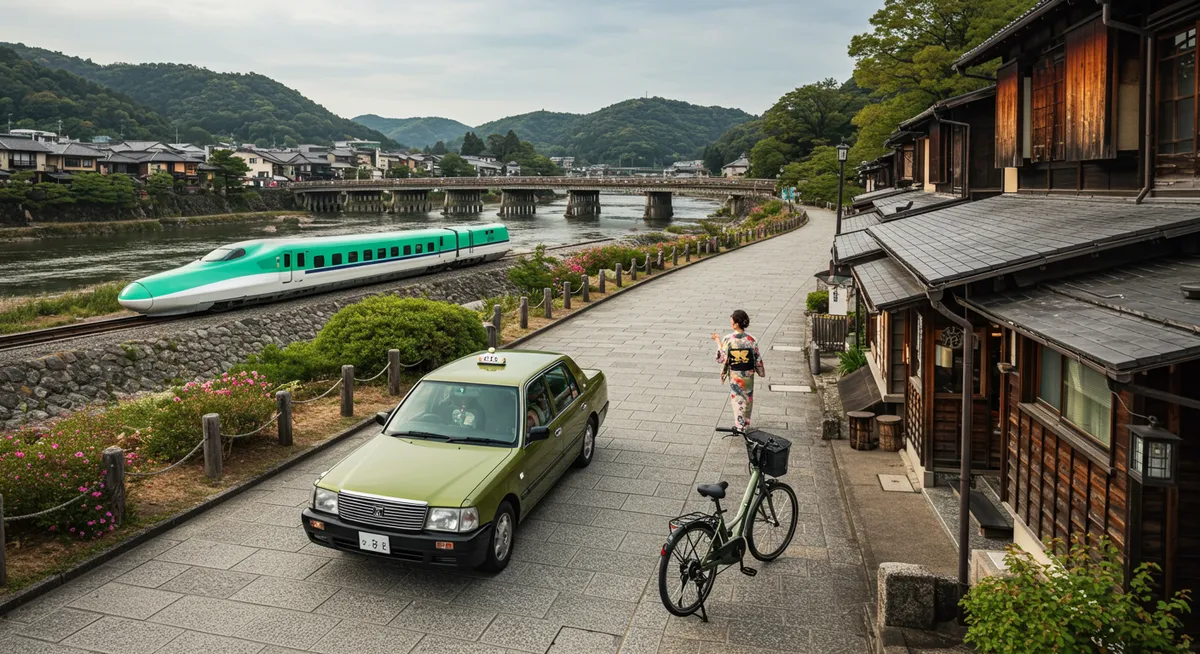
TL;DR: Kyoto's public transport network combines city buses, two subway lines, JR and private railways, taxis, bicycles, and walkable streets. For most visitors in 2026, the best strategy is to pick up an IC card (ICOCA) for tap-and-go convenience, grab a Subway & Bus 1-Day Pass (¥1,100) on heavy sightseeing days, and mix subway rides with buses to avoid traffic. This Kyoto transportation guide breaks down every option, cost, and insider tip so you spend less time commuting and more time exploring temples, shrines, and hidden backstreets.
Kyoto City Bus: The Backbone of Sightseeing
Turn this guide into a personal route with our free Kyoto itinerary planner.
The Kyoto City Bus system is the most extensive public transport network in the city, reaching virtually every major attraction from Kinkaku-ji to Fushimi Inari. Three main operators run routes across Kyoto: the Kyoto City Transportation Bureau (pale green buses), Keihan Bus (red and white), and JR West Japan Bus (white and blue). Buses run frequently, roughly every 10 to 15 minutes from early morning until approximately 10:30 PM, though last buses on some routes depart as early as 9 PM.
Kyoto City Bus uses a flat fare of ¥230 for adults and ¥120 for children within the central flat-fare zone. You board through the rear door and exit through the front, paying as you step off. If you are traveling outside the flat-fare zone, take a numbered ticket when boarding and pay the displayed fare at the front. An IC card makes this seamless since you simply tap on entry and tap again on exit.
Since June 2024, Kyoto has restructured its bus timetable to reduce overcrowding on popular sightseeing routes. Loop and main-line buses now run more frequently, and dedicated sightseeing express buses such as the EX100 (Kinkaku-ji route) and EX101 (Ginkaku-ji and Nanzen-ji route) provide direct service to top attractions with fewer stops. These express routes are included in the Subway & Bus 1-Day Pass, making them an efficient alternative to packed regular buses during peak tourist seasons in 2026.
A practical tip: buses along Shijo-dori and around Kyoto Station can experience significant delays during cherry blossom season (late March to mid-April) and autumn foliage season (mid-November to early December). On those days, combining bus rides with subway segments saves considerable time. Planning your route in advance using a well-structured Kyoto itinerary helps you avoid the worst bottlenecks.
Kyoto Subway and Train Network: Fast and Reliable
Kyoto's subway system consists of two lines that form a cross-shaped network beneath the city. The Karasuma Line runs north to south, connecting Kokusaikaikan in the north to Takeda in the south and passing through Kyoto Station. The Tozai Line runs east to west, linking Rokujizo to Uzumasa Tenjingawa and intersecting the Karasuma Line at Karasuma Oike Station. Subway fares start at ¥220 and max out at ¥360 based on distance, and trains run approximately every five to eight minutes throughout the day.
The subway is the fastest way to travel across Kyoto's core without worrying about road traffic. It is especially useful for reaching areas like Higashiyama (Tozai Line) and downtown Shijo-Karasuma (Karasuma Line). For destinations the subway does not directly serve, transferring to a bus at a subway station is often faster than taking a bus the entire way from Kyoto Station.
Beyond the municipal subway, several railway lines expand your reach across the Kansai region. JR West operates lines from Kyoto Station to Arashiyama (JR Sagano Line, about 15 minutes), Nara (JR Nara Line, about 45 minutes), and Osaka (JR Special Rapid, about 30 minutes). The Keihan Railway connects eastern Kyoto along the Kamo River corridor to Osaka, with convenient stops at Gion-Shijo and Demachiyanagi. The Hankyu Railway runs from Kawaramachi (downtown Kyoto) to Osaka-Umeda, and the Kintetsu Railway provides another route to Nara. If you are planning a day trip to Nara from Kyoto, both JR and Kintetsu offer fast, affordable connections.
The Eizan Railway deserves special mention for reaching northern Kyoto destinations like Kurama and Kibune, popular for hiking and riverside dining. And the scenic Sagano Romantic Train (Torokko) through the Hozugawa River gorge is a must-ride experience when visiting Arashiyama, though advance reservations are recommended in 2026 as tickets sell out quickly.
Transportation Passes and IC Cards: Saving Money in 2026
Choosing the right pass can significantly reduce your daily transport costs in Kyoto. The most popular option is the Subway & Bus 1-Day Pass, priced at ¥1,100 for adults and ¥550 for children. This pass provides unlimited rides on all Kyoto City subway lines, city buses (including the sightseeing express buses), Kyoto Bus, Keihan Bus, and West Japan JR Bus routes within the designated zone. Since a single subway trip costs ¥220 and a bus ride costs ¥230, you break even after just five trips, and everything beyond that is essentially free.
The 1-Day Pass also includes discount coupons for approximately 60 tourist attractions across Kyoto, adding further value beyond transportation savings. You can purchase it at subway station ticket machines, the Kyoto Station Bus Information Center, or major hotel concierge desks. For visitors staying multiple days, buying a fresh pass each morning of heavy sightseeing is the most cost-effective approach.
For broader regional travel, the Kansai Thru Pass (2-day for ¥4,480 or 3-day for ¥5,600) covers non-JR trains and buses across Kyoto, Osaka, Nara, and Kobe. This is ideal if you plan day trips from Kyoto to multiple cities. The Japan Rail Pass or regional JR Kansai passes cover JR lines but do not work on city buses or the municipal subway.
An IC card such as ICOCA, Suica, or Pasmo is essential regardless of whether you buy a day pass. These rechargeable cards work on virtually all trains, subways, and buses in Kyoto and across Japan. You simply tap the card reader when boarding and alighting, and the correct fare is deducted automatically. IC cards can also be used at convenience stores, vending machines, and coin lockers, making them an all-purpose travel wallet. In 2026, physical IC cards are available at JR station ticket machines, and mobile IC cards can be added to Apple Wallet or Google Pay for smartphone-based travel.
Taxis, Bicycles, and Walking: Alternative Ways to Explore
Taxis in Kyoto are plentiful and more affordable than in many other major cities. The base fare starts at approximately ¥500 for the first 1.2 kilometers, with incremental charges afterward. Taxis are particularly useful late at night after public transport stops running, for reaching hillside temples with limited bus service, or when traveling with heavy luggage between your hotel and Kyoto Station. Most taxi drivers do not speak extensive English, so having your destination written in Japanese or showing it on a map app is helpful.
Cycling is one of the best ways to experience Kyoto at a relaxed pace. The city is largely flat with a grid layout, making navigation straightforward. Numerous bicycle rental shops operate near Kyoto Station and in popular districts like Gion and Arashiyama, with daily rates typically ranging from ¥800 to ¥1,500. Electric-assist bicycles are also available and well worth the small premium, especially in summer heat. Dedicated cycling lanes are expanding across the city, and many temples and shrines provide bicycle parking. Cycling between eastern Kyoto sights like Kiyomizu-dera, Kodai-ji, and Nanzen-ji is faster and more enjoyable than waiting for crowded buses.
Walking remains the most rewarding way to discover Kyoto's charm. The narrow lanes of Gion, the Philosopher's Path from Ginkaku-ji to Nanzen-ji, and the torii gate trails at Fushimi Inari are all best experienced on foot. Kyoto's grid system (inherited from its original Tang Dynasty-inspired layout) makes it easy to orient yourself. Consider the best time to visit Kyoto when planning walking-heavy days, as summer humidity and winter cold can affect comfort.
Getting to Kyoto: Airport and Intercity Connections
Kyoto does not have its own airport, but it is well connected to both Kansai International Airport (KIX) and Osaka Itami Airport. The JR Haruka Express runs directly from KIX to Kyoto Station in approximately 75 minutes, with reserved seats available and discounted tickets for foreign tourists. From Itami Airport, limousine buses reach Kyoto Station in about 50 to 60 minutes.
The Shinkansen (bullet train) connects Kyoto to Tokyo in approximately 2 hours and 15 minutes on the Nozomi service, making Kyoto Station one of the most accessible major cities in Japan. If you are planning a combined trip, check out our Tokyo to Kyoto bullet train guide for detailed scheduling and fare information. Kyoto Station itself is a major transportation hub with JR lines, the Kintetsu Railway, the Karasuma subway line, city bus terminals, taxis, and long-distance highway buses all converging in one location.
Insider Tips for Navigating Kyoto Efficiently in 2026
Use Google Maps or the Navitime Japan Travel app for real-time transit directions. Both apps show live bus and train schedules, platform numbers, and walking transfer times. Google Maps is particularly reliable for bus route planning in Kyoto, often suggesting faster mixed-mode routes that combine subway and bus segments.
Avoid relying solely on buses during peak tourism periods. The combination of narrow streets, heavy pedestrian traffic, and construction can cause bus delays of 20 to 30 minutes on popular routes. Starting your day early (before 9 AM) gives you a head start at major attractions and avoids the worst crowding on public transport.
When deciding how many days to spend in Kyoto, factor in transit time between different areas of the city. Eastern Kyoto (Higashiyama), western Kyoto (Arashiyama), and northern Kyoto (Kinkaku-ji, Daitoku-ji) are spread out, and trying to cover all three zones in one day means spending significant time on buses and trains rather than enjoying the sights.
For evening outings, note that most buses and subways run until around 11 PM, but frequency drops significantly after 9 PM. Plan your return trip in advance when exploring things to do in Kyoto at night, and keep enough IC card balance or cash for a taxi as a backup.
Budget-conscious travelers should pair a 1-Day Pass with strategic walking between clustered attractions. Eastern Kyoto in particular has many temples within walking distance of each other, so you may only need two or three bus or subway rides to cover a full day of sightseeing. For more money-saving strategies, see our Kyoto budget travel tips.
Frequently Asked Questions
What is the cheapest way to get around Kyoto in 2026?
Are IC cards like ICOCA accepted on all Kyoto transportation?
Is it easy to navigate Kyoto without speaking Japanese?
How do I get from Kansai Airport to Kyoto?
Should I rent a car to explore Kyoto?
What is the best transportation app for Kyoto?
Getting around Kyoto in 2026 is straightforward once you understand the transit options available. The bus network reaches every corner of the city, the subway provides quick cross-town travel, and railways connect you to the broader Kansai region. Pair an IC card with a day pass on busy sightseeing days, mix in cycling and walking for the most atmospheric neighborhoods, and use a navigation app to optimize your routes. With the right approach to transportation, you can focus on what makes Kyoto truly special: its temples, gardens, cuisine, and centuries of living history.