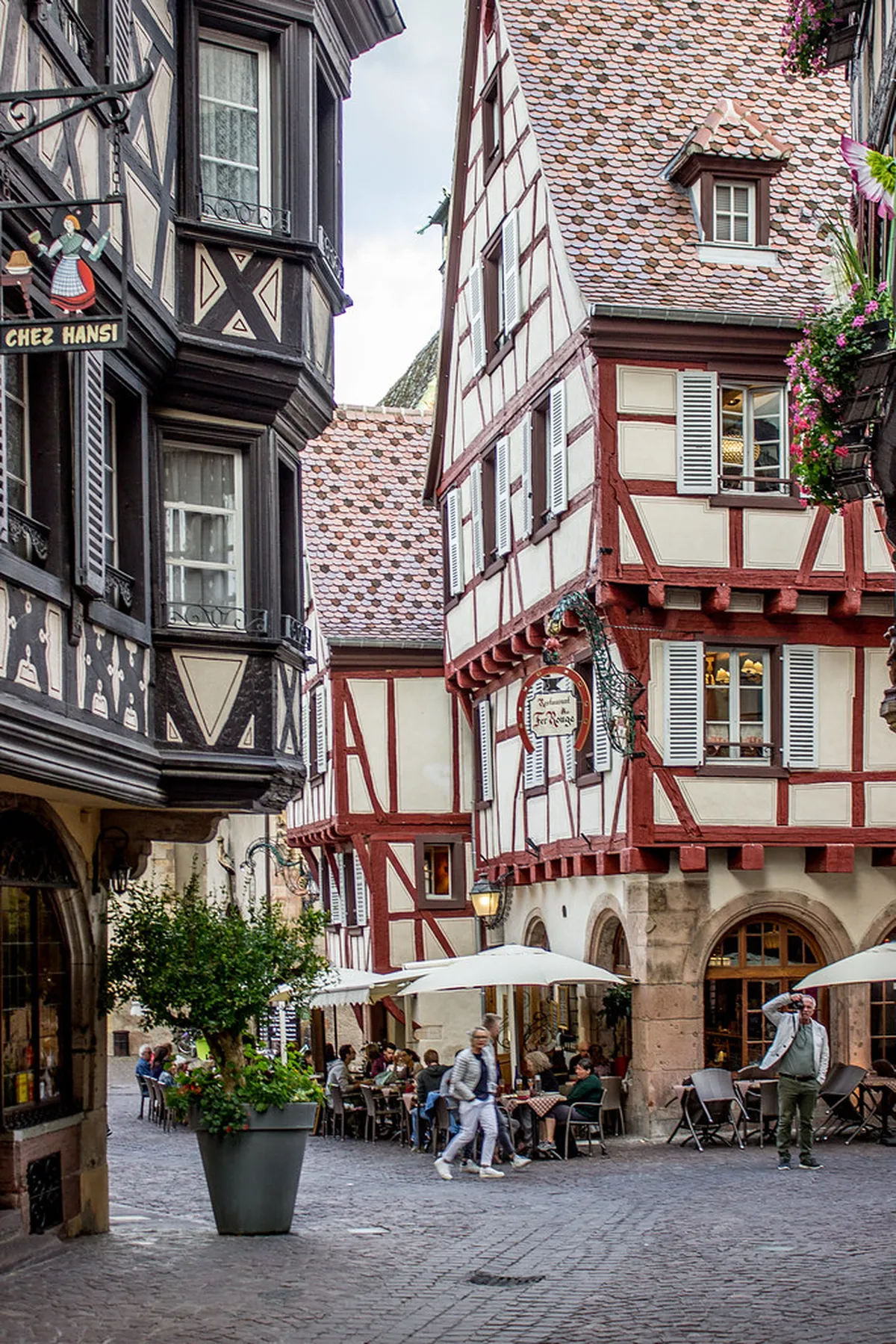
Colmar sits at the heart of the Alsace Wine Route, making it one of the best bases for exploring vineyards in northeast France. The most common booking dilemma is straightforward: half day or full day? Each format suits a different traveler, and choosing wrong can mean missing Grand Cru vineyards or rushing a village you wanted to explore.
This guide compares both formats side by side, covering itineraries, winery stops, village time, tasting logistics, and cost. Whether you have a packed schedule or a free day, the comparison below will help you book with confidence.
What Is the Alsace Wine Route (Route des Vins)?
Turn this guide into a personal route with our free Colmar itinerary planner.
The Alsace Wine Route — the Route des Vins d'Alsace — is France's oldest signposted wine trail, established in 1953. It runs roughly 170 kilometers down the eastern flank of the Vosges mountains, from Marlenheim in the north to Thann in the south, threading through more than 70 wine-growing villages. Colmar sits almost exactly halfway along the route and is the unofficial capital of Alsace wine, which is why it works so well as a base: the densest cluster of celebrated villages and Grand Cru slopes lies within a 20-minute drive in either direction.
Alsace is unusual among French wine regions because its bottles are labelled by grape variety rather than by château or appellation alone. The seven principal varieties you will meet along the route are Riesling (the region's flagship dry white), Gewurztraminer (aromatic, with lychee and rose notes), Pinot Gris (rich and sometimes off-dry), Muscat (floral and delicate), Sylvaner (light and easy-drinking), Pinot Blanc (soft and food-friendly), and Pinot Noir (Alsace's only red). On top of these, Crémant d'Alsace — the region's traditional-method sparkling wine — accounts for roughly a quarter of all production and is poured at most cellar visits as an aperitif.
The route is protected as part of a centuries-old viticultural landscape: dry-stone-walled terraces, half-timbered villages, and 51 classified Grand Cru sites whose names appear on the best bottles. Touring it from Colmar means you can sample this whole spectrum — from a €4 glass of Sylvaner in a village wine bar to a cellar-door flight of single-site Grand Cru Riesling — without ever venturing more than a short drive from the old town.
Best Wine Route Villages Near Colmar
The stretch of the wine route immediately around Colmar contains several of the most photographed villages in France. Each has a slightly different character, and which ones you reach depends heavily on whether you tour by half day, full day, or self-drive.
Riquewihr
About 15 km north of Colmar, Riquewihr is the showpiece of the route — a walled medieval village whose flower-decked main street is lined with 16th-century merchant houses. It is also the busiest, so arrive early. It is one of the easiest day trips from Colmar; see our dedicated guide to a the village of Riquewihr for timing and transport.
Eguisheim
Just 7 km southwest of Colmar and repeatedly voted one of France's favourite villages, Eguisheim is built in concentric rings around a central château, with pastel half-timbered houses and a circuit of cave doors you can walk in under an hour. It is quieter than Riquewihr midweek — our the nearby village of Eguisheim covers how to combine it with a tasting.
Kaysersberg
Around 12 km northwest, Kaysersberg pairs a ruined hilltop castle with a fortified bridge over the Weiss river and the birthplace of Albert Schweitzer. It sits below the Schlossberg Grand Cru, one of the best Riesling slopes in Alsace.
Ribeauvillé
A larger market town 16 km north of Colmar, Ribeauvillé is overlooked by three ruined castles and is home to several well-known producers, including Trimbach. It makes a natural pairing with neighbouring Hunawihr on a full-day route.
Turckheim
The closest of the famous villages — barely 7 km west of Colmar — Turckheim keeps a nightly summer tradition of a costumed night watchman doing his rounds, and sits at the foot of the Brand Grand Cru. Its proximity makes it the most common single stop on half-day tours.
Hunawihr
Tiny and tranquil, Hunawihr is famous for its fortified church ringed by vineyards and its Grand Cru Rosacker, the source of Trimbach's legendary Clos Sainte Hune Riesling. It is a tranquil counterpoint to the busier villages and is usually visited alongside Ribeauvillé or Riquewihr.
Half Day vs Full Day Alsace Wine Tours: The Core Difference
A half-day Alsace wine tour from Colmar typically runs around four hours, usually finishing before early afternoon. A full-day tour covers roughly seven to eight hours, with more winery stops and deeper village access. The difference is not just time — it shapes how many Grand Cru sites you reach and how relaxed the pace feels.
Half-day tours work best when wine is one part of a larger Colmar day rather than the main event. Full-day tours suit travelers who want the complete Route des Vins experience, including multiple villages and longer cellar sessions. If you're combining a one-day Colmar itinerary with a vineyard outing, a half day usually fits more naturally.
- Half-day tour at a glance
- Duration: ~4 hours
- Winery stops: 1–2 cellars
- Grand Cru access: limited or none
- Village time: 1 village, brief
- Cost range: ~€45–€80 per person
- Best for: time-pressed travelers, first-timers
- Full-day tour at a glance
- Duration: ~7–8 hours
- Winery stops: 3–4 cellars
- Grand Cru access: yes, typically 1–2 sites
- Village time: 2–3 villages, with free time
- Cost range: ~€95–€160 per person
- Best for: wine enthusiasts, unhurried explorers
What Each Tour Format Actually Covers
Half-day tours typically depart around 9 AM or 2 PM and visit one or two family producers along the southern wine route. Group sizes are usually small, often capped at eight to twelve participants, which keeps cellar sessions personal. Most half-day formats run as shared small-group experiences, though private options are available at a higher cost.
Full-day tours generally start between 8:30 AM and 9:30 AM and include three to four winery visits across different villages. Operators like Ophorus offer small-group full-day Alsace wine tours with air-conditioned vehicles and bilingual guides. Full-day private tours allow deeper customization — you can request specific appellations, particular producers, or a focus on one grape variety.
Both formats typically include a knowledgeable guide, transport by minivan, and curated tasting stops. Tasting fees at individual cellars are often charged separately, so budget an extra €5–€15 per winery visit. Confirm what is included in writing before booking, especially if a tour mentions "tasting costs not included" in its terms.
Alsace Grand Cru Vineyards Near Colmar
Alsace has 51 classified Grand Cru appellations, and several cluster close to Colmar in the southern wine route. Schlossberg near Kaysersberg, Kaefferkopf near Ammerschwihr, and Goldert near Gueberschwihr are among the most visited. Each Grand Cru carries its own soil character — granite, limestone, or clay — which shapes the wines in distinct ways.
Reaching Grand Cru sites meaningfully almost always requires a full-day format. Half-day tours may pass through Grand Cru vineyard land, but rarely allow time for a dedicated cellar tasting at a Grand Cru producer. If Grand Cru Riesling or Gewurztraminer is a priority, confirm with your operator before booking whether the itinerary actually includes a stop at a classified site.
The key grape varieties you will encounter across Grand Cru tastings are Riesling, Gewurztraminer, Pinot Gris, and Muscat. Sylvaner and Pinot Blanc appear more often in entry-level tastings and are excellent introductions to Alsace wine style. A good guide will explain how the same grape tastes differently depending on which Grand Cru it comes from.
The Alsace Wine Route Through Southern Alsace
The Route des Vins d'Alsace stretches roughly 170 kilometers from Marlenheim in the north to Thann in the south. Tours from Colmar typically focus on the southern stretch, which runs through the most concentrated cluster of classified vineyards. Villages like Eguisheim, Rouffach, Ammerschwihr, and Riquewihr all sit within a short drive of Colmar's center.
The landscape shifts noticeably as you move south — foothills give way to open vineyard slopes with panoramic views across the Rhine plain. Many operators follow the same core route but differ in which villages they stop in and for how long. A full-day tour covers more of this corridor, giving you time to walk village lanes rather than just viewing them from a van window.
Day Trips from Colmar to Wine Villages
Choosing which wine villages to visit depends on your tour length, your interest in crowds, and the season you travel. Riquewihr is the most visited village on the route and can feel congested in July and August — full-day tours that arrive early avoid the worst of the peak hour rush. Eguisheim offers a similar medieval character with a circular old town layout, and tends to be slightly quieter than Riquewihr outside of weekends.
Ammerschwihr is a practical stop for Grand Cru Kaefferkopf tastings and has good parking right at the village edge. Rouffach, further south, rewards full-day itineraries with its market square and access to less-known family producers. On a half-day tour, realistically expect one village stop with perhaps thirty to forty-five minutes of free walking time.
Harvest season, running from mid-September through October, brings added atmosphere but also operational constraints. Some family cellars close to outside visitors during vendange because the whole team is in the vineyard. For the best seasonal timing across wine, crowds, and access, April through June and late October offer the strongest combination of open cellars and manageable visitor numbers.
December adds another layer of complexity — the Colmar Christmas market draws very large crowds to the old town, which affects parking and transport logistics for wine tours departing from central Colmar. Wine tours still run in December and can be atmospheric, but plan for slower road access and book well ahead.
Wine Tasting Experiences in and Around Colmar
Not every wine experience requires leaving Colmar's old town. Several wine shops and small tasting rooms operate within walking distance of Place de la Cathédrale, offering Alsace wines by the glass with no transport needed. This in-town tasting option suits travelers combining wine with sightseeing, or anyone short on time who wants a flexible, self-guided approach.
Route des Vins tastings — guided and vineyard-side — provide deeper context that in-town shops cannot fully replicate. Standing in a Grand Cru vineyard while a winemaker explains the soil beneath your feet changes how the wine tastes in the glass. For hidden local producers the old town shops rarely stock, explore some of the lesser-known corners of Colmar where independent caves and wine merchants sometimes operate.
When booking a cellar visit, consider whether you want a family domaine or a larger négociant operation. Family domaines typically offer personal commentary from the winemaker, limited cuvées not sold in supermarkets, and a more informal atmosphere. Négociant cellars carry broader portfolios and run more structured visits, which can work well for groups with mixed levels of wine knowledge. Ask your tour operator which type of producer is on the itinerary before you pay — the experiential difference is significant.
You can also browse GetYourGuide for a range of Colmar wine and day tour options to compare formats and read recent traveler reviews. Reading recent reviews helps identify whether a tour genuinely reaches Grand Cru sites or just passes through the area.
Colmar Food and Wine Pairing After Your Tour
Alsatian cuisine pairs naturally with the wines you taste on tour, and knowing the logic makes dinner more enjoyable. Tarte flambée — the thin-crust Alsatian flatbread — pairs cleanly with Pinot Blanc, whose mild acidity cuts through the crème fraîche topping. Choucroute garnie, the region's signature braised sauerkraut dish, is the classic match for an off-dry Riesling.
Munster cheese, pungent and creamy, traditionally pairs with Gewurztraminer — the wine's lychee and rose notes offset the cheese's intensity. Many cellar visits on full-day tours include a brief food pairing moment, but the experience is worth repeating at a proper Colmar restaurant afterward. The Colmar covered market is a practical stop for picking up regional charcuterie, Munster, and local wines to take home.
Guided Tour vs Self-Drive vs Bike
There are three practical ways to experience the Alsace Wine Route from Colmar, and the right choice depends on whether you want to taste freely, set your own pace, or cover ground under your own power.
Guided minibus tour
The simplest option. A half-day shared minibus tour runs about €60–€75 per person and covers one to two villages with a tasting; a full-day tour costs roughly €90–€120 per person and adds two to three more cellars plus Grand Cru access. The big advantage is that everyone tastes — there is no designated driver — and a bilingual guide handles cellar bookings, which family domaines often require in advance. The trade-off is a fixed itinerary and group pace.
Self-drive with a rental car
Renting a car (around €40–€70 per day from Colmar, plus fuel) gives you total freedom over which villages and producers you visit, and the route is compact enough to see four or five villages in a day. The catch is the French drink-drive limit of 0.5 g/L — well below two glasses — so one person in your group must stay the designated driver and effectively skip the tasting, or spit rather than swallow. Parking in popular villages like Riquewihr fills early in summer.
E-bike along the vineyard cycle paths
Alsace has an excellent network of signed vineyard cycle routes, and the gentle gradients around Colmar are well-suited to e-bikes. Rentals run about €30–€45 per day. You can loop Colmar–Turckheim–Niedermorschwihr–Katzenthal, or head north toward Eguisheim, tasting modestly as you go. It is the most scenic option and removes the driving-versus-tasting dilemma, though you will cover fewer cellars than a minibus and it is weather-dependent.
| Option | Typical cost (2026) | Pros | Cons |
|---|---|---|---|
| Guided minibus (half day) | ~€60–€75 pp | Everyone tastes; no driving; cellars pre-booked | Fixed route; group pace; fewer villages |
| Guided minibus (full day) | ~€90–€120 pp | Grand Cru access; 3–4 cellars; multiple villages | Long day; least flexible on timing |
| Self-drive (rental car) | ~€40–€70/day + fuel | Full freedom; most villages per day | Designated driver can't taste; summer parking |
| E-bike | ~€30–€45/day | Scenic; no driving/tasting conflict; flexible | Fewer cellars; weather-dependent; less range |
Top Wineries & Tastings
The villages around Colmar are home to some of the most respected names in Alsace. A few are worth seeking out whether you tour with a guide or drive yourself.
Domaines worth visiting
Famille Hugel (Riquewihr) — one of Alsace's oldest wine families, making wine since 1639. Its cellar door in the heart of Riquewihr is well set up for visitors and pours everything from entry-level Gentil blends to late-harvest Vendange Tardive. Maison Trimbach (Ribeauvillé) — the benchmark for bone-dry Riesling, famous for its Cuvée Frédéric Émile and the rare single-vineyard Clos Sainte Hune. Dopff au Moulin (Riquewihr) — a pioneer of Crémant d'Alsace and a good stop if sparkling wine interests you. Domaine Weinbach (Kaysersberg) — a biodynamic estate based in the historic Clos des Capucins, producing some of the most sought-after Grand Cru wines in the region; visits are by appointment and best arranged ahead.
Tasting etiquette and typical cost
Most family domaines welcome visitors but appreciate a phone call or email ahead, especially the smaller and more prestigious ones. A standard tasting (dégustation) of four to six wines costs roughly €5–€15 per person, and the fee is often waived or deducted if you buy a few bottles — buying a bottle or two is the polite norm rather than an obligation. It is perfectly acceptable to use the spittoon (crachoir), particularly if you are driving. Greet the producer, taste from lightest to heaviest (Crémant and Sylvaner first, Gewurztraminer and sweet wines last), and don't feel you must finish every pour. Grand Cru flights cost more — often €15–€25 — because the wines themselves carry a premium.
Pricing, Booking, and Practical Logistics
Half-day shared tours typically cost between €45 and €80 per person, depending on the operator and what is included. Full-day shared tours generally run €95 to €160 per person, with some premium small-group formats reaching higher. Private tours are priced per group rather than per person — a typical private full-day tour starts around €300–€400 for up to eight participants, which works out to roughly €40–€50 per person in a group of eight.
Group tours usually require a minimum of two participants to confirm, so solo travelers should check departure guarantees before booking. Most operators offer free cancellation up to 24 or 48 hours before departure, but terms vary — always read the cancellation clause. Reserve-now-pay-later options are increasingly common and useful if your travel dates are not yet fixed.
The standard meeting point for group wine tours from Colmar is typically 1 Place Scheurer Kestner, near the main train station. Travelers staying outside the old town center should confirm whether their accommodation is within the hotel-pickup zone for private tours. Getting to Colmar itself is straightforward from Paris, Strasbourg, or Basel — see this guide on how to get to Colmar for train and transport options.
Tasting costs not included in the tour price typically add €5–€15 per cellar visit, depending on the producer. On a full-day tour visiting four wineries, budget an extra €20–€60 for tastings on top of the base tour price. Some operators bundle tasting fees into a premium tier — this is worth paying if you plan to taste Grand Cru wines, which are priced higher than standard appellation pours.
Frequently Asked Questions
What is the difference between a half-day and full-day Alsace wine tour from Colmar?
A half-day tour runs approximately four hours and typically includes one or two winery visits with limited village time. A full-day tour covers seven to eight hours, with three to four cellar stops, multiple village visits, and access to Grand Cru appellations. The core trade-off is depth versus flexibility within your broader Colmar schedule.
How many wineries do you visit on a full-day tour vs a half-day tour?
Half-day tours typically include one to two winery stops. Full-day tours cover three to four producers, often across different villages along the southern Route des Vins. The extra stops on a full-day itinerary allow for a broader comparison of grape varieties and terroir styles.
What types of wines are sampled during Alsace wine tastings?
Expect Riesling, Gewurztraminer, Pinot Gris, and Pinot Blanc as the core varieties in most tastings. Grand Cru stops may focus on a single variety from a classified site to highlight terroir character. Crémant d'Alsace, the local sparkling wine, sometimes appears as an opening or closing pour.
Can the tour be customized for dietary requirements or preferences?
Private tours offer the most flexibility for dietary requests, including vegan-friendly pairings or allergen-aware snacks. Group tours have less room for customization, so contact the operator directly before booking if dietary needs are a concern. Most cellars can adjust pours on request with advance notice.
When is the best time of year to book an Alsace wine tour from Colmar?
April through June offers open cellars, quieter crowds, and comfortable walking weather across the wine villages. Harvest season in September and October adds atmosphere but can limit cellar access as producers focus on picking. December is possible but logistically complex — the Colmar Christmas market significantly increases traffic and parking challenges near the old town meeting points.
The right Alsace wine tour format depends on how much of your Colmar trip you want to dedicate to wine. A half day makes sense when you have city sightseeing planned alongside a vineyard visit, while a full day rewards anyone who wants Grand Cru access, multiple villages, and unhurried cellar sessions. Either way, the southern Route des Vins delivers some of the most distinctive white wines in France.
Before booking, confirm whether tasting costs are included, check the cancellation window, and ask which type of producer — family domaine or négociant — features on the itinerary. Those three questions will tell you more about a tour's actual value than the headline price alone. Plan the timing around harvest closures and peak market seasons, and your Alsace wine experience will be significantly smoother.