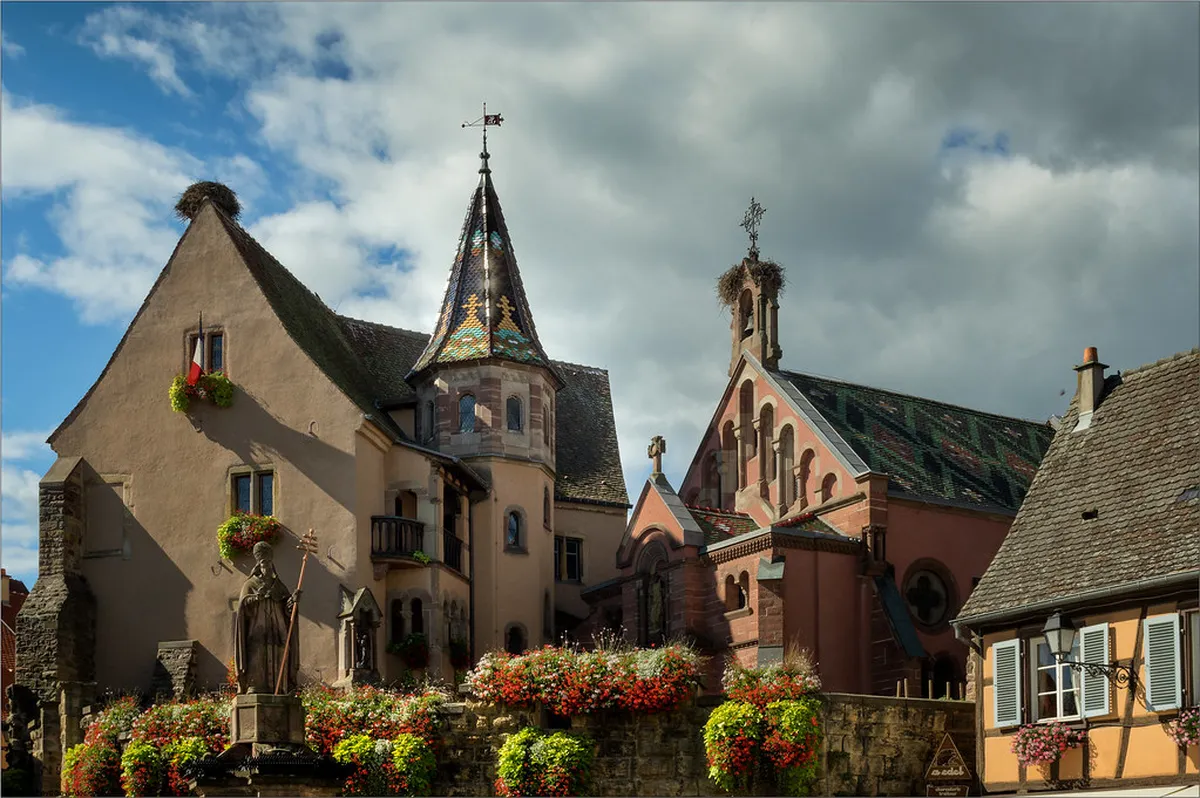
Eguisheim is one of the most complete medieval villages in Alsace and was voted Village Préféré des Français — France's favourite village — in 2013. Sitting just 6 kilometres south of Colmar, it takes under 10 minutes to reach by car and is an easy half-day addition to any our complete Colmar guide. The village is small enough to walk in an hour yet layered enough to reward an entire afternoon. In 2026, it remains one of the most visited villages on the Alsace Wine Route.
What sets Eguisheim apart from other Alsatian villages is its concentric layout. Three rings of half-timbered houses spiral inward from the outer rampart wall to the central castle courtyard, a design dictated by medieval defence. Walking any of these curved lanes feels like following the groove of a shell. The riot of geraniums, pelargoniums, and climbing roses pressed against the ancient stonework makes it the most photogenic village in the region at any time of year.
Village Préféré des Français: The Village That Won France
Turn this guide into a personal route with our free colmar itinerary planner.
The title France's Favourite Village was awarded by a nationally televised competition in 2013 and Eguisheim won by popular vote. The judges cited the near-perfect preservation of its medieval street plan, the quality of its floral displays, and the active role residents play in maintaining the village's appearance. It also holds a 4-star Ville Fleurie award — the highest grade for floral decoration in France — which it has defended consistently for decades. These two titles together explain why coach tours descend on the village every summer morning.
The historical core is built around a feudal castle founded in the 9th century. The site is also the birthplace of Bruno d'Eguisheim-Dagsbourg, who became Pope Leo IX in 1049 — a fact the village celebrates prominently in its central square. The octagonal castle courtyard still stands, ringed by the colourful chapel of Saint-Léon and surrounded by the spiral streets that grew outward from its walls over the following centuries. Understanding this origin makes the geometry of the old town immediately legible: every ring of houses is a layer of history.
Despite the accolades, Eguisheim manages to stay lived-in. Vineyards come right up to the edge of the village. Locals park their cars on the same streets visitors photograph. The wine caves are working cellars, not museums. That combination of genuine daily life and exceptional preservation is what the national vote was really recognising.
The Circular Old Town: How to Walk Rue du Rempart
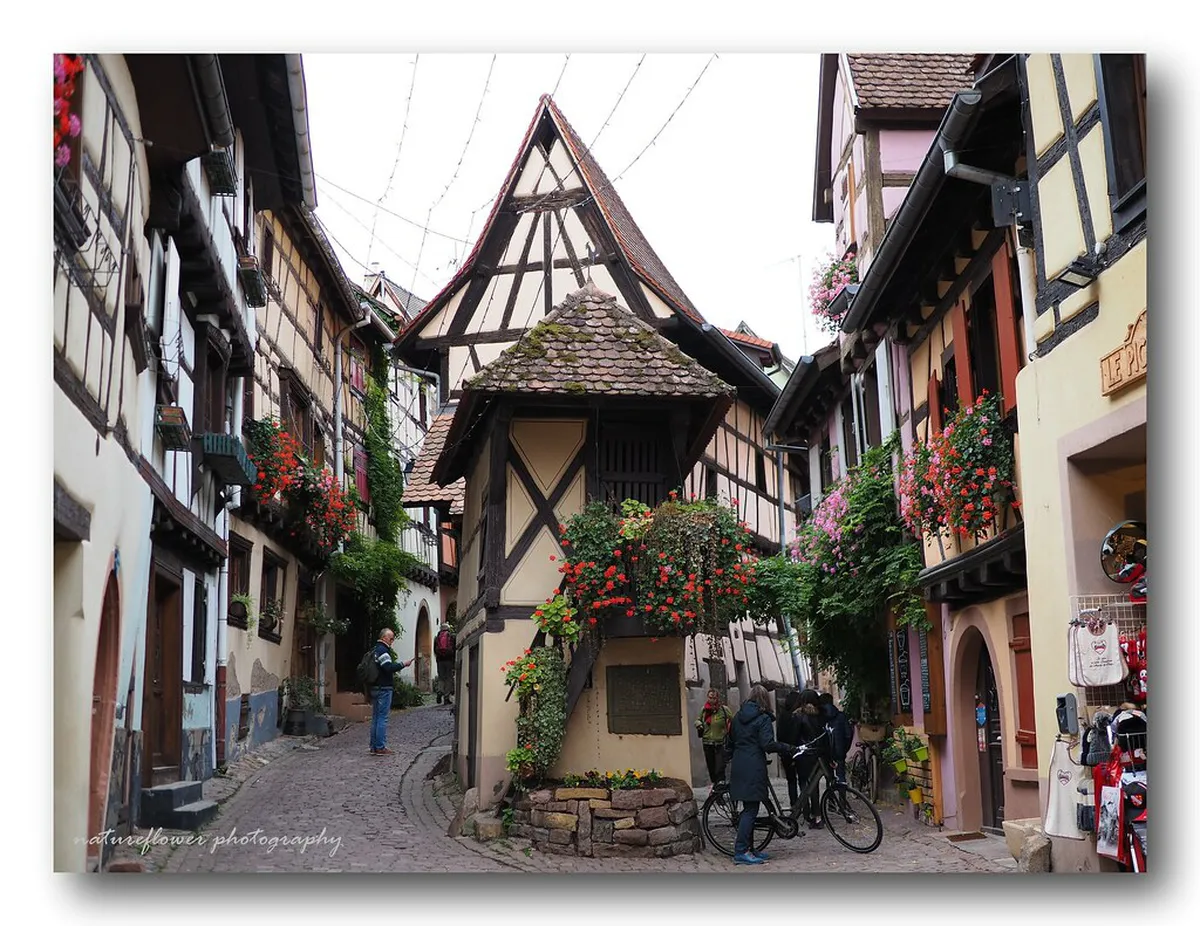
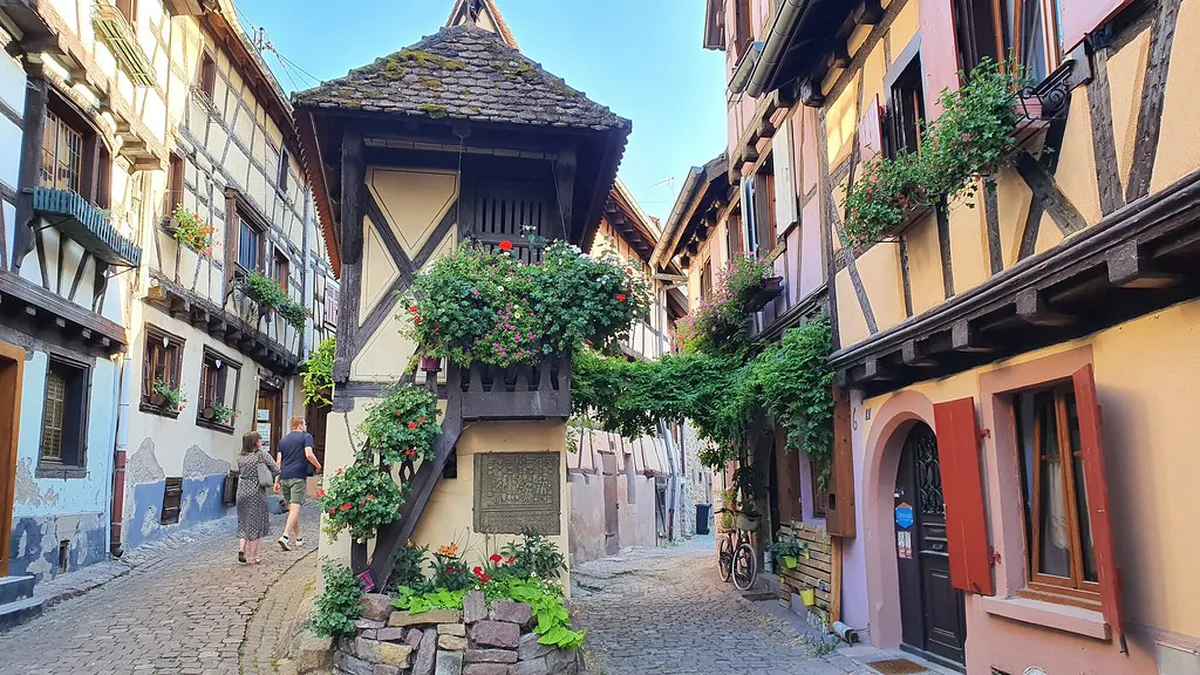
The correct way to approach the old town is to walk the outer ring first. The Rue du Rempart Sud runs along the base of the old rampart wall and is the street that defines Eguisheim's postcard identity. The houses here are pressed close together, their half-timbered facades painted in deep ochre, sage green, and terracotta. The most photographed building on this street is the Maison au Pigeonnier — a narrow, flower-smothered corner house that appears on virtually every piece of Eguisheim promotional material. Arrive before 09:00 on a summer morning to shoot it without tour groups in frame.
| Highlight | What it is | Time needed | Cost |
|---|---|---|---|
| Circular old town / Rue du Rempart | Three concentric rings of half-timbered houses spiralling in from the rampart wall to the castle courtyard | 45–60 min | Free |
| Saint-Léon chapel & fountain | Restored Romanesque chapel and the fountain topped by a statue of Pope Leo IX on the central Place du Château | 15–20 min | Free |
| Three Castles hike (Les Trois Châteaux) | Waymarked vineyard-and-forest trail to the ruined towers on the Schlossberg ridge above the village | 2–2.5 h round trip | Free |
| Wineries (Grand Cru tastings) | Walk-in cellars such as Wolfberger and Domaine Emile Beyer on the Eichberg and Pfersigberg slopes | 30–60 min | €5–8 fee (often refunded with purchase) |
From the outer ring, follow any of the spoke-like alleys inward to reach the second and third concentric rings. Each successive ring is slightly older and slightly quieter. The stonework becomes more irregular, the timber framing heavier, and the vine growth denser. This inward journey from the outer rampart to the castle courtyard covers roughly 500 years of construction layers in about 200 metres of walking.
The Place du Château at the centre is the focal point of the village. The Saint-Léon fountain stands here, topped with a statue of Pope Leo IX. The adjacent Saint-Léon Chapel is worth stepping inside: its interior features a painted Romanesque ceiling with vivid colours that have been carefully restored. Look up at the rooftops around the square and you will almost certainly spot one of the stork nests that have made Eguisheim a reliable address for these birds since the 1970s rehabilitation programme.
One detail that distinguishes Eguisheim from its Alsatian neighbours: doorways throughout the circular lanes bear carved stone lintels inscribed with the original owner's name, trade, and the year of construction — sometimes dating to the 1500s and 1600s. A carpenter, a cooper, a vintner. These inscriptions turn the whole village into a readable archive. Most visitors walk straight past them. Slowing down to read them gives a genuinely different experience of the place and rewards a second circuit of the rings.
Storks in Eguisheim: Where to See Them
The white stork is the symbol of Alsace and Eguisheim is one of the region's most reliable places to observe them. By the late 20th century the species had nearly disappeared from France due to hunting and habitat loss. A coordinated reintroduction programme began in the 1970s and Eguisheim's rooftops became an early success story. Today several breeding pairs return every spring and nest on chimneys and purpose-built platforms above the central square and the church tower.
The best time to see storks in residence is April through August, when the adults are feeding chicks. You can watch them from the Place du Château without any specialist equipment — they are large birds, visually unmissable, and largely unbothered by the foot traffic below. The distinctive bill-clattering display, used for pair bonding, is audible from street level in May and June. By mid-September most birds have left for sub-Saharan Africa on the autumn migration.
If you are visiting in 2026 outside nesting season, the stork platforms are still visible and the Tourism Office near the village entrance has a small display explaining the reintroduction history. The stork theme runs through local craft shops as well — it is the single most common motif on Eguisheim souvenirs, from painted ceramics to Alsatian cotton towels.
The Three Castles Hike: Les Trois Châteaux d'Eguisheim
The ruins of Wahlenbourg, Weckmund, and Dagsbourg sit on the forested ridge of the Schlossberg, directly above the village vineyards. Built in the 11th and 12th centuries as seats of the Counts of Eguisheim, the three towers were eventually destroyed in the 15th century during territorial conflicts. Their silhouette on the ridge line is visible from the village square on a clear day and gives Eguisheim a dramatic vertical dimension that few Alsatian wine villages can match.
The hiking trail to the ruins starts at the southern edge of the village, where the tarmac gives way to vineyard tracks. The path is well-waymarked with yellow paint blazes and climbs steadily through the Grands Crus vineyards of Eichberg and Pfersigberg before entering the forest. Allow 45 to 60 minutes each way at a comfortable pace. The ascent is moderate — around 200 metres of elevation gain — and suitable for anyone reasonably fit wearing proper footwear. Running shoes are sufficient on dry days; the path gets slippery after rain.
At the summit you get an unobstructed view east across the Rhine Plain to the Black Forest in Germany, and west over the Vosges. The ruins themselves are unfenced and free to enter at all times. There are no facilities once you leave the village, so carry water and a snack. The round trip from the village square takes roughly two to two and a half hours. This makes the castle hike the deciding factor in whether to spend a half-day or a full day in Eguisheim: factor it in if you want more than the old town circuit.
Wineries and the Alsace Wine Route
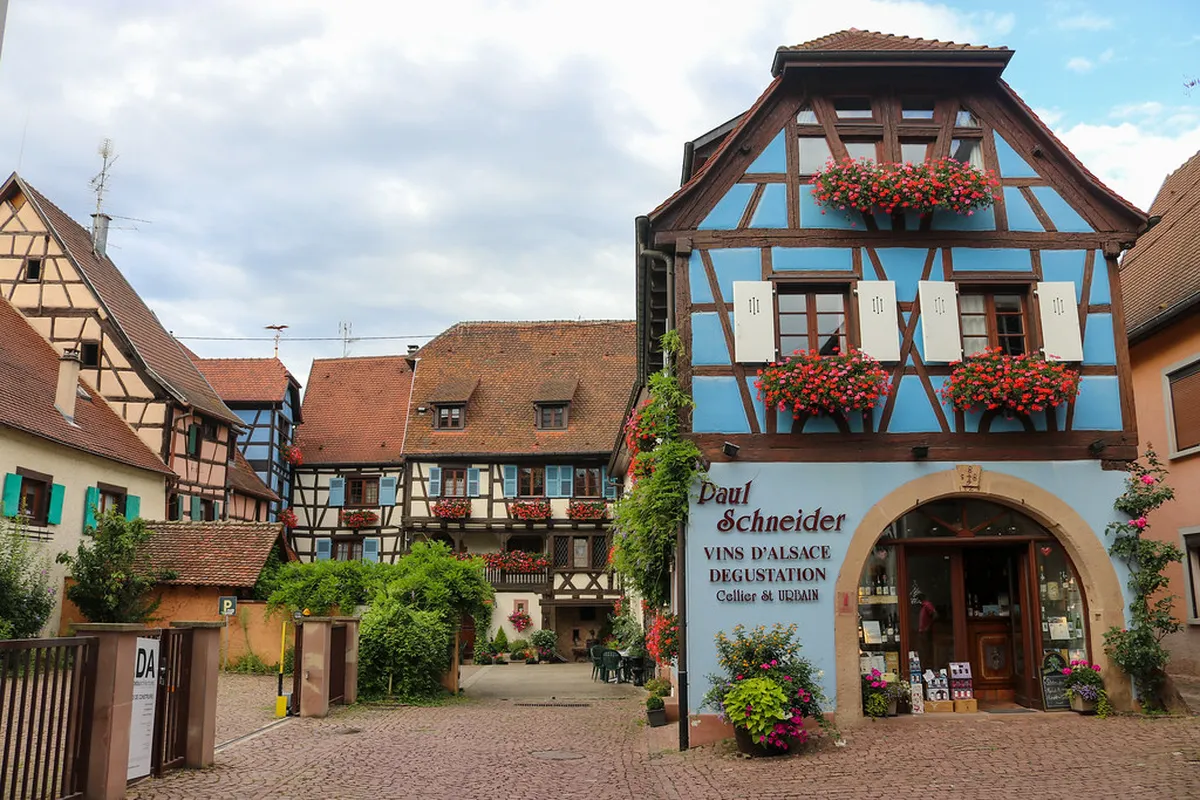
Eguisheim sits on the Route des Vins d'Alsace and is flanked by two of the region's most respected Grand Cru appellations: Eichberg and Pfersigberg. These limestone and sandstone slopes produce Gewürztraminer, Riesling, and Pinot Gris with a distinctly mineral, long-lived character. The families who farm here have often held the same plots for multiple generations. Unlike the famous Grand Crus of Burgundy, tastings at these cellars remain accessible and untouristy — you can walk in off the street at most estates.
Wolfberger is the largest cooperative in the area and its tasting room on the Route de Rouffach is professionally staffed and easy to navigate without prior wine knowledge. They produce a well-regarded Crémant d'Alsace — the local sparkling wine made by the traditional method — that represents excellent value at around €10–14 a bottle. For a more intimate visit, Domaine Emile Beyer in the village centre offers guided tastings that explain the differences between individual vineyard parcels. Book ahead for groups of more than four. A small tasting fee of €5–8 is typical at smaller domaines and is often refunded against a purchase.
The Vendanges Tardives harvest, typically in October, draws visitors who want to see the late-picked grapes being sorted before pressing. This is also when you will find the most characterful dessert wines available for tasting. Combining Eguisheim with one of the structured tours described in our Alsace wine region tours guide is the most efficient way to cover multiple producers in a single day.
Eguisheim Christmas Market
The Eguisheim Christmas market opens in late November and runs through late December, following the four Sundays of Advent. It is a fraction of the size of the Colmar or Strasbourg markets, with around 30 to 40 stalls concentrated in the central courtyard and along the Place du Château. That scale is precisely the attraction. The stalls lean toward local artisans — hand-thrown pottery, embroidered Alsatian linen, carved wooden figures — rather than the mass-produced trinkets that fill the bigger markets. There is no queue for vin chaud here.
The village is lit with warm white lights that follow the curves of the Rue du Rempart, amplifying the existing fairytale character of the architecture. On Sundays during Advent, horse-drawn carriages carry visitors along the outer ring. Saint Nicholas visits on the first and second Sundays of December, drawing local families with children. The atmosphere by early evening, when the tour coaches have gone and only local visitors remain, is as good as anything in Alsace in December.
One practical point: parking becomes scarce after 15:00 on Saturdays in December. Arrive by 14:00 or come on a weekday evening. The walk from Colmar is not practical in winter, but the bus remains a reliable option. Coordinating the Christmas market with nearby villages is covered in detail in our Colmar Christmas market guide.
How to Get from Colmar to Eguisheim: Bus 440, Car, and Bike
By car, Eguisheim is 6 kilometres south of Colmar on the D83, a straight run through the vineyard plain. The drive takes 10 minutes under normal conditions. Sat-nav will take you directly to the Parking de la Mairie, a large surface lot on the western edge of the village. This car park costs approximately €4 for all-day access and is the only sensible place to leave a vehicle — the lanes inside the circular old town are restricted to residents and service vehicles. Arrive before 10:00 in summer or before 14:00 on December weekends to secure a space before the lot fills.
By public transport, the simplest route from Colmar is bus line 440 (operated by Réseau 68), which departs from the Colmar central bus station roughly every 30 to 60 minutes on weekdays and has reduced frequency at weekends. The journey takes around 15 minutes and drops you near the village entrance. A single ticket costs around €1.50. This is the most reliable non-car option and is well-suited to solo travellers and couples who do not want to worry about parking. Timetables are available at the Colmar bus station and on the Réseau 68 website.
During summer (roughly July to mid-September), the Kut'zig tourist shuttle also links Colmar, Eguisheim, and several neighbouring wine villages on a hop-on hop-off basis. It is designed for tourists and runs less frequently than bus 440, but the circular route makes it easy to visit two or three villages in one afternoon without backtracking. Cycling is the third option: the vineyard paths between Colmar and Eguisheim are flat, well-surfaced, and scenic. The ride takes 25 to 30 minutes each way and follows a dedicated cycling track along the Route des Vins. Bike hire is available at multiple points in Colmar — see the our complete Colmar guide for hire locations and route advice.
Best Time to Visit Eguisheim and Crowd Patterns
Late spring (May to mid-June) is the best combination of good weather, full flower displays, and manageable crowds. The geraniums are freshly planted, the storks are nesting, the vineyards are vivid green, and you can walk the Rue du Rempart before 09:30 with only a handful of other visitors. Temperatures sit between 16°C and 22°C and the daylight hours allow an afternoon hike to the Three Castles after a leisurely morning in the village.
July and August bring the heaviest visitor volumes. Coach tours arrive by 10:00 and the old town fills quickly. The village is still beautiful but the experience is more crowded. If you are visiting in high summer, the practical answer is to be there before the coaches arrive or to return in the early evening after 18:00, when the day-trippers have gone and the village settles back to its local pace. September is a strong compromise: the harvest season begins, winery visits are at their most interesting, the crowds ease, and the foliage on the rampart walls turns amber and copper.
The Christmas market period (late November through December) represents a second peak, particularly on weekends. Weekday evenings in December are unusually tranquil — the market stalls are lit but the village is quiet enough to hear your own footsteps on the cobblestones. For anyone planning a Riquewihr day trip on the same visit to Alsace, note that both villages share very similar crowd rhythms: what is true of Eguisheim on a Saturday afternoon in August is equally true of Riquewihr — go early or go late.
Frequently Asked Questions
Is Eguisheim worth visiting?
Yes, Eguisheim is absolutely worth visiting for its unique circular layout and status as one of France's most beautiful villages. It offers a quieter, more authentic experience compared to larger towns like Colmar. The combination of medieval history, world-class wine, and stunning floral displays makes it a highlight of the Alsace region.
How much time do you need in Eguisheim?
Most visitors find that 2 to 4 hours is sufficient to walk the main streets, visit the castle, and enjoy a wine tasting. If you plan to hike to the Three Castles or enjoy a long lunch at a local winstub, allow for a full day. It is an ideal half-day trip when following a 1-day itinerary.
How do you get from Colmar to Eguisheim?
The easiest way is by car or taxi, which takes about 10 minutes. During the tourist season, the Kut'zig shuttle bus provides a convenient link between the two locations. Active travelers can also enjoy a pleasant 30-minute bike ride through the vineyards on well-marked paths.
Where is the best place to park in Eguisheim?
The best place to park is the designated visitor lot near the village entrance called Parking de la Mairie. It offers all-day parking for a flat fee of €4. Arrive before 10:00 AM during peak season to ensure you find a spot before the tour buses arrive.
Eguisheim captures the essence of Alsatian charm with its colorful houses and deep-rooted wine traditions. Whether you are a photographer, a wine lover, or a history enthusiast, the village offers something truly special. Taking the time to explore beyond the main square reveals the quiet magic that makes this a local favorite. It remains a vital stop for anyone exploring the the best day trips from the city.
Remember to respect the local pace of life and the residents who keep the village so beautiful. By planning your logistics ahead of time, you can focus on the fairytale atmosphere and delicious local flavors. Eguisheim is more than just a photo backdrop; it is a living piece of French heritage. We hope this guide helps you make the most of your visit to this enchanting circular village.