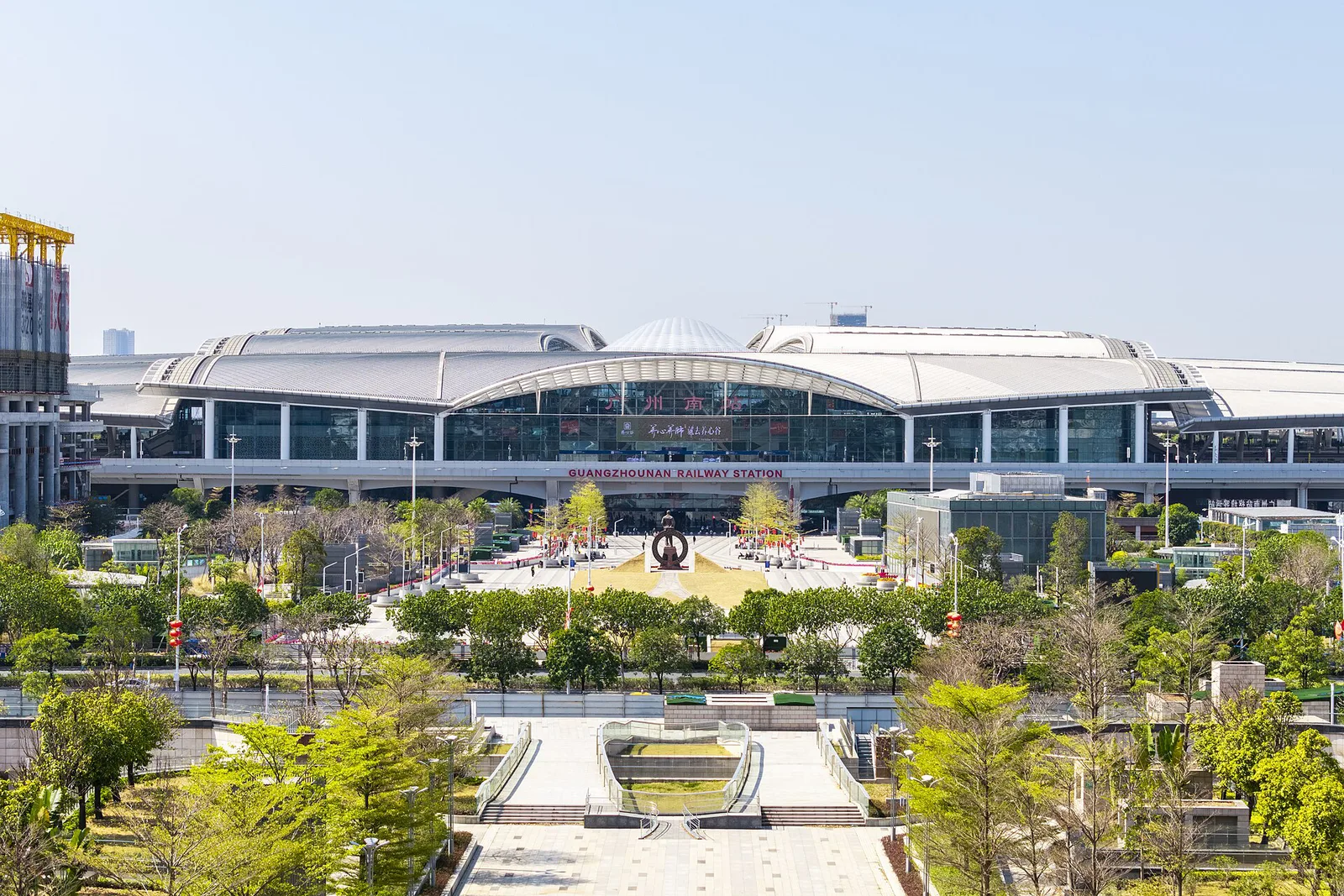
Guangzhou South Railway Station (广州南站, Guangzhounan) is the city's largest railway station and one of China's four largest railway passenger hubs. It sits in Shibi, Panyu District, about 17 km south of central Guangzhou, and it is the main departure point for high-speed trains to Hong Kong, Shenzhen and the rest of the national network.
This guide covers the routes that matter most to visitors: the high-speed train to Hong Kong West Kowloon, trains to Shenzhen North and Futian, the intercity link to Baiyun Airport, and the metro lines into the city. Fares, journey times and departure counts below are taken from the timetable for 28 October 2026. Schedules change, so check 12306 before you travel.
It also explains how real-name tickets and ID checks work, where border formalities happen on the Hong Kong route, and how long the in-station transfers take between the intercity platforms and the metro.
Guangzhou South Railway Station: Location and Overview
Guangzhou South is at 133 Nanzhan Road, Shibi, Panyu District, about 17 km (10.5 miles) south of central Guangzhou. It opened on 30 January 2010. For a time it was Asia's largest railway station by area, and it is still the largest station in Guangzhou.
The station has 28 high-speed tracks served by 13 island platforms and 2 side platforms. It is the interchange and terminus for the Guangzhou–Shenzhen–Hong Kong Express Rail Link, the Beijing–Guangzhou high-speed railway and the Guangzhou–Zhuhai intercity railway. Trains on the Guiyang–Guangzhou and Nanning–Guangzhou high-speed lines also use it.
It is one of the busiest stations anywhere. On 1 October 2026 it handled 1.049 million passengers, making it the first railway station in the world to pass one million passengers in a single day. Expect crowds on public holidays and give yourself extra time to move through the building.
Transferring to the City Center via Guangzhou Metro
The metro is the main way into central Guangzhou. Four lines serve the station: Guangzhou Metro Lines 2, 7 and 22, and Foshan Metro Line 2.
Guangzhou South is the southern terminus of Line 2, which runs north through Gongyuanqian and Guangzhou Railway Station to Jiahewanggang. At Jiahewanggang you can change to Line 3 for Baiyun Airport. Note that since 26 January 2026 Guangzhou Railway Station no longer starts or terminates conventional trains; those services moved to Guangzhou Baiyun Railway Station.
Line 22 is the quick option for the west side of the city. It reaches Fangcun in Liwan District in about 17 minutes, with transfers to Lines 1 and 11 at Fangcun and to Lines 1, 10 and the Guangfo Line at Xilang. Line 22 does not yet serve Guangzhou Baiyun Railway Station or the airport. Line 7 also stops at Guangzhou South.
You can pay at the station ticket machines, by mobile payment or with a rechargeable transit card. See our Guangzhou transport guide for more on getting around the city.
- Metro lines at Guangzhou South
- Line 2: southern terminus; runs north via Gongyuanqian and Guangzhou Railway Station to Jiahewanggang (change to Line 3 for the airport)
- Line 22: to Fangcun (Liwan District) in about 17 minutes; transfers to Lines 1 and 11 at Fangcun and to Lines 1, 10 and the Guangfo Line at Xilang
- Line 7: also stops at the station
- Foshan Metro Line 2: also serves the station
- Before you ride
- Fares and journey times depend on your destination; check the fare chart in the station or a metro app
- Payment: ticket machines, mobile pay or transit card
Taxi and Ride-Hailing Services at Guangzhou South
Taxis and ride-hailing cars are a direct option if you have heavy luggage or are heading somewhere the metro does not reach easily. Follow the 'Taxi' signs after you leave the arrivals area and use the official taxi queue rather than accepting offers from drivers inside the station.
Fares and journey times depend on traffic and where you are going; the station is about 17 km from central Guangzhou, so a taxi into the centre is not a short ride. Ride-hailing apps such as Didi are widely used in China, but set up mobile payment (WeChat Pay or Alipay) before you arrive.
Have your destination address written in Chinese to avoid miscommunication with the driver. A useful phrase: '请带我去 [destination address in Chinese]' ("Please take me to ...").
Language tip for taxis:
Guangzhou South Railway Station: 广州南站 (Guǎngzhōu Nánzhàn)
Zhujiang New Town: 珠江新城 (Zhūjiāng Xīnchéng)
Guangzhou Railway Station: 广州火车站 (Guǎngzhōu Huǒchēzhàn)
Public Bus Routes and Late-Night Transfer Options
Local buses serve the station and are a low-cost way to reach parts of Panyu and the surrounding districts. Routes, stops and timetables change, so check the latest information at the station or in a transit app before relying on a bus. You can find more Guangzhou transportation details online.
If you are travelling late, plan the whole journey in advance. On the 28 October 2026 timetable, the last departures from Guangzhou South on the main routes were:
- Hong Kong West Kowloon: last train 21:28
- Futian (central Shenzhen): last train 22:29
- Shenzhen North: last train 23:25
- Baiyun Airport East (intercity): last train 21:03
Check the last metro departure for your line on the day you travel, and keep a taxi or ride-hailing app as a backup if your train is delayed.
Private Transfer Services for International Travelers
A pre-booked private car is the least stressful option if you have a lot of luggage, are travelling as a family or group, or do not speak Chinese. The driver takes you straight from the station to your hotel, so there is no need to navigate the metro or the taxi queue.
It costs more than public transport, and prices depend on the vehicle and destination. Services such as Lokalee.app offer bookable transfers. Confirm the pickup point and the driver's contact details in advance, and share your train number so the driver can track delays.
The Interchange Process: Moving Around the Station
Guangzhou South is a very large building, and changing between rail and metro can involve a long walk. Follow the signs for your line and allow more time than you would at a smaller station.
The Guangzhou East Ring intercity trains to Baiyun Airport use Panyu intercity station, which sits underground at Guangzhou South. According to Guangzhou Daily, the transfers from Panyu intercity station take about:
- Guangzhou Metro Line 22: about 2 minutes
- Guangzhou Metro Lines 2 and 7: about 8 minutes
- Foshan Metro Line 2: about 15 minutes, because it is on the opposite side of the station
If you are connecting from a high-speed train to the airport intercity, or the other way round, build these walking times into your plan, especially on holidays when the station is at its busiest.
How to Purchase and Manage China Train Tickets
China's rail tickets are real-name. Each ticket is linked to an ID document, and you board with the same document you used to buy it. Foreign visitors use a passport recognised by the PRC government; Hong Kong and Macao residents use their Mainland Travel Permit. Keep that document on you from the entrance to the platform.
You can book through the official 12306 website or app, or through third-party sites such as Trainspread.com or Trip.com. Booking ahead is sensible on busy routes and around public holidays.
We could not find an official arrival guideline for Guangzhou South, so check your train's details on 12306 and leave a margin for crowds and the long walks inside the station.
On the Hong Kong route, border formalities are not done at Guangzhou South. When you arrive at Hong Kong West Kowloon, you clear Hong Kong and Mainland immigration in one stop on Level B2. For the return trip, MTR says passengers leaving West Kowloon can start check-in up to 90 minutes before departure. The procedures normally take 30–45 minutes, real-name checks close 30 minutes before departure, and boarding gates close 5 minutes before departure.
For more on travelling around the city, see our guide to Guangzhou transportation.
Getting to and from Guangzhou South: Main Rail Routes
Guangzhou South is the starting point for most high-speed trips out of the city. The figures below come from the timetable for 28 October 2026; check 12306 for your travel date.
Hong Kong West Kowloon
G-trains on the Guangzhou–Shenzhen–Hong Kong Express Rail Link take 47–77 minutes. The fastest, G6503, runs non-stop in 47 minutes. Second Class costs ¥215 (HK$250), First Class ¥323–344 and Business ¥645. Selected train G6507 has a ¥187 Second Class fare. There were 37 departures on 28 October 2026, the first at 06:32 and the last at 21:28.
Shenzhen North and Futian
High-speed G and C trains reach Shenzhen North in 29–50 minutes. Second Class costs ¥74.5, First Class ¥99.5 and Business ¥199.5, and there were 169 departures between 06:18 and 23:25. For central Shenzhen, cross-boundary G-trains stop at Futian in 43–60 minutes, with Second Class at ¥82 and First Class at ¥108; there were 15 departures between 06:32 and 22:29.
Baiyun Airport
The direct rail link is the Guangzhou East Ring intercity from Panyu intercity station, underground at Guangzhou South. S-trains reach Baiyun Airport East (T3) in 41–49 minutes; C-trains take 63–83 minutes. Second Class costs ¥26 to Airport East and ¥29 to Airport North. There were 29 departures, the first at 06:37 and the last at 21:03.
Terminal 1 has been closed for renovation since 7 May 2026, and trains pass through the Airport South stations without stopping; Terminals 2 and 3 are operating. Terminal 3 has no metro station, so the intercity to Airport East is the direct rail option for T3. By metro, take Line 2 to Jiahewanggang and change to Line 3. See our Guangzhou Baiyun International Airport guide for terminal details.
Beijing and other long-distance routes
Guangzhou South is a terminus of the Beijing–Guangzhou high-speed railway and is also served by the Guiyang–Guangzhou and Nanning–Guangzhou high-speed lines and the Guangzhou–Zhuhai intercity railway. Journey times and fares on these routes vary by train, so check 12306 for current options.
- Hong Kong West Kowloon
- Journey time: 47–77 minutes (G6503 non-stop, 47 minutes)
- Fares: Second Class ¥215 / HK$250, First Class ¥323–344, Business ¥645
- Departures: 37 on 28 October 2026 (06:32–21:28)
- Shenzhen North
- Journey time: 29–50 minutes
- Fares: Second Class ¥74.5, First Class ¥99.5, Business ¥199.5
- Departures: 169 on 28 October 2026 (06:18–23:25)
- Futian (central Shenzhen)
- Journey time: 43–60 minutes
- Fares: Second Class ¥82, First Class ¥108
- Departures: 15 on 28 October 2026 (06:32–22:29)
- Baiyun Airport East (T3) / Airport North
- Journey time: 41–49 minutes to Airport East on S-trains (63–83 minutes on C-trains)
- Fares: Second Class ¥26 to Airport East, ¥29 to Airport North
- Departures: 29 on 28 October 2026 (06:37–21:03)
Essential Station Facilities and Passenger Services
Guangzhou South is built to move very large numbers of people, so the main challenge for visitors is distance and crowds rather than a lack of services. A few practical habits make a visit easier.
Keep your passport or travel permit handy, since you will need it for ticket checks. Set up mobile payment before you arrive, as it is the easiest way to pay for food, drinks and metro rides. Download a metro app or save an offline map so you can find your line quickly when you step off the train.
If you need help, ask at an information desk or a staff member in uniform, and have your destination written in Chinese. Explore other things to do in Guangzhou while you plan your trip.
Frequently Asked Questions
How do I get from Guangzhou South Railway Station to the city centre?
Take the metro. Guangzhou South is the southern terminus of Guangzhou Metro Line 2, which runs north through Gongyuanqian and Guangzhou Railway Station to Jiahewanggang. Metro Line 22 reaches Fangcun in Liwan District in about 17 minutes, with transfers to Lines 1 and 11 there and to Lines 1, 10 and the Guangfo Line at Xilang. Line 7 also stops at the station.
How do I get from Guangzhou South to Baiyun Airport?
The direct rail option is the Guangzhou East Ring intercity from Panyu intercity station, which sits underground at Guangzhou South. S-trains reach Baiyun Airport East (T3) in 41–49 minutes, and second class costs ¥26. Trains to Airport North cost ¥29. On 28 October 2026 there were 29 departures, the first at 06:37 and the last at 21:03. By metro, take Line 2 to Jiahewanggang and change to Line 3. Terminal 1 has been closed for renovation since 7 May 2026, and trains pass through the Airport South stations without stopping.
How long is the train from Guangzhou South to Hong Kong, and how much does it cost?
High-speed trains to Hong Kong West Kowloon take 47–77 minutes. The fastest, G6503, runs non-stop in 47 minutes. Second class costs ¥215 (HK$250 at the October 2026 HKD rate), first class costs ¥323–344 and business class costs ¥645. On 28 October 2026 there were 37 departures, the first at 06:32 and the last at 21:28.
Do I need my passport for the Guangzhou South–Hong Kong train, and where is immigration?
Yes. Tickets are real-name, and you board with the same document you bought the ticket with. Foreign visitors use a passport recognised by the PRC government. Hong Kong and Macao residents use their Mainland Travel Permit. Border formalities are not done at Guangzhou South. When you arrive at West Kowloon, you clear Hong Kong and Mainland immigration in one stop on Level B2.
How long does it take from Guangzhou South to Shenzhen?
Trains to Shenzhen North take 29–50 minutes. Second class costs ¥74.5, first class ¥99.5 and business ¥199.5. On 28 October 2026 there were 169 departures between 06:18 and 23:25. Some cross-boundary trains also stop at Futian in central Shenzhen, taking 43–60 minutes for ¥82 in second class.
How early should I arrive at Guangzhou South?
We could not find an official arrival guideline for Guangzhou South. Check your train's details on 12306. For the return trip, MTR says passengers leaving Hong Kong West Kowloon can start check-in up to 90 minutes before departure. The procedures normally take 30–45 minutes, real-name checks close 30 minutes before departure, and boarding gates close 5 minutes before departure.
Can I transfer to Foshan Metro at Guangzhou South?
Yes. Foshan Metro Line 2 serves Guangzhou South. According to Guangzhou Daily, the transfer from Panyu intercity station to Foshan Metro Line 2 takes about 15 minutes, because it is on the opposite side of the station. The transfer to Guangzhou Metro Lines 2 and 7 takes about 8 minutes, and to Line 22 about 2 minutes.
How big is Guangzhou South Railway Station?
It is the largest station in Guangzhou and one of China's four largest railway passenger hubs. It has 28 high-speed tracks, and on 1 October 2026 it handled 1.049 million passengers in a single day.
Guangzhou South is the city's main high-speed rail hub, with direct trains to Hong Kong West Kowloon in as little as 47 minutes, frequent services to Shenzhen North and Futian, and an intercity link to Baiyun Airport East. Metro Lines 2, 7 and 22 and Foshan Metro Line 2 connect it with the rest of Guangzhou and Foshan.
Carry the ID you booked with, check your train on 12306, and allow time for crowds and the long transfers inside the station. On the Hong Kong route, remember that immigration happens at West Kowloon, not at Guangzhou South.
To fit your arrival or departure into a full trip, see our Guangzhou itinerary for 1, 3 or 5 days.
Sources: China Railway 12306 (official ticketing); Wikipedia: Guangzhou South Railway Station.