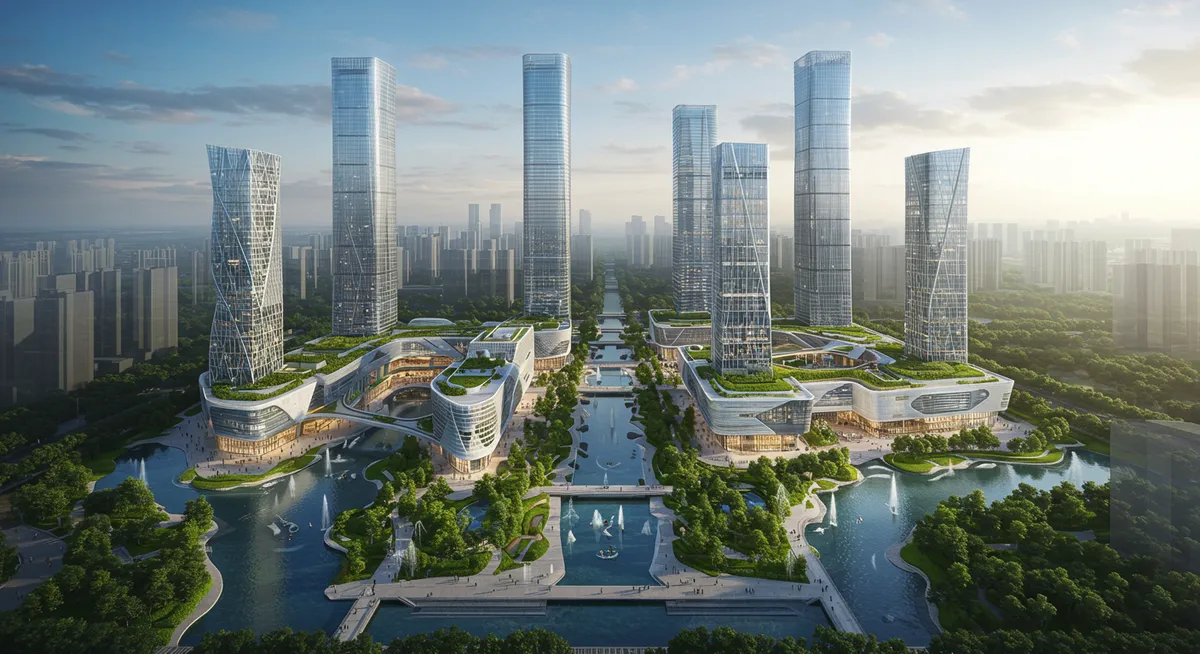
The best Zhujiang New Town architecture walk follows Guangzhou's central axis from the two finance towers to Huacheng Square's cultural buildings, then finishes at Haixinsha facing Canton Tower. Allow 90–120 minutes for the outdoor route, or half a day if entering a venue.
Turn this guide into a personal route with our free Guangzhou itinerary planner.
- Start: Zhujiang New Town Metro Station on Lines 3 and 5; Guangzhou's official event-transit guidance has identified Exit B1 for Huacheng Square, but follow live station signage.
- Finish: Haixinsha, with the APM station nearby and Canton Tower visible across the Pearl River.
- Distance: roughly 2.5–3 kilometers, depending on crossings, exterior loops, and event diversions.
- Time: 90–120 minutes outdoors; add at least 1–2 hours for one interior visit.
- Cost: the outdoor walk uses public space and needs no attraction ticket; museums, performances, tours, and Canton Tower have separate rules.
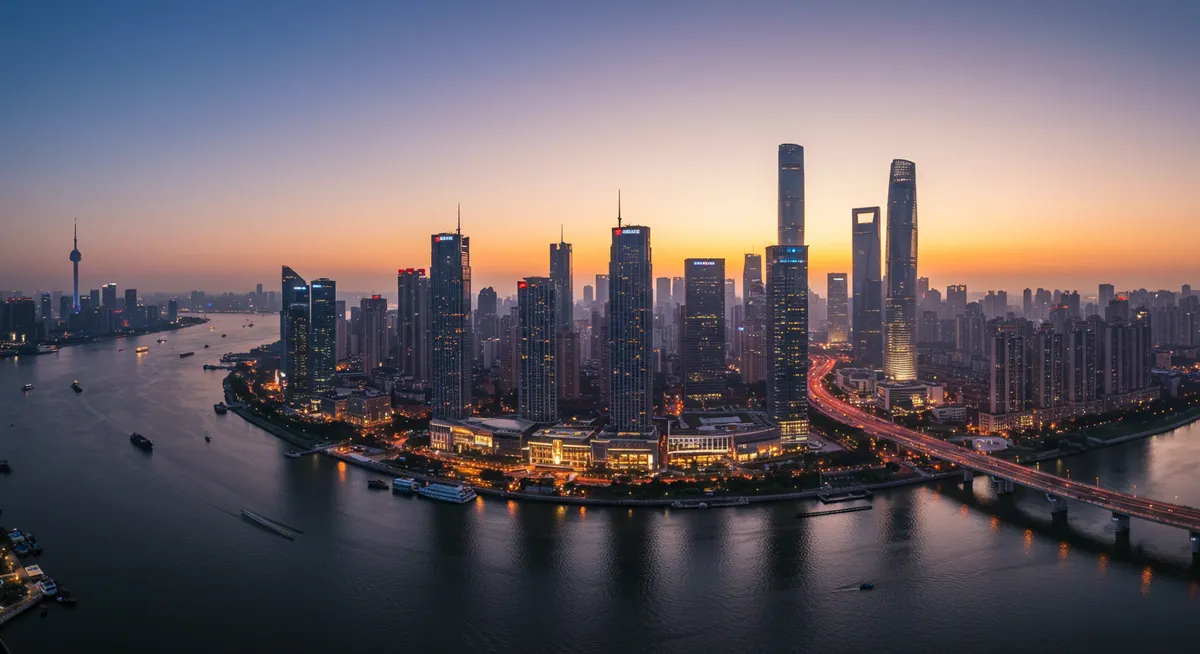
- Best timing: start 90 minutes before sunset for daylight details, blue hour, and the illuminated skyline.
- Important correction: Huacheng Square does not have a guaranteed synchronized light show every night. Verify dated festival programming before planning around a show.
Quick Plan for the Architecture Walk
Keep the core route outdoors and treat every interior as optional. This makes the walk reliable when a museum is full, the Opera House is preparing for a performance, or weather changes the pace.
| Plan item | Practical answer |
|---|---|
| Start point | Zhujiang New Town Station, then Huacheng Square's northern/central axis |
| End point | Haixinsha and the Pearl River sightline toward Canton Tower |
| Outdoor walking time | 90–120 minutes with observation and photo stops |
| Approximate distance | 2.5–3 kilometers; live detours can make it longer |
| Recommended direction | North to south, so Canton Tower becomes the visual endpoint |
| Indoor add-on | Choose one: library, museum, or a pre-booked Opera House visit |
| Weather fallback | Shorten exterior loops and use a nearby public venue or commercial concourse only if currently open |
The district rewards slow looking more than landmark collecting. At each stop, compare massing, structure, facade, public function, and the building's relationship to the central axis. The observation prompts below turn a skyline stroll into an architecture walk without requiring specialist vocabulary.
Zhujiang New Town Architecture Walk Map and Stop Order
The route forms a simple north-to-south line with short side-to-side crossings. Save the Chinese names offline and use a live local map because construction, performances, and festivals can redirect pedestrian access.
| Stop | Approximate leg | What to identify | Observation prompt |
|---|---|---|---|
| 1. Huacheng Square axis | 5–10 minutes from the metro exit | North–south civic space and paired skyline | How does the open axis make distant buildings read as one composition? |
| 2. Guangzhou IFC | About 5 minutes west | 440-meter mixed-use tower by WilkinsonEyre | Can you trace the diagonal structural grid through the glass skin? |
| 3. CTF Finance Centre | About 8 minutes across the axis | 530-meter mixed-use tower by KPF | Where do changes in proportion reveal changes of use inside? |
| 4. Guangzhou Library | 8–10 minutes south | Public library by Nikken Sekkei and Guangzhou Design Institute | How do the cleft, stone louvers, and glass respond to light and heat? |
| 5. Guangdong Museum | 3–5 minutes | Museum by Rocco Design Architects | Does the perforated volume feel like a box, a carved object, or both? |
| 6. Guangzhou Opera House | 5–8 minutes across the plaza | Performing-arts complex by Zaha Hadid Architects | Walk around one corner: how quickly do the twin forms change? |
| 7. Haixinsha | 12–15 minutes south | River edge and the sightline to Canton Tower | How does the tower complete the axis without occupying the square? |
These times are orientation estimates, not a navigation promise. Add time for traffic signals, security checks, photographs, mobility needs, and one-way crowd controls. Avoid cutting through hotel, office, or ticketed interiors to save time; every essential view is available from public outdoor approaches.
Getting There: Metro, Exit, and Route Verification
Use Zhujiang New Town Station on Metro Lines 3 or 5 for the full walk. Guangzhou's official event-transit guidance has identified Exit B1 for Huacheng Square, while the APM provides closer stops within the district.
At Zhujiang New Town Station, look for 珠江新城 and follow current signs toward Huacheng Square (花城广场). Published municipal event directions have named Exit B1, but station works or event controls can change the best path. Confirm the exit on the station map before passing the gates and follow staff directions over an old screenshot.
If the finance towers are not a priority, the APM's Guangzhou Opera House stop can place you closer to the cultural buildings. That creates a shorter loop rather than the complete north-to-south route. Haixinsha APM station is the logical finish; the Guangzhou Metro guide explains payment, transfers, airport connections, and last-train planning.
- Offline navigation: save the names 珠江新城, 花城广场, 广州图书馆, 广东省博物馆, 广州大剧院, and 海心沙.
- Exit reality check: an exit letter confirms a street portal, not a step-free route. Ask staff for the operating lift if stairs or escalators are unsuitable.
- Event days: temporary barriers may separate the most direct exit from the square. Follow the designated route rather than crossing a closed area.
- Return plan: check live APM and metro operating information before extending the walk after dark.
Step-by-Step Zhujiang New Town Architecture Route
Read the district as an urban composition before studying individual icons. The most useful sequence moves from commercial scale to civic buildings, then opens toward the river and Canton Tower.
Stop 1: Huacheng Square and the Central Axis
Begin where the open space gives you a clear north–south orientation. Huacheng Square is not just a gap between landmarks: it is the device that makes towers, cultural buildings, Haixinsha, and Canton Tower legible as one planned scene.
Look for: symmetry that is suggested rather than exact. Guangzhou IFC and CTF Finance Centre balance each other at skyline scale, but their heights, structures, materials, and internal programs differ. Farther south, the library, museum, and Opera House break the office-district rhythm with lower, more sculptural forms.
Observation prompt: stand in two positions about a minute apart. Notice which buildings disappear behind one another and which become more prominent. The central axis is experienced through movement, not from one “correct” photo spot.
Stop 2: Guangzhou International Finance Center
WilkinsonEyre designed the 440-meter Guangzhou International Finance Center as a 103-storey mixed-use building containing offices, hospitality, commercial space, and a podium complex. Its engineering is not hidden: a diagonal grid, or diagrid, is visible through the transparent envelope.
Look for: the tower's rounded triangular plan, tapering profile, and continuous diagonal structure. The architect describes the form as informed by technology rather than applied symbolism, correcting the common travel-page claim that it represents a traded gemstone.
Observation prompt: step back until the base and upper taper fit in the same view. Does the structural pattern make the tower appear lighter, or does the enormous scale still dominate? Treat lobby, restaurant, and upper-floor access as private or customer-controlled unless current signage explicitly invites visitors.
Stop 3: CTF Finance Centre
Kohn Pedersen Fox's 530-meter CTF Finance Centre was completed in 2016. It stacks offices, residences, hospitality, and a sky lobby above retail and other mixed-use facilities, with transitions in program helping organize the supertall form.
Look for: pale vertical piers and the warmer tone of the terracotta facade rather than a generic all-glass skin. KPF notes that the ceramic-clad piers shade the exterior while preserving floor-to-ceiling views, making material performance part of the expression.
Observation prompt: compare the vertical emphasis here with IFC's diagonal structure across the axis. The old article described bamboo-inspired setbacks and a public observation deck; neither is needed to understand the building, and public access should never be assumed.
Stop 4: Guangzhou Library
Nikken Sekkei and Guangzhou Design Institute co-designed Guangzhou Library, completed in 2012 as a large public library. Nikken describes an open civic institution organized around clear internal circulation, while the library's own account connects the layered form to books and accumulated history.
Look for: two masses divided by a tall central cleft, deep-set glazing, irregular stone louvers, and layered edges that change as you approach. These elements bring light inward while reducing the impression of one enormous solid block.
Observation prompt: compare the shaded facade with the finance towers' smooth envelopes. Which building communicates public access most clearly from outside?
As checked on October 15, 2026, the library's published opening hours start at 9:00 and it is closed on Wednesdays (open on public holidays). Floors 1–7 and the basement study area stay open until 21:00, but floors 8–9 and the basement exhibition hall close at 17:30. Holiday notices, weather, and service changes can override these hours, so check the official Guangzhou Library website on the day. Entry is an optional visit, not a shortcut through the route.
Stop 5: Guangdong Museum
Rocco Design Architects designed the Zhujiang New Town complex of Guangdong Museum. The museum's official description links the exterior to a traditional lacquer box and the spatial concept to Guangdong's ivory puzzle-ball craft: a “vessel” whose carved-looking outer layer contains a complex interior.
Look for: the dark red-brown perforated skin, openings of different sizes, and the way the main volume appears lifted above its setting. Move diagonally rather than inspecting only the front; the apparent depth of the outer layer changes with the angle.
Observation prompt: compare the museum with the library next door. Both are major civic containers, but one reveals an open cleft while the other protects an inner world behind a patterned shell.
As checked on October 15, 2026, the museum's official visitor guide lists standard hours of 9:00–17:00, Tuesday to Sunday, with last entry at 16:00; it is closed on Mondays except national holidays. General admission is free, but every visitor needs a real-name, timed reservation through the museum's official WeChat account (“Guangdong Museum”), which the museum describes as its only booking channel. Tickets are released at 22:00, each order covers up to five people, and you verify your ID at the West Gate. The extended evening hours (to 21:00) ran only from July 1 to August 30, 2026 and have ended. Check the official museum site for holiday changes and paid special exhibitions.
Stop 6: Guangzhou Opera House
Zaha Hadid Architects completed Guangzhou Opera House in 2010. Its two asymmetrical boulder-like forms were developed through ideas of river erosion, geology, and topography. The complex contains a 1,800-seat auditorium and a smaller 400-seat multifunction hall.
Look for: triangular granite and glass fields, diagonal seams, deep cuts between surfaces, and routes that feel more like a landscape than a conventional front facade. Circle the public exterior where barriers permit; the form changes quickly as one volume overlaps the other.
Observation prompt: find a view where one “boulder” nearly hides the other, then move until both separate. This is a better way to understand the design than repeating the nickname alone.
Do not assume the lobby is casually open. The Opera House's official visitor page says architecture visits are guided, identity-based, and reservation-controlled; published tours can be adjusted around rehearsals and performances. As checked in July 2026, the page asks visitors to reserve at least five working days ahead and notes Monday closure. Verify the current visit notice through the official Guangzhou Opera House website before building an interior stop into the day.
Stop 7: Haixinsha and the Canton Tower View
Continue south toward Haixinsha for the route's strongest long view. Canton Tower stands across the Pearl River and completes the visual axis from outside Zhujiang New Town. The 600-meter tower was completed in 2010; architects Mark Hemel and Barbara Kuit developed its twisting, narrowing form.
Look for: the contrast between the tower's open lattice and the dense office skyline behind you. Its shape is created by rotation between elliptical floor plates, producing the narrow waist rather than attaching a decorative twist to a conventional shaft.
Observation prompt: turn 180 degrees. How does the axis read differently when Canton Tower is behind you and the two finance towers become the endpoint?
Finish at Haixinsha APM station or continue only with a separately verified plan. The old route incorrectly suggested walking to Canton Tower via Liede Bridge; that bridge lies well east of the axis and is not the sensible pedestrian extension. For a tower visit, use live navigation and the Canton Tower Sky Walk guide.
Can You Enter the Buildings?
Yes, but no interior is guaranteed as part of this self-guided walk. Public institutions have their own hours and security rules, while the finance towers contain controlled commercial, residential, office, and hospitality spaces.
| Building | Outdoor view | Interior planning in 2026 |
|---|---|---|
| Guangzhou IFC | Available from public approaches | Do not assume access beyond areas currently signed as public |
| CTF Finance Centre | Available from the square and surrounding streets | Retail or other public areas may operate, but upper floors are controlled |
| Guangzhou Library | Available without entering | Check current library hours, closures, and visitor rules |
| Guangdong Museum | Available without entering | Check date-specific hours, capacity, identification, and exhibition tickets |
| Guangzhou Opera House | Available where exterior approaches are open | Use the official guided-visit or performance booking process |
One interior is enough for most walkers. Adding several security checks turns a focused architecture route into a venue-hopping day and makes sunset timing fragile. Choose the building most aligned with your interests, then keep the remaining stops exterior-only.
Pace, Weather, and Accessibility
The central axis is broad and largely paved, but that does not make every route step-free or comfortable in all conditions. Crossings, level changes, lift locations, event barriers, heat, and wet surfaces require a flexible plan.
- Mobility: use the operating station lift and surface ramps shown by live signage. A memorized exit may lead to stairs even when the station itself is accessible.
- Rest needs: plan shorter legs and identify an open indoor fallback before arrival. Seating, shade, and unrestricted indoor access should not be assumed at every stop.
- Heat and humidity: the open square can feel demanding in the afternoon. Carry water, use sun protection, and slow the pace rather than rushing between air-conditioned interiors.
- Rain: polished paving can become slippery and umbrellas narrow the usable walkway. Heavy rain also obscures the upper portions of the towers.
- Haze or low cloud: focus on facade details at the library, museum, and Opera House instead of expecting complete supertall views.
- Typhoon or storm warnings: follow official closures and transport notices. Do not treat the outdoor route as an all-weather attraction.
- Festival crowds: temporary one-way systems can override the normal map. Allow extra time and keep a meeting point outside controlled entrances.
Families can shorten the walk by beginning at an APM stop near the cultural buildings. Travelers using wheelchairs or with limited stamina should verify lift status, accessible entrances, and venue assistance directly; the article does not claim a universally barrier-free route.
Blue Hour and Night Extension
For the best transition, reach the Opera House or museum area before sunset and finish toward Haixinsha at blue hour. Building illumination adds contrast, but it is not the same as a scheduled show.
- Daylight: examine stone, terracotta, louvers, glazing, and structural grids while material detail remains visible.
- Late golden hour: move around the Opera House, where angled surfaces change more dramatically than flat tower facades.
- Blue hour: frame the cultural buildings against a sky that still holds color, then walk south toward Canton Tower.
- After dark: photograph the ordinary illuminated skyline without waiting for a countdown that may not exist.
There is no confirmed universal nightly Huacheng Square light-show timetable. Synchronized facades, projections, installations, or performances belong to date-specific programs such as the Guangzhou International Light Festival. The Huacheng Square night-view and festival guide explains how to verify an official announcement.
For photography, expose for the brightest facade, keep verticals as straight as practical, and avoid placing a tripod in pedestrian flow. In humid weather, clean the lens before every night sequence; condensation and fingerprints create large halos around building lights.
How to Pair the Walk with a Guangzhou Itinerary
Pair this route with one contrasting area or one timed evening activity, not both. The architecture walk works best as a flexible block around a museum, Canton Tower booking, or river experience.
Modern Guangzhou Half-Day
Begin with the finance towers, complete the architecture route, then choose either Guangzhou Library or Guangdong Museum. Finish around Haixinsha near sunset. This is the most coherent plan for design, urbanism, and photography without crossing the city.
Modern and Historic Architecture Day
Walk Zhujiang New Town in the morning, take a proper lunch and transport break, then visit the Chen Clan Ancestral Hall. The contrast between a contemporary civic axis and richly worked traditional craft gives each stop more context than a day of similar skyscrapers.
Architecture and One Evening Experience
Start in late afternoon and choose one separately timed finish: Canton Tower or a Pearl River night cruise. Leave a generous transfer buffer and verify the correct wharf or tower entrance. Ordinary skyline viewing at Huacheng Square remains the flexible fallback.
For day-by-day sequencing, compare the 3-day Guangzhou itinerary, the slower 5-day plan, and the main Guangzhou itinerary guide.
Zhujiang New Town Architecture Walk FAQ
How long does the Zhujiang New Town architecture walk take?
How far is the self-guided route?
Which metro exit should I use for the architecture walk?
Is the Zhujiang New Town architecture walk free?
Can I enter Guangzhou Opera House without a performance ticket?
Is the route wheelchair accessible?
Does Huacheng Square have a light show every night?
Can I walk from Haixinsha to Canton Tower?
What is the best time for architecture photography?
Sources and Fact Checks
Architecture, access, and schedule claims were checked against designer, venue, and government sources for this July 29, 2026 update. Commercial listings, user reviews, and videos were used only to identify traveler questions and content gaps.
- Guangzhou municipal event-transit guide — published Zhujiang New Town Exit B1 and APM directions for Huacheng Square, plus the reminder that event controls can alter service.
- Zaha Hadid Architects: Guangzhou Opera House — design concept, completion, function, and auditorium capacities.
- Guangzhou Opera House official website and visitor notice — reservation, identification, tour format, and schedule caveats.
- KPF: CTF Finance Centre — height, completion, mixed-use program, and terracotta facade.
- WilkinsonEyre: Guangzhou International Finance Center — architect, height, use, form, and diagrid.
- Nikken Sekkei: Guangzhou Library and the official library website — co-design, completion, function, and current notices.
- Guangdong Museum official profile and M+ Rocco Design archive — design concept and architect attribution.
- Guangdong Museum visitor guide — standard hours, Monday closure, and booking rules (checked October 15, 2026); the July 2026 municipal notice covered extended hours from July 1 to August 30, 2026 only.
- Guangzhou Library opening hours — floor-by-floor hours and Wednesday closure (checked October 15, 2026).
- Guangzhou's Canton Tower designer interview — completion, height, designers, and original concept.
- Official Guangzhou International Light Festival notice — evidence that special lighting programs are date-specific events.
Build the Walk into Your Trip
Keep the Zhujiang New Town architecture walk as a flexible outdoor anchor, reserve only the interior that matters most, and leave room for weather and crowd changes. Use the ItiMaker trip planner to place the route beside your confirmed museum, tower, cruise, or performance time.