Visit May Fourth Square about 45–60 minutes before sunset if you want one outing to include the red Wind of May sculpture, daylight waterfront views, blue hour, and Qingdao's illuminated Fushan Bay skyline. The square is in Shinan District and has its own interchange station on Metro Lines 2 and 3. Allow longer if you plan to continue east along the waterfront to the Olympic Sailing Center. Do not assume a programmed light show will run: ordinary skyline lighting, a themed light show, and a special event are three different things.
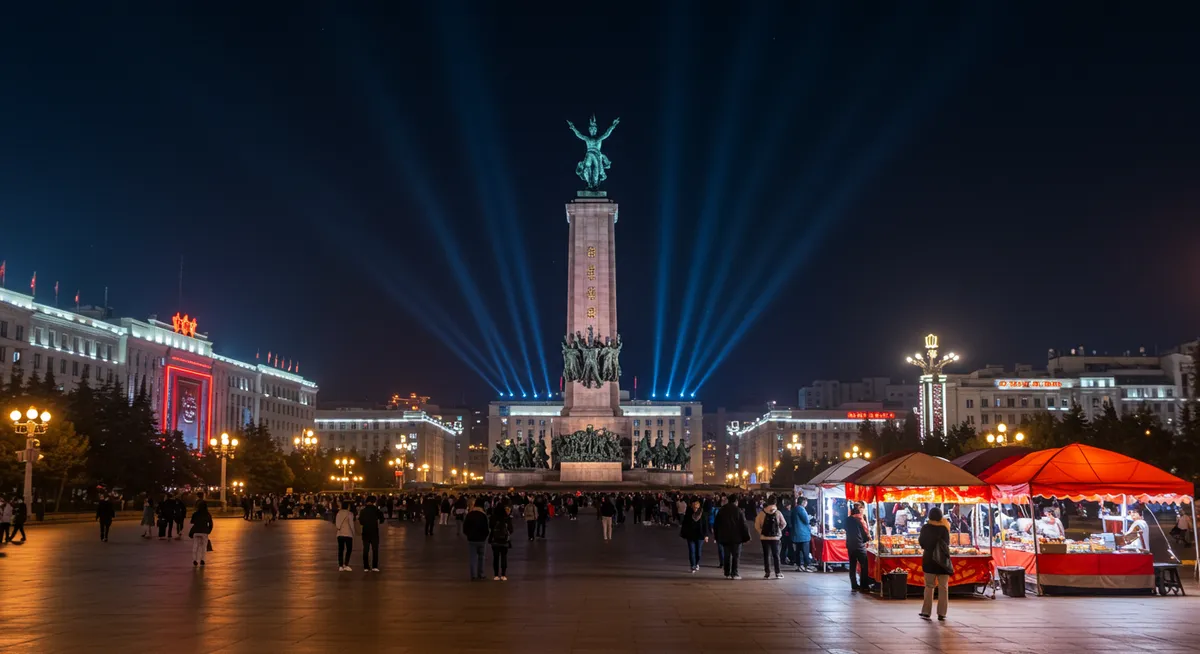
May Fourth Square at a Glance
Turn this guide into a personal route with our free Qingdao itinerary planner.
May Fourth Square (五四广场, Wǔsì Guǎngchǎng) is a civic waterfront space on Donghai West Road, south of Qingdao's municipal government offices and facing Fushan Bay. Qingdao's official visitor page says the square was built in 1996 and covers 100,000 square metres. Donghai Road separates its greener northern area from the southern coastal plaza.
The landmark in almost every photograph is Wind of May (五月的风), a red, upward-spiraling steel sculpture on the seaward side. The official description supports its form and location but does not provide the sculpture dimensions or designer biography repeated across many travel pages. Those details are unnecessary for planning a visit: the useful fact is that it is easy to see from the plaza and works as the route's main meeting point.
Quick decision: Make May Fourth Square a priority for modern Qingdao, a simple night walk, or skyline photography. If your time is limited and you care more about the old city, use it as a compact evening stop after the historic sights rather than a separate half-day attraction.
For the wider context, compare it with the old-town and coast stops in our best things to do in Qingdao and the main Qingdao itinerary hub.
Why Is It Called May Fourth Square?
The name connects the square to the May Fourth Movement of 1919. Qingdao's official account uses careful wording: the movement was triggered by the issue of sovereignty over Qingdao. At the Paris Peace Conference, former German rights in Shandong were set to pass to Japan rather than return to China, and student demonstrations began in Beijing on May 4, 1919.
That distinction matters because some guides incorrectly say the May Fourth Movement “started in Qingdao.” Qingdao was central to the dispute that ignited the movement; the famous May 4 demonstrations took place in Beijing. The square commemorates that connection rather than marking the physical site of the Beijing protest.
Wind of May translates the commemorative theme into a modern city symbol. It is reasonable to describe the form as energetic or flame-like, but detailed claims about individual curves, colors, or materials “representing” a specific political idea should be treated as interpretation unless an official curatorial source states it.
How to Get to May Fourth Square
Metro: use the correct station name
May Fourth Square Station (五四广场站) is an interchange on Qingdao Metro Lines 2 and 3. Qingdao Metro confirms that both lines serve the station. Follow the station signs for the square after arrival, because the most convenient exit can change with underground works, temporary closures, or your first stop in the plaza.
Do not paste 四方广场 into a map. That means Sifang Square and is a different place; one competitor page mistranslates the attraction this way. Use 五四广场 or 五四广场地铁站. From Qingdao Station, the old city, or another district, let the official metro tool calculate the current transfer rather than relying on a static travel-page timetable.
Taxi and ride-hail
Use “五四广场” as the destination and check that the pin is beside Fushan Bay in Shinan District. On busy evenings, a drop-off on the north side may be simpler than trying to reach the waterfront edge. After large events, police can redirect vehicles or establish temporary pickup points, so reopen live navigation before requesting the return ride. Our Qingdao transport guide covers metro payment and Didi basics.
A Practical May Fourth Square Waterfront Walk
This route keeps the landmark, sea, and skyline in a logical order without pretending the entire Qingdao coast is one short promenade.
- Begin on the north side of the square. Get oriented before crossing toward the water. The contrast between the civic buildings, lawn, broad plaza, and bay explains the site's layout better than heading straight to the sculpture.
- Walk south to Wind of May. Circle the sculpture rather than photographing it only from the busiest frontal position. The landward side gives urban context; the seaward side opens toward Fushan Bay.
- Pause on the coastal edge. Check the wind and visibility, then look east toward the marina and west along the bay. Keep clear of runners, family groups, and anyone setting up a photograph.
- Continue east toward the Olympic Sailing Center. Qingdao's official 2026 waterfront route links May Fourth Square with the Olympic Sailing Center, then continues farther along the eastern coast. The marina area offers broader skyline angles than the sculpture plaza.
- Extend to the breakwater only if conditions suit. An exposed waterfront feels much longer in wind, rain, heat, or dense crowds. Reverse the route or use a live map to choose a practical metro or ride-hail pickup rather than forcing the full extension.
For a compact first visit, stop after the sculpture and near-shore viewpoint. For a fuller evening, continue through the Olympic Sailing Center and wait for blue hour. Do not try to walk directly from May Fourth Square to distant Shilaoren or Zhanqiao based on a competitor's “40-kilometre promenade” description. Those are separate itinerary segments. The three-day Qingdao plan and five-day Qingdao itinerary place them more realistically.
Night Views: Lighting Is Not Always a Light Show
Fushan Bay can look impressive after dark even when no programmed show is running. The normal scene may include illuminated building facades, street and promenade lighting, reflected city light, and the red sculpture against the skyline. That is ambient night lighting, not proof that a scheduled performance has begun.
A themed light show uses coordinated building facades around the bay and operates under a published city schedule. Qingdao government reports confirm that Fushan Bay shows were operating in 2026, but the city publishes special arrangements for holidays and can alter or suspend timings. A special event—such as a concert, civic ceremony, or New Year program—has its own access, crowd, and transport plan.
For the date of your visit, check the latest Qingdao Urban Management (“青岛城管”) notice or an official Qingdao government event post. A 2026 official New Year guide specifically directed visitors to that account for current show information and warned that crowd controls or temporary closure can occur. It also clarified that an advertised night program did not include fireworks. Do not rely on a blog's weekly timetable or promise of a “nightly show.”
Where to stand for the skyline
May Fourth Square is the easiest viewpoint when the sculpture is part of your composition. For a wider look back across the buildings, continue toward the Olympic Sailing Center or the bay-side breakwater if it is open and comfortable. Official city notices have sometimes recommended viewpoints away from May Fourth Square during peak holidays because the square becomes congested. Treat the best viewpoint as a crowd and weather decision, not a permanent ranking.
Photography Plan
- Daylight: Include the municipal-center axis, open plaza, sculpture, and bay to show where the landmark sits.
- Late afternoon: Side light can add shape to the sculpture, but the exact sun angle changes by season and weather. This is not a guaranteed over-water sunset location.
- Blue hour: Balance the red sculpture with the deepening sky before building lights dominate the exposure.
- After dark: Expose for the bright facades, steady the camera without blocking the path, and take a second frame for people or the sculpture if needed.
- During a programmed show: Use a wider composition and a short enough shutter speed to preserve changing graphics. Keep expectations flexible if haze, rain, or a schedule change reduces visibility.
A phone is sufficient for most visitors. Clean the lens before shooting—sea spray and fingerprints are more damaging to night contrast than a lack of specialist equipment. Tripods may be awkward in a holiday crowd, and temporary event rules can restrict where equipment is placed.
Weather, Crowds, and Safety
The plaza is exposed to coastal wind. A warm city forecast can still feel cool beside the bay after sunset, while summer afternoons can be hot and humid with little shade on the hardscape. Check the official forecast, wind, rain radar, and any thunderstorm alert. Leave the open waterfront during lightning, strong wind, or a safety announcement.
Weekend evenings, public holidays, school breaks, and announced performances bring the heaviest pedestrian flow. In April 2026, Qingdao police documented a child becoming separated from family in the square; the red sculpture was used as the search reference point. Agree on a meeting place before the group spreads out, keep children close, and do not stop at the top of stairs or metro exits for photographs.
Street activity, fountains, performances, and vendors vary. Do not promise children that fountains will run or build an evening around an unsourced event list. When an official program matters, verify the date, location within the square, admission conditions, and any temporary barriers on the same day.
Accessibility and Comfort
The core square uses broad, mostly firm paved surfaces, and the metro station is part of Qingdao's accessible transit network. That does not mean every route is step-free at all times. The plaza is large, elevators may be farther from the exit you first see, and event barriers can create detours.
- Use the official metro map or ask station staff for the working elevator and most suitable exit.
- Choose a precise ride-hail drop-off on the north side if long cross-plaza distances are difficult.
- Expect some slopes, curb transitions, crowds, and longer gaps between resting places on the eastward waterfront extension.
- Confirm accessible toilets and event routing locally rather than relying on a permanent facility list.
If mobility or sensory overload is a concern, visit in daylight or early evening on a non-event weekday. A square-only visit still delivers the main landmark without requiring the full marina walk.
How to Fit the Square into a Qingdao Itinerary
May Fourth Square works best as the modern-waterfront counterpart to Qingdao's historic districts. Combine Zhanqiao, Zhongshan Road, or the old German-era streets earlier in the day, then travel by metro for the square and Fushan Bay after the heat eases. Our Zhanqiao Pier guide and Badaguan walking guide explain those separate areas.
A beach day can also end here, but change out of wet clothing and leave enough time for transport. Compare the coast options in the Qingdao beaches guide. For a route based on your hotel, dates, and walking tolerance, use the Qingdao itinerary planner.
Official Sources and Live Checks
- Qingdao Municipal Government: May Fourth Square history and layout
- Qingdao Metro: Lines 2 and 3 at May Fourth Square Station
- Qingdao Municipal Government: 2026 Fushan Bay night-tour report
- Qingdao Municipal Government: event-specific lighting and crowd guidance
- Qingdao Municipal Government: official waterfront route from May Fourth Square
Frequently Asked Questions
Is May Fourth Square worth visiting?
Yes if you want Qingdao's best-known modern landmark, an easy Fushan Bay walk, or skyline photography. It can be a compact stop; extend east to the Olympic Sailing Center when the waterfront is the main evening activity.
What is the best time to visit May Fourth Square?
Arrive about 45–60 minutes before sunset to see the sculpture in daylight, remain for blue hour, and decide whether conditions suit a longer night walk. Visit earlier on hot, stormy, or major-event days.
Does May Fourth Square have a light show every night?
No nightly performance should be assumed. The skyline may be illuminated without a programmed show, while themed shows and special events follow changeable official schedules. Check Qingdao Urban Management or a current city notice for your date.
Which metro line goes to May Fourth Square?
Qingdao Metro Lines 2 and 3 both serve May Fourth Square Station, 五四广场站. Do not confuse it with 四方广场, Sifang Square, which is a different place.
Is May Fourth Square free and open all night?
The civic square normally has no attraction ticket, but do not treat third-party round-the-clock claims as a guarantee. Events, maintenance, safety measures, and crowd limits can restrict part or all of the public space.
What does Wind of May commemorate?
The sculpture is the centerpiece of a square named for the May Fourth Movement. Qingdao's sovereignty issue helped trigger the movement, while the landmark May 4, 1919 student demonstrations began in Beijing.
Can you walk from May Fourth Square to the Olympic Sailing Center?
Yes. Follow the waterfront east from Wind of May toward the marina. Continue only as far as weather, crowds, and walking ability allow, then reverse the route or use live navigation for the return.
Is May Fourth Square wheelchair accessible?
The main plaza is largely firm and paved, and the metro interchange has accessibility infrastructure. Elevators, long distances, slopes, crowd barriers, and temporary closures can still affect the route, so confirm the best exit with station staff.